Dear Debaters,
Submitting a culture can indeed be confusing; however, it is a process that should not be taken for granted. Failure to follow shipping regulations can result in fines, but even worse, exposure can result in illness or disease.
For the purpose of my explanation, I will assume the culture would be a potential hazard that would not be privy to any regulatory exceptions.
Before you send anything out, there are several questions you must first ask yourself:
- Is this a culture or a patient sample?
- Primary samples are pretty easy to identify, because they come directly from the patient.
- Cultures are anything that has been propagated (put in conditions where bacteria can grow). This includes a slant or plate of bacteria, inoculated nutrient rich broth, freeze-dried material for quality control or proficiency testing, or even a swab that contains one CFU for subculturing.
- Where is it going and how will it get there?
- Some facilities have special requirements for sample submission. For example, Mayo Clinic has their very own shipping box, and you must follow the instructions they (or any manufacturers) provide.
- The method of transport matters.
- If your sample is being transported by a courier, you will need to refer to US Department of Transportation’s Hazardous Material regulations (https://www.ecfr.gov/current/title-49/subtitle-B/chapter-I/subchapter-C).
- If your sample is being shipped using FedEx, UPS, or US Postal Service, you will refer to IATA’s Dangerous Goods Regulations (https://www.iata.org/en/publications/dgr/). Note that commercial carriers and USPS have restrictions on what can be shipped.
- While there are exceptions for samples transported by the courier, they do not apply to cultures of potentially pathogenic bacteria, so they will need to be triple packaged in a sturdy, properly marked outer container. This means they cannot be in a biohazard bag passed off to the courier.
- What is the classification of the sample or isolate?
- Infectious substances belong in hazard class 6, specifically in division 6.2. They must be packed such that hazards are communicated in a universal, understandable way and so that everyone who handles the package is safe from exposure.
- Category A Infectious substances are those that are shipped in a form that when an otherwise healthy human or animal is exposed, can cause permanent disability or life-threatening or fatal disease. This would include cultures of Mycobacterium tuberculosis or blood from an Ebola patient.
- Exposure of an otherwise healthy person to Category B substances is less likely to result in such severe consequences. Examples of Category B substances include Salmonella cultures or blood for infectious disease testing.
- What do you have available for shipping?
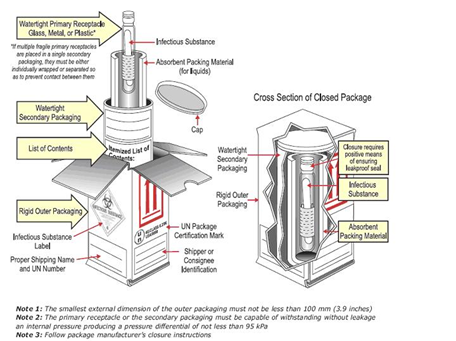
- Cultures (and other samples) should always be triple packaged; that is, they should be in a primary, secondary, and outer container. The primary container is the slant, tube, culturette, etc., that contains bacteria. The secondary container is the biohazard bag (with absorbent), and the outer container is the box that everything is packed in. Each level of packaging should be clean and sufficient to ensure containment. For example, the primary container should be decontaminated, sealed, and leakproof. The secondary container should also be clean and leakproof with sufficient absorbent present. The outer container should be sturdy and clean, and the total package should be put together such that the primary container will remain intact.
- More specific requirements for packaging depend on your answer to some of the questions above. The following images can be used for guidance. Notice the orientation of the infectious substance label and the UN3373 label. These should be applied in the diamond orientation, so make sure the label can be applied without wrapping it around the sides of the outer container (label size, depending on the outer package, is four-by-four or two by two inches).
Category A
Category B
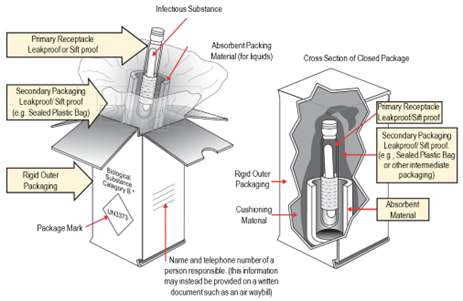
As I mentioned in the beginning, most of the time cultures will not qualify for exceptions in the HAZMAT regulations, so if you send packages with the courier or even one of your staff, they are required to be packaged according to the images above. You can read more about exceptions here: https://www.ecfr.gov/current/title-49/part-173#p-173.134(b).
This information is not exhaustive and is not intended to substitute formal training. Shipping regulations outline training requirements, some of which are very prescriptive and require employee certification.
The MT Public Health Laboratory hosts more detailed, formal training events online and in person, free of charge, with continuing education available. If you would like more information regarding these events, or if you need more resources regarding the packing and shipping process, please contact Crystal Fortune, cfortune@mt.gov or 406-444-0930.