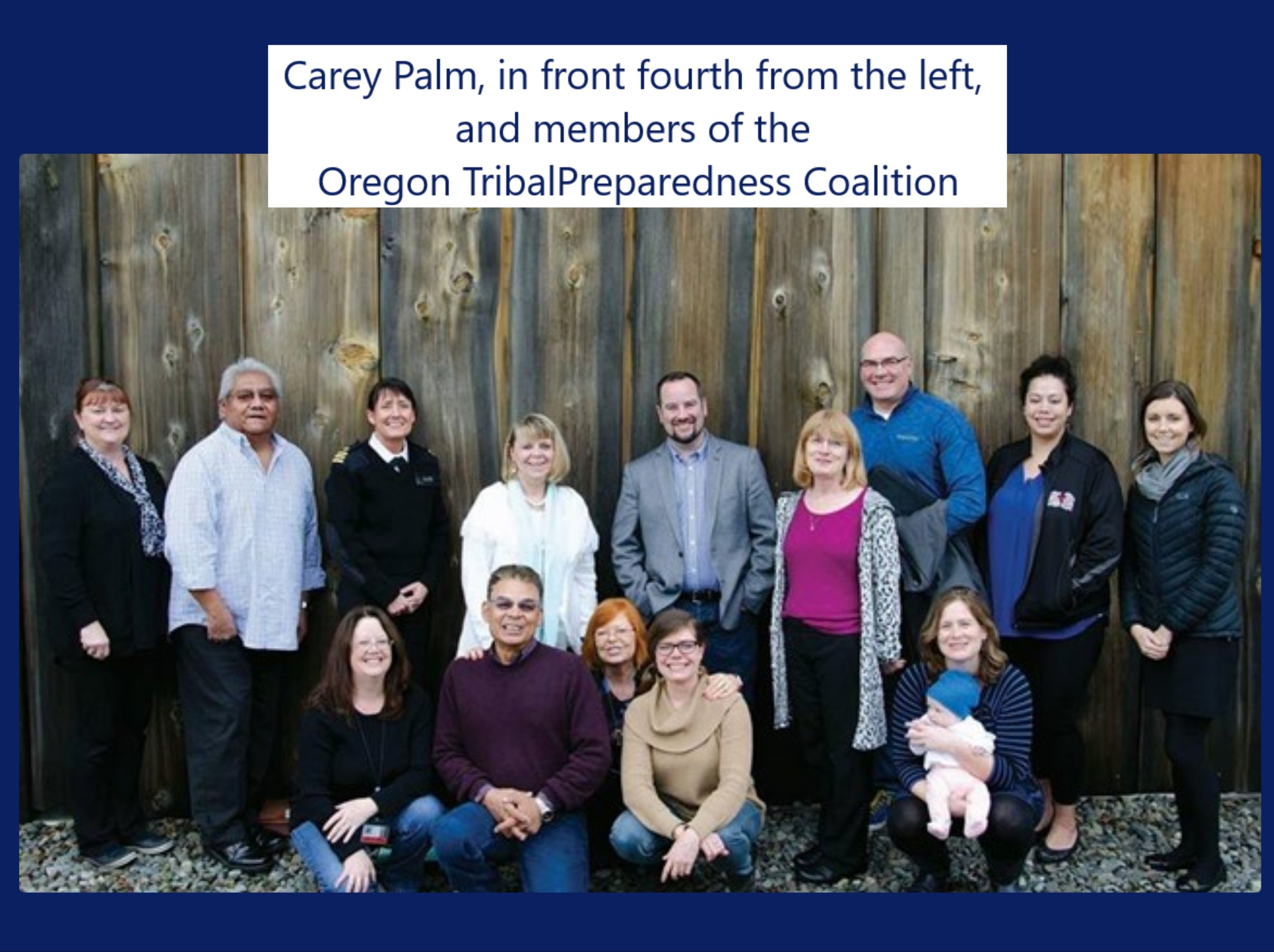
Getting to Know Carey Palm, the Emergency Preparedness Tribal Liaison
in the Health Security, Preparedness and Response Program
Interviewed by Stuart C Vaughters
We are pleased to introduce Carey Palm who serves in the vital role of Emergency Preparedness Tribal Liaison in the Health Security, Preparedness and Response (HSPR) program for the Oregon Health Authority (OHA). SERV-OR is also a part of the HSPR program, so Carey is very familiar with the crucial role that our volunteers play in supporting Oregonians during emergencies. As the Emergency Preparedness Tribal Liaison, Carey contributes to the State’s Emergency Support Function (ESF) 8, which coordinates plans, procedures, and resources to ensure health and medical care during emergencies or emerging public health situations.
Carey took time out of her hectic schedule crisscrossing the state to answer these questions to educate us about her work.
In your own words, describe your position as the Emergency Preparedness Tribal Liaison in OHA’s Health Security, Preparedness and Response program.
Well, honestly, in my own words I would say that I have the BEST job in the division! I get to work with each of the nine federally recognized Tribes in Oregon, the Columbia River InterTribal Fish Commission (CRITFC) and the Urban Indian Health Program. I provide technical assistance for planning and standard operating procedure development, assist with connecting other State agencies with Tribal Emergency Managers and facilitate the Oregon Tribal Preparedness Coalition. I love my job and I couldn’t even dream up a better one!
How long have you been in the position and what is your career background?
I have been in my current position at HSPR for 19 years, but ironically my career background is in Analytical Cartography & Geography. Prior to coming to HSPR, I was the GIS Analyst for The Coquille Indian Tribe.
Based on your career background and what you’ve seen, what would you say is the value of volunteerism and response?
Based on my experience, the value of volunteerism and response truly makes a difference out in the field and on the ground—like a breath of fresh air and an assurance that we have support of experienced responders and volunteers because they actually care and want to help.
What is the most rewarding part about working with the Tribes?
The most rewarding part about working with the Tribes is getting to be in the community and to see the ways in which they take care of their people, the smiles on faces when arriving at an incident or simply to assist in food and water distribution, and just being in-service and the trust they have in me, to do whatever I can to support their needs in an event or response.