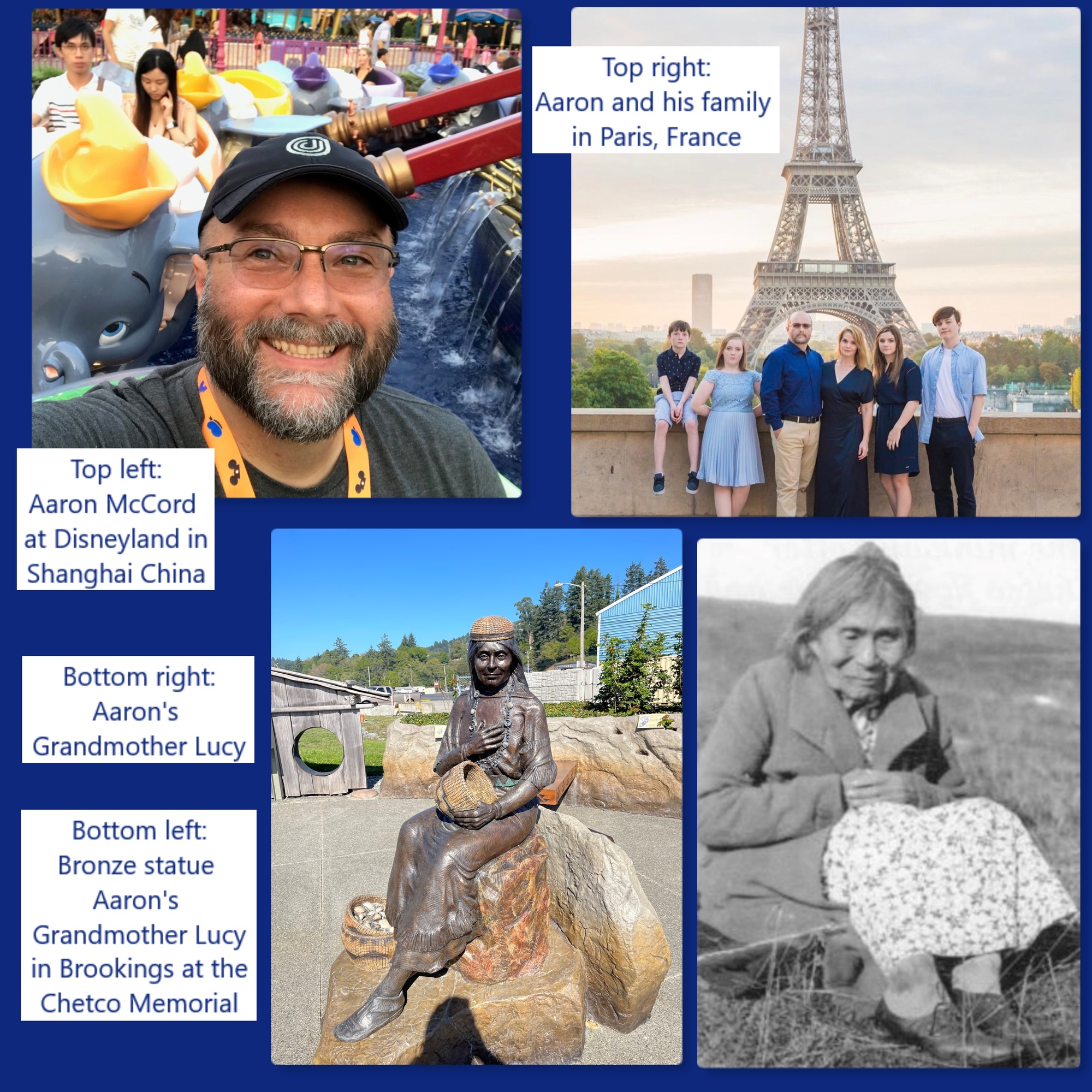
Introducing Aaron McCord, an Oregon Tribal Member in Action
article by Jacqueline Felix
Aaron McCord, a Tribal member of the Confederated Tribes of Siletz Indians, is the Medical Surge and Wildfire Planner in the Health Security, Preparedness and Response (HSPR) program at the Oregon Health Authority (OHA). The Confederated Tribes of Siletz Indians is a confederation of 27 tribes originating from Northern California to Southern Washington.[1] Aaron is a tribal member of “the Chetco Tribe (chit-dee-ni)” from coastal southern Oregon. Chit-dee-ni literally means the Chetco people.
When asked how being a tribal member influences his work, Aaron said being a tribal member influences his work by being a “good steward of the earth” and helping each other. He is currently learning the Chetco tribe language in an effort bring back a language his ancestors were not allowed to speak or learn. “My grandmother was not allowed to learn. She would see and hear her mother and grandmother speaking it, but they did not teach her because of the stigma back then. My ancestors spoke it quite well.”
In this role as the Medical Surge and Wildfire Planner, Aaron partners with federal, county, and city authorities in providing needed medical supplies for wildland fires and other disasters in the state of Oregon. He also plans the movement of hospital patients from overwhelmed hospitals to less crowded hospitals during or resulting from state emergencies or medical surge events. Aaron enjoys the variety in the work performed and the ability to problem solve for complex and unique situations.
Aaron’s first step into the emergency services field started as a junior volunteer firefighter. For him, the value of volunteering lies in the ability to try something for a period of time in areas such as potential work disciplines to discover if it is a right fit. Volunteering can also provide incentives such as attaining certifications, networking and most importantly, connecting with your community by serving others.
During Aaron’s nearly 30-year professional career as an intensive care paramedic, he has delivered babies, saved lives and navigated a variety of emergency situations. As part of his career, he joined the International Red Cross and had opportunities to work for air and land ambulance services, train medical staff with lifesaving skills, and set up ambulance services infrastructure in overseas countries. He has lived and worked across the globe in areas such as the Middle East, Asia, Southeast Asia, Europe, and Australia, New Zealand and Papua New Guinea.
Aaron encourages education and recognition of Oregon land and the history of the people that have been here for thousands of years. “I would encourage everybody, especially with it being the month of November, to look up what land you're standing on, who were the people that lived on this land for 14,000 years and find out a little bit more about them.” Through education, a better understanding and appreciation of Oregon Tribal history can foster awareness, respect and support.