Strengthening Rural Preparedness:
The Eastern Oregon Regional Medical Reserve Corps Mobilize for Resilience
article by Caye Gomez de Soler
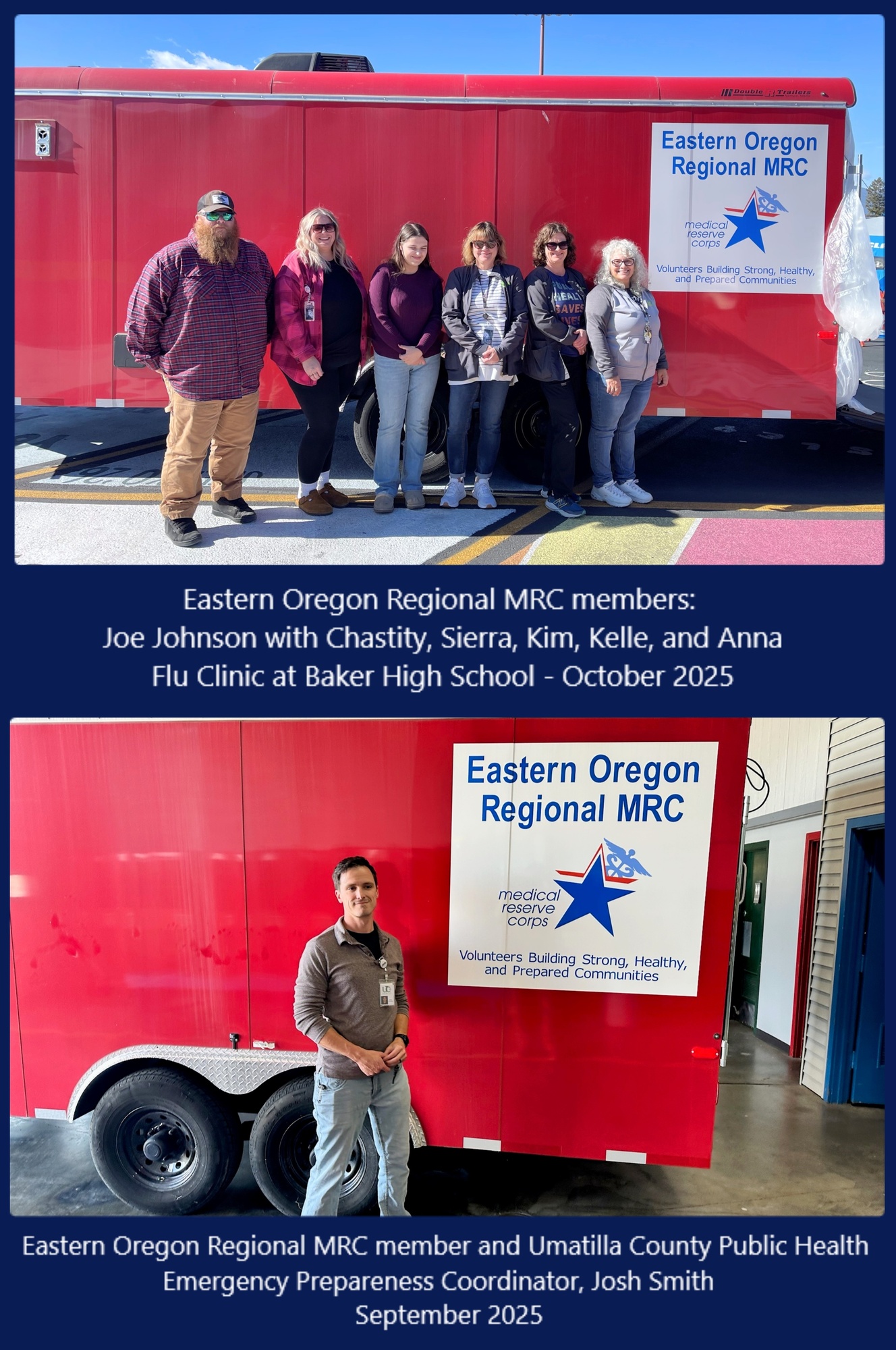 The Eastern Oregon Regional Medical Reserve Corps (EORMRC) is enhancing emergency response capacity across ten counties through innovative mobile support units designed to meet the unique challenges of rural communities. Based out of the Baker County Emergency Management Office, EORMRC Coordinator Joe Johnson—whose background spans public health preparedness, emergency management, and U.S. Air Force service—oversees regional volunteer coordination and disaster readiness efforts.
To bolster local response capability, the EORMRC has developed fully equipped mobile trailers that serve as medical and logistical support units. These trailers can be rapidly deployed to assist during wildfires, severe weather events, disease outbreaks, or medical surges, providing critical stabilization resources until state or federal aid arrives. Each unit carries supplies for mass care, sheltering, triage, and volunteer operations.
Local MRC volunteers can immediately utilize the trailers, during emergencies, as self-contained operational bases. Outfitted with power, communications, and medical infrastructure, they allow responders to establish triage and rest areas quickly, focusing their efforts on patient care and community support rather than logistics. Collaboration with Oregon’s Tribal Nations is also a key priority. Recognizing the access challenges faced by rural and frontier areas—including remote locations, disparities in healthcare, and lack of resources—the EORMRC ensures these regional assets are available to Tribal partners through county emergency management channels or the Oregon Health Authority.
Currently, trailers are stationed in Baker and Umatilla Counties, with expansion to Union County underway and additional rural placements planned. This distributed network ensures 24/7 readiness, allowing quick access to resources wherever they are needed most. Maintenance is a collaborative effort between the EORMRC and hosting counties. Local County Captains or designees conduct annual inspections and inventory checks, while EORMRC replenishes supplies and fuel after every deployment or exercise—ensuring all generators, tents, and medical kits remain mission-ready.
This mission of collaboration and preparedness is reflected across the region through dedicated local leadership. Josh Smith, Umatilla County’s Public Health Emergency Preparedness (PHEP) Coordinator and new member of the Eastern Oregon Medical Reserve Corps, brings years of experience as a firefighter, paramedic, and educator to his role. A Hermiston native, Smith began serving his community in 2004 and joined Umatilla County in early 2025, continuing his lifelong dedication to emergency response and public service.
This fall, Umatilla County became home to one of the new EORMRC response trailers—mobile support units designed to assist during large-scale incidents and community events. “We’re very excited to have this resource in Umatilla County,” said Smith. “Each trailer is stocked with tents, command post supplies, and medical equipment—everything responders need to manage large events or emergencies. It’s a surge system that helps lessen the burden on local responders.”
The county received its trailer on September 23rd and deployed it just days later to support the Rock the Locks event. Smith’s team is now refining deployment plans to ensure rapid regional response. Collaboration with Tribal partners also plays a key role in Smith’s work. He works closely with Yellowhawk Tribal Health Center and the Confederated Tribes of the Umatilla Indian Reservation on public health events, resource sharing, and training. “Their support and collaboration are vital to improving our region’s preparedness,” Smith said.
Through innovation, partnership, and readiness, the Eastern Oregon Regional Medical Reserve Corps continues to strengthen the foundation of rural health preparedness—ensuring that every community, Tribal and non-Tribal, has the tools and trained personnel needed to respond effectively when disaster strikes.