A Brief History of the Medical Reserve Corps | Alex Drungil
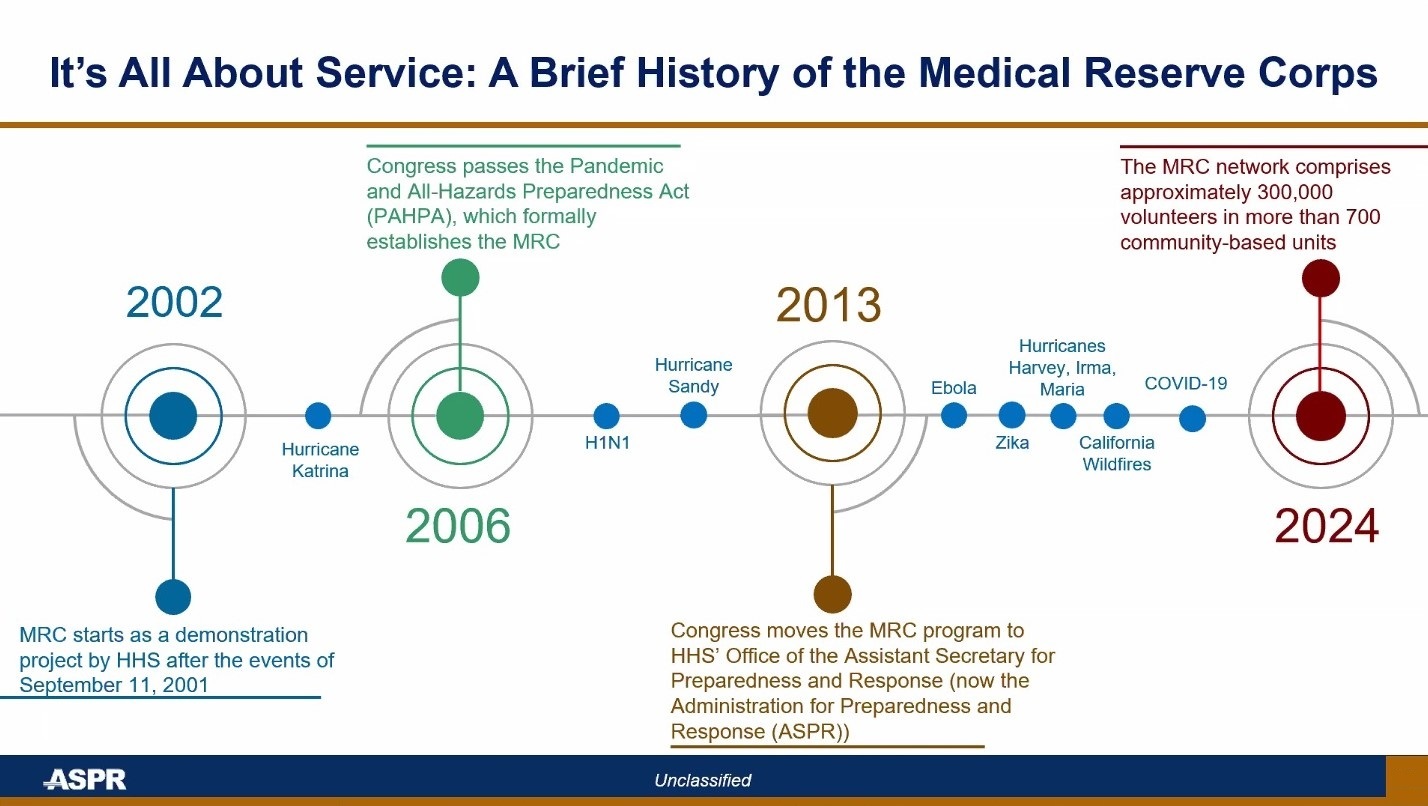
The Medical Reserve Corps (MRC) has been a cornerstone of community-based volunteer response for over two decades. Established in the aftermath of the September 11, 2001, attacks, the MRC was launched as a demonstration project by the U.S. Department of Health and Human Services (HHS) in 2002. Since then, it has grown into a nationwide network of volunteers dedicated to supporting public health and emergency response efforts.
Formal Establishment and Growth
In 2006, Congress passed the Pandemic and All-Hazards Preparedness Act (PAHPA), which formally recognized and established the MRC within federal emergency response structures. This legislation marked a significant milestone, reinforcing the importance of trained volunteers in disaster preparedness and response.
The MRC’s impact became evident in subsequent years as volunteers played vital roles in responding to major disasters. From Hurricane Katrina in 2005 to the H1N1 influenza outbreak in 2009, MRC volunteers were on the front lines, providing medical and logistical support in times of crisis.
A New Home within ASPR
By 2013, Congress moved the MRC program under the Office of the Assistant Secretary for Preparedness and Response, now known as the Administration for Preparedness and Response (ASPR). This shift improved coordination of MRC activities within national emergency preparedness efforts. The MRC continued to respond to crises such as Hurricane Sandy in 2012, the Ebola outbreak in 2014, and the Zika virus outbreak in 2016.
Recent Challenges and Expanding Roles
Over the past decade, MRC volunteers have provided critical assistance during significant public health and disaster events, including Hurricanes Harvey, Irma, and Maria in 2017, the California wildfires, and most notably, the COVID-19 pandemic. The pandemic highlighted the vital role of MRC volunteers in mass vaccination efforts, testing, and community resilience-building initiatives.
The MRC Today
Currently, the National MRC network is comprised of approximately 300,000 volunteers across more than 700 units. These dedicated individuals continue to serve in various capacities, from disaster response to strengthening public health initiatives. The MRC remains a vital asset in ensuring communities are prepared for emergencies, embodying the spirit of service and resilience.
The MRC in Oregon
Oregon is home to 14 MRC units. The longest-standing, Multnomah County MRC, originated in September 2002, while the newest—Deschutes County MRC and Lane County MRC—were established in April 2023. Funding through the MRC-STTRONG Grant is now available which can help start the next MRC units in Oregon, further strengthening the state’s emergency preparedness and public health response capacity. Contact the MRC State Coordinator to learn more about starting an MRC in your jurisdiction (Sophie.Flora-DeSart@oha.oregon.gov) and/or complete the MRC Start Up Interest Form.
The history of the MRC is a testament to the power of volunteerism in safeguarding public health. As we look ahead, the MRC will undoubtedly continue to evolve, adapting to new challenges while staying true to its mission of protecting and serving communities in times of need.