Specimen Quality in Newborn Screening Blood Spots
- Every year over 10,000 Montana newborns are screened prior to hospital discharge for genetic and metabolic conditions through the Montana Public Health Laboratory (MTPHL) as part of the state’s Newborn Screening Program.
- Newborn screening testing relies heavily on proper specimen collection and adequate blood spots. The testing does require multiple punches out of the blood spots, and MTPHL does it’s best to analyze the specimen to determine if there are enough “good spots” for testing prior to deeming a specimen “unsatisfactory”. MTPHL does not test specimens that have been deemed “unsatisfactory” due to the high possibility for erroneous results that may cause unnecessary concern.
- MTPHL calls the submitting facilities when specimens are found to be unsatisfactory and requests a recollection. Per ARM 37.57.316, repeat specimens should be collected within three days of notification. If a baby has a condition, a delay in submission of a quality sample can be life-threatening, so timing is critical!
- There are several reasons a newborn screening specimen may be found unsuitable for testing, with the most frequent causes being clotted or layered spots. Below are examples of some common issues, including pictures, potential causes, and ways to prevent them.
-
"Incomplete Saturation" or " Quantity Not Sufficient"
-
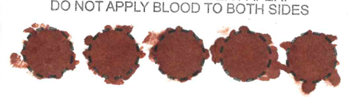 Specimen Front
-
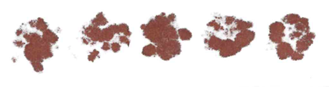 Specimen Back
-
Avoid this type of rejection by:
- Ensuring the infant is well hydrated prior to collection,
- Warming the heel to help with good blood flow,
- using the proper size lancet (<2mm length),
- allowing a large drop to form on the heel before touching with the filter paper,
- watching the blood soak completely through the paper.
-
"Layered Blood"
-
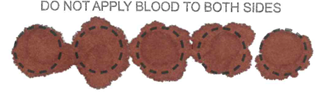 Specimen Front
-
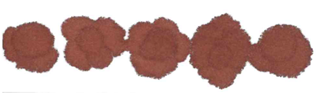 Specimen Back
-
Avoid this type of rejection by:
- Warming the heel to help with good blood flow,
- Allowing a large drop to form on the heel before touching the filter paper,
- Filling on circle at a time, so blood does not have time to dry between application,
- Do not apply additional blood to an incompletely filled circle,
- Do not apply blood to both sides of the filter paper.
-
"Clotted Specimen"
-
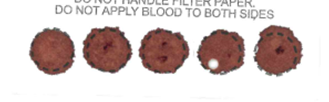 Specimen Front
-
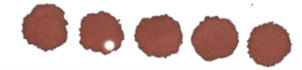 Specimen Back
-
Avoid this type of rejection by:
- Applying blood drop immediately to the newborn screening card,
- Avoiding touching the same circle multiple times with blood.
-
"Plasma Separated from Cells"
-
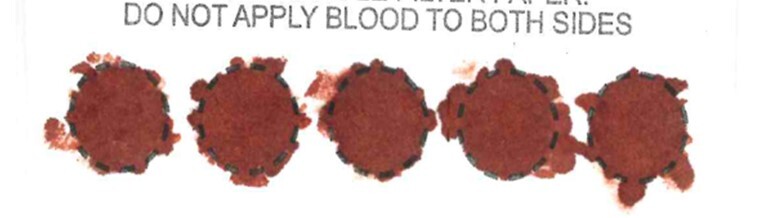 Specimen Front
-
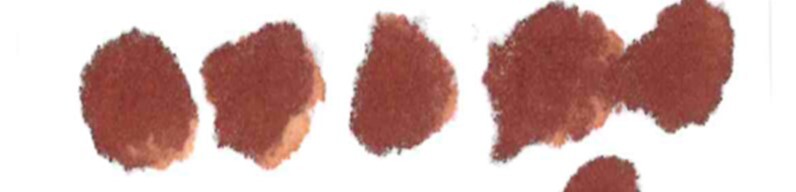 Specimen Back
-
Avoid this type of rejection by:
- Ensuring alcohol is dry before lancing the heel,
- Avoiding "milking" or excessive squeezing of the heel,
- Avoiding use of capillary tube to collect the specimen (capillary tubes can also damage filter paper or result in clotted specimens),
- Dry the sample flat.
-
"Specimen Dried to Cover"
-
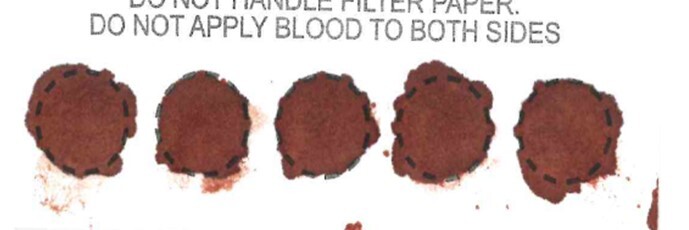 Specimen Front
-
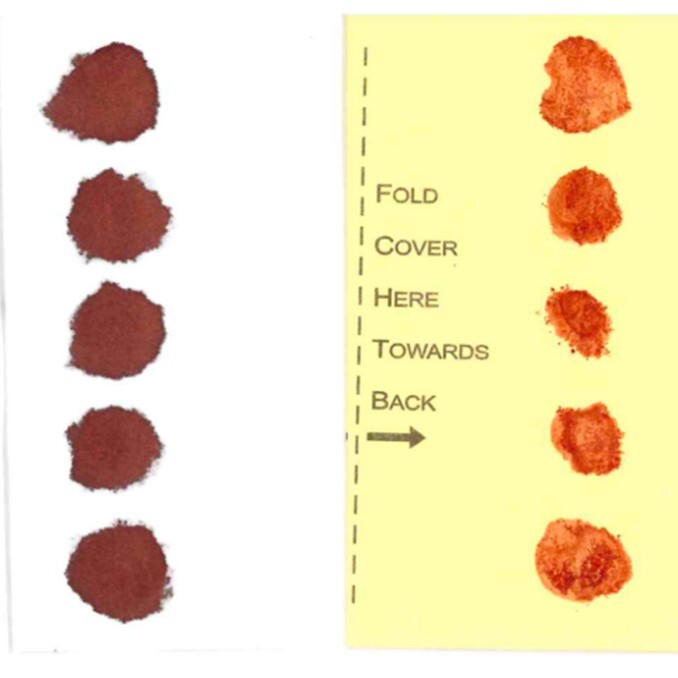 Specimen Back
-
Avoid this type of rejection by:
- Allowing the specimen to completely dry before folding the cover over the filter paper.
-
Here's an acceptable collection
- Nice big drops that fill the circle and soak through to the back.
-
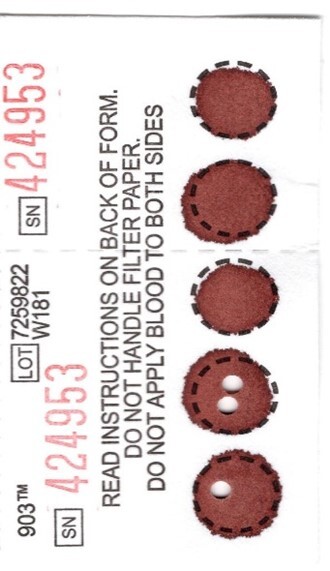 Specimen Front
-
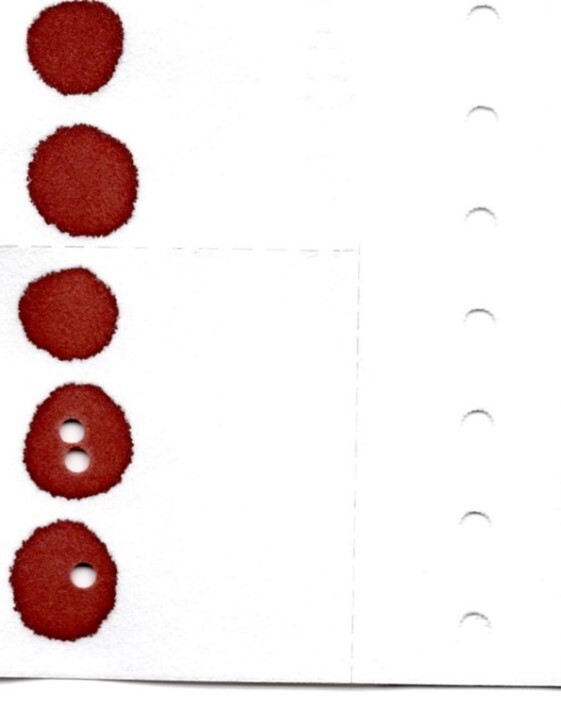 Specimen Back