Get Smart About Drugs website is a DEA resource for parents, educators and caregivers. Visit www.getsmartaboutdrugs.gov. Video courtesy of the U.S. Drug Enforcement Agency (DEA).
San Bernardino County’s Public Health Officer has issued a health advisory to bring attention to the dangers of fentanyl due to a marked increase of overdose deaths in the county. Health advisories are issued to raise public awareness when a significant threat to public health is identified, along with recommendations to eliminate or mitigate the risk.
In 2018 there were 30 fentanyl overdose deaths in the county. The number rose to 74 in 2019, and then to 227 in 2020. Last year, there were 309 fentanyl overdose deaths in the county.
Several County agencies – Public Health, Sheriff, District Attorney, Behavioral Health, County Superintendent of Schools, and Arrowhead Regional Medical Center – are collaborating with community-based organizations, healthcare providers, and schools to develop strategies to raise awareness and identify solutions to reduce fentanyl use.
“Deaths related to opioid use, such as fentanyl, are completely preventable,” said the County’s Health Officer Dr. Michael Sequeira. “Efforts to reduce the effects of opioid overdose and death are a top priority for San Bernardino County.”
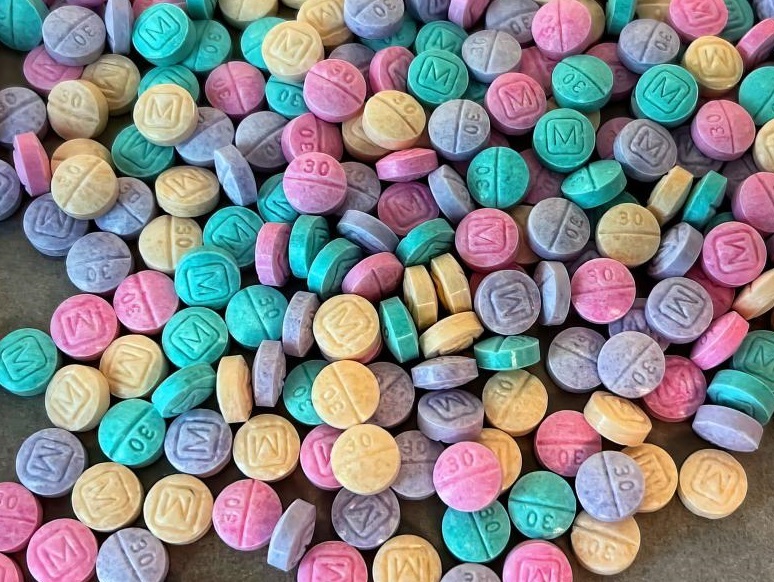 |
Sequeira is also warning people to be aware of the emergence of “rainbow fentanyl,” which is a potentially fatal drug found in pills and powders in a variety of bright colors, shapes and sizes that could be attractive to young people. According to the Centers for Disease Control and Prevention, fentanyl is a cheap synthetic drug 50 to 100 times stronger than morphine and is responsible for more overdose deaths than any other illegal drug in the United States. It is a major contributor to fatal and nonfatal overdoses in the United States. Fentanyl’s increased presence in the drug supply is a key contributor to the increase in overdose deaths. |
|
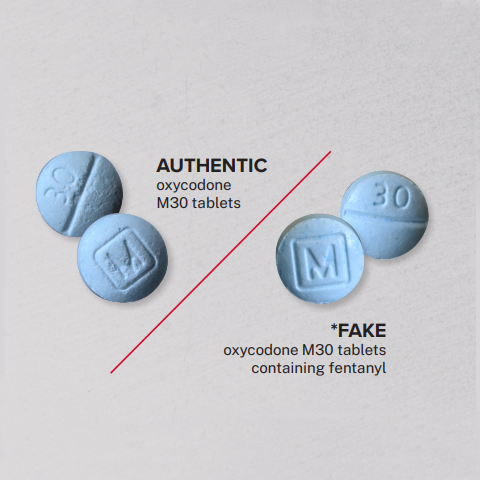
A photo depicts an authentic and a fake prescription pill side-by-side. Learn more about the One Pill Can Kill campaign at www.dea.gov/onepill. Photo courtesy of the U.S. Drug Enforcement Agency (DEA). |
Many illegal drugs, including counterfeit prescription opioid pills, heroin, cocaine, methamphetamine, and ecstasy, can be mixed with fentanyl with or without a person’s knowledge, as they would not be able to see, taste, or smell the fentanyl. The Department of Public Health is working on implementing various strategies to protect the community, including:
|
Anyone who encounters fentanyl in any form should not handle it and should call 911 immediately.
Recognizing the signs of opioid overdose can save a life. Here are some things to look for:
To learn more about how Public Health is working to address the opioid epidemic, visit https://wp.sbcounty.gov/dph/programs/health-edu/opioid-initiative.