GUIDANCE BULLETIN #2
Understanding Colorado Regulations and its application to Aerial Adventure Courses, Zip Lines, Climbing Walls and Free Fall Devices.
A PDF of the current Amusement Rides and Devices Regulations is available on our Regulations and Statutes webpage.
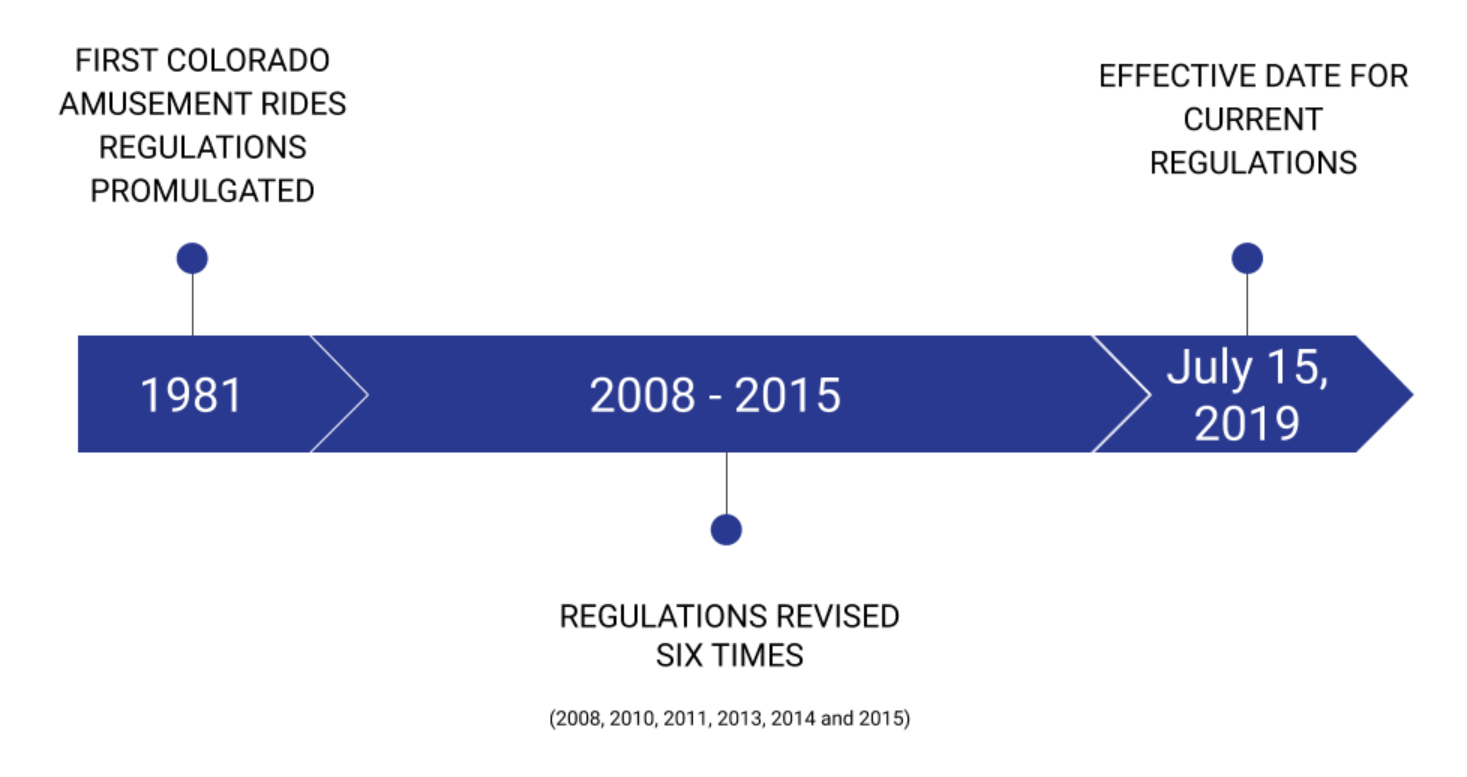
Coinciding with the rapid succession of revised Regulations, the challenge course industry has been evolving rapidly. One change is the installation of courses designed for the sole purpose of fun and entertainment - typically called Aerial Adventure Courses. This is a shift from what the challenge course industry was founded on, as the experience focuses on amusement (versus sport, fitness and education).
Within the State of Colorado’s Department of Labor and Employment, the Division of Oil and Public Safety manages several programs dedicated to ensuring the public’s safety - including the Amusement Program. Part of the program’s responsibility is to promulgate rules.
A regulation’s scope advises how those rules shall be applied:
“These rules and regulations shall apply to the construction, Inspection, operation, repair and maintenance of Amusement Rides or Devices located in Colorado by any individual, corporation, company, firm, partnership, association, or state or local government agency.” [Section 1-4]
Definitions can be found in Section 1-6 of the Regulation.
“Any mechanized device or combination of devices which carry or convey persons along, around or over a fixed or restricted course for the purpose of giving its passengers amusement, pleasure, thrills, excitement or the opportunity to experience the natural environment. Amusement rides or devices include but are not limited to, an aggregation of amusement rides or devices in an amusement setting such as amusement parks, carnivals, fairs and festivals. Amusement rides and devices also include but are not limited to, bungee jumping, Bungee Trampolines, Trampoline (Institutional, TC, TC Foam Pit), Climbing Walls in amusement settings, Concession Go-karts, Bumper Devices, gravity-propelled rides and devices, Water Slides, Trackless Trains, Simulators, stationary wave systems, Aerial Adventure Courses, and traditional amusement rides.”
“A patron participatory facility or facilities consisting of one or more elevated walkways, platforms, Zip Lines, nets, ropes, or other elements that require the use of fall hazard Personal Safety Equipment (PSE). Typically noted as ropes courses, Free Fall Devices and Zip Lines in the regulation.”
“A concession, commercial amusement device where participants attached to a pulley traverse by gravity from one point to another by use of a cable or rope line suspended between support structures.”
“A guided aerial exploration or transit of a landscape by means of a series of Zip Lines and platforms generally supported by man-made structures.”
The aforementioned terms are inclusive in nature and can be used to describe a lot of the structures in operation in Colorado. On the surface, many courses can look the same to a layperson, regardless of how they are operated.
The definition of what a climbing wall is (when regulated within the State of Colorado), can be a helpful example for users on how a structure that looks the same can be operated in many ways and therefore regulated differently.
“An artificially constructed wall with holds for hands and feet used for climbing. Regulated climbing walls include climbing walls located in amusement settings and fixed or portable climbing walls for use by the general public as amusement devices and not for sport or fitness training.”
The definition specifically advises that climbing walls used at gyms for fitness, or natural rocks used for sport (as an example), are not Amusement Rides or Devices regulated by the Division of Oil and Public Safety. Whereas the pop-up wall you can pay to climb at the fair or a ski resort is regulated (as an example).
Likewise, freefall devices exist in many industries, most notably in construction and in the safety of at-height workers. The Division of Oil and Public Safety is not the regulating body for employees working at height in Colorado, OSHA (Occupational Safety and Health Administration) is.
For the Amusement Program in Colorado, a Freefall Device is seen as an Amusement Ride or Device when it meets this definition:
“A component of an Aerial Adventure Course used to control a patron’s intentional descent from an elevated structure and engineered to allow the patron to experience a rapid initial descent while ensuring a controlled landing.”
In Section 1-4 Scope, the Regulations list 11 exemptions.
These exemptions advise users of when the State of Colorado does not consider you an Amusement Ride or Device. If none of the exemptions apply to you, and you have a ride or device that meets the aforementioned definitions, please contact OPS to register with the State and obtain a permit.
The complete exemptions list can be found in the current copy of the Regulations. Those considered most applicable to the Challenge Course industry have been included here:
Exemption (D): “Climbing walls used for sport and fitness training, located in educational facilities, schools, gymnasiums, sport and public entity recreational facilities, or other facilities solely devoted to sport and recreational activities, training and instruction.”
Exemption (H): “Any amusement ride or device operated at a private event that is not open to the general public and not subject to a separate admission charge or any amusement ride or device owned and operated by a non-profit organization who meets all the requirements in Sections 2-1 and 2-2 of these regulations and operates their rides less than 8 days in any calendar year.”
The original question was, ‘when does a challenge course become an Amusement Ride or Device in the State of Colorado?’ The short answer is, ‘when it meets the definitions denoted earlier and does not meet any exemptions.’
Some products are designed and operated in ways that cause them to meet the exemptions some of the time and other times be considered an Amusement Ride of Device. In this case, you require an operating permit for any time you are operating within the realm of amusement.
If you have any questions about your specific program we encourage you to review the Regulations with your legal counsel and communicate with OPS staff.
We are available to answer your questions and get your feedback on the Regulations.
Please join our stakeholder list to receive news and information from us.
We look forward to hearing from you!