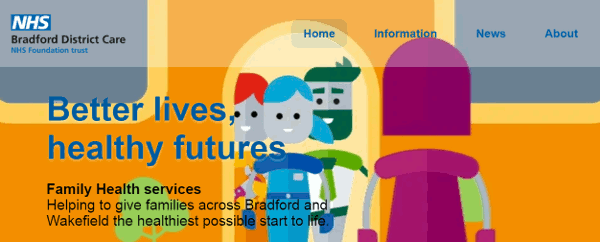
Bradford District Care Foundation Trust have launched a new Family Health services website betterliveshealthyfuturesbw.nhs.uk. Parents and families can find lots of useful information, help and advice during pregnancy and when caring for their babies or small children.
The website guides families on:
- what to expect on the six contacts with the Health Visiting service, from antenatal to 2-2 1/2 years,
- information on key topics including caring for a crying baby, a baby’s development, feeding, mental health, immunisations, safe sleep and oral health.
- It also has links to a broad range of other trusted information sites.
Families can also access core information about the School Nursing service and useful guides will be added on relevant topics for this service over the coming months.
Families will be encouraged to visit the Family Health services betterliveshealthyfuturesbw.nhs.uk website through their appointment letters, starting with the Health Visiting service.
The website has been developed with input from specialist clinical leads and most importantly, people who are using Family Health services to ensure it meets their needs. The website will be promoted more widely but please encourage families to visit the Family Health services betterliveshealthyfuturesbw.nhs.uk site to find out more.
This follows the Care Trust’s Family Health services, covering health visiting, school nursing and oral health, now being co-located with Bradford Metropolitan District Council’s Prevention and Early Help service in the Family Hubs, to provide an integrated offer for families across the Bradford District.
|

The Breastfeeding Strategy 2019-2024 produced and implemented by Bradford District Care Trust aims to protect, promote, support and normalise breastfeeding. Not just that, the strategy ensures that all parents and babies are supported in their feeding by advocating:
- responsive breast feeding,
- safe responsive bottle feeding,
- relationship building.
The Breastfeeding Strategy is founded on the basis that feeding is an integral part of a reciprocal relationship between the parent/carer and baby.
If practitioners can support parents to understand their babies and realise that their baby is communicating all the time, parents are more likely to notice feeding cues and integrate feeding into a reciprocal relationship.
To encourage breastfeeding going forward BDCT have to:
- build services which will offer essential support in the early days when mother's can find it difficult,
- provide the support women and babies, partners and dads, and the wider family needs,
- have a society wide understanding of breastfeeding
|

As part of the move for Bradford District to be a more breastfeeding friendly community a Breastfeeding Welcome Scheme has been launched. Any business or organisation can sign up to show they are a safe place for a woman to breastfeed.
Another service, Bradford Breastfeeding Buddies offer a mother to mother support network. Volunteer peer supporters contact mothers, who opt into the service when their baby is born, to offer support and information within the vital first few weeks and beyond.
Bradford District is proud to have a Breastfeeding Strategy – demonstrating commitment to the smallest and most vulnerable of our people. Babies are really important, their early experiences, feeding and being a part of that, have a long term impact.
|
 |
|
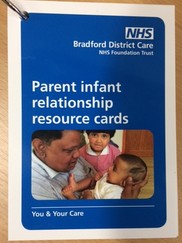
A new parent infant relationship resource has been developed to support practitioners in delivering key messages to families.
The Ready to Relate resource cards are a simple and effective way for practitioners to open up different ways of supporting families to understand their baby better, to enable discussion and share information.
The cards are now used in Bradford District by Health Visitors, Midwives and Mental Health services to name a few and are embedded into the Breastfeeding Strategy action plan, launching soon.
|
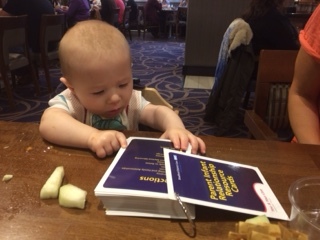
The resource is simply a set of cards on a keyring with pictures of babies, some with an adult, depicting different interactions. There are simple explanations and suggestions for use on the back of the cards.
Babies are born ready to relate and communicate all the time. A relationship with another is essential for an infant's mental health. With huge advances in understanding early brain development, evidence underpins the importance of the first 1001 days and the impact the parent infant relationship has on this. It is hoped the new resource will help professionals to give this information to families in an accessible way.
To find out more or to book onto a 2 hour taster session email Jane Dickens, Lisa Milne or the ready to relate dedicated inbox.
Parent Infant Relationship training is also available at New Mill lead by the Perinatal Mental Health lead and Parent-Infant Therapists. This is open to all professionals working with families. This will provide a firm knowledge base, enable practitioners to keep baby in mind and look at how they may integrate the information into their roles and services.
|
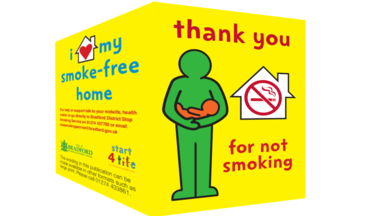
In order to reduce exposure to second hand smoke in the home and to support a consistent approach and routine intervention a new resource has been produced by Public Health at Bradford Council in partnership with the Every Baby Matters Smoking in Pregnancy Steering group members and Trainee Environmental Health Officers to support midwives engage effectively with parents and carers.
|
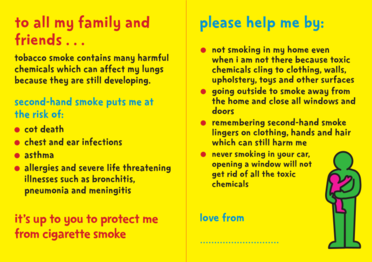
The new resource will be given to all new parents/carers upon discharge from hospital with the aim to encourage parents to live in a smoke-free home and warn them of the dangers second hand smoke can have on their baby. The A5 greeting card style resource is due to be handed out from the beginning of 2020 and also advises that the warnings about second hand smoke should be considered by family and friends too.
|
The NCSCT works with and for the field to deliver training and assessment programmes, support services for local and national providers and conducts research into behavioural support for smoking cessation. They offer training modules to guide professionals when communicating with pregnant women about smoking and the effects of secondhand smoke. Below are links to training modules available:
Brief advice on smoking to pregnant women and carbon monoxide screening
Secondhand smoke: promoting smoke free homes and cars
A guide to e-cigarettes for health professionals

Warm Homes Healthy People is a service focused on prevention and early intervention (from October to March) to address the impacts of fuel and food poverty on groups who are more vulnerable to health problems associated with cold homes and/or who may have less contact with health services. It provides free energy advice and support for people across the Bradford district area, aiming to save people money and keep them warm in their homes. Potentially eligible groups include, but are not limited to, the elderley, pregnant women, young children (under 5), people with mental health conditions, people on a low income and people with addictions.
|
Approval for new trial to prevent Group B Strep in newborn babies
Ethical approval has been given for a £2.8 million trial to prevent Group B Strep being passed on to newborn babies.
Child Safeguarding Practice Review Panel: second national review
Panel chair Edward Timpson writes to the Secretary of State for Education announcing the second national child safeguarding practice review into sudden unexpected infant death (SUDI) in families where the children are considered at risk of harm.
|