Reel in Michigan's Fisheries
Fishing in Michigan’s state parks
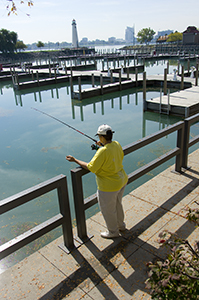 Michigan’s 103 state parks offer tons of opportunities for outdoor fun, from biking to wildlife watching to camping – and everything in between. Michigan’s 103 state parks offer tons of opportunities for outdoor fun, from biking to wildlife watching to camping – and everything in between.
Many of Michigan’s state parks have great access to fishing, either on the Great Lakes, on an inland lake or on a river or stream. If you have a Recreation Passport (required for vehicle entry into state parks and recreation areas) you can experience excellent fishing – in addition to those countless other outdoor activities.
Not sure where you want to go? Let us point out a few destinations for you!
This quiet park just north of Atlanta has two boat launches on its waterbody. It’s home to splake and smallmouth bass. While you’re there, why not try and spot an elk!
Check out the fourth largest lake in the U.P. with more than 8,000 acres to fish. Nearby is Palms Book State Park, which gives you an up-close view of lake trout living in Kitch-iti-kipi, the largest freshwater spring found in the state.
Found in Brighton, this 4,000-acre park offers an “up north” experience while staying south of the bridge. There’s a fishing pier on Island Lake and you might find panfish, bass and even a few carp.
Located in Waterford, this 3,745-acre park offers fishing piers and a boating access site on its namesake waterbody. You might catch bluegill, bullhead, carp, catfish, crappie, largemouth bass, northern pike, sunfish and walleye.
Fish right in the heart of downtown Detroit at either of these destinations. There are numerous fishing access points on Belle Isle that give you great opportunities to cast a line on the Detroit River. Milliken State Park offers tons of shoreline fishing and a 52-slip harbor on the river as well.
Plenty of fishing can be found at this state park. The park has two accessible fishing piers, one at Gun Lake and one at Deep Lake.
Great Lakes Fishing
Planning to stay at a popular park along the shore of one of the Great Lakes? Why not book a charter fishing trip? Plenty of locations – like Grand Haven, Lakeport, Ludington, Muskegon and Orchard Beach – have access to excellent fishing. Check out the Michigan Charter Boat Association’s website to find a local guide.
Accessible Fishing
Looking for parks to visit that offer accessible fishing? There are numerous state parks and recreation areas with accessible fishing piers, boardwalks or shore access. These include Bald Mountain, Bay City, Brighton, Dodge #4, Fort Custer, Hartwick Pines, Hayes, Metamora-Hadley, Muskegon, Otsego Lake, Port Crescent, Seven Lakes, Tahquamenon Falls, Waterloo and others.
Full details about these locations can be found on the DNR’s accessible fishing page.
Celebrate the Centennial
Don’t forget to celebrate 100 years of Michigan state parks throughout the yearlong centennial celebration. One hundred years ago, the Michigan State Park Commission set the course for visitors to enjoy and explore four seasons of fun. Visit Michigan.gov/StateParks100.
BACK TO TOP
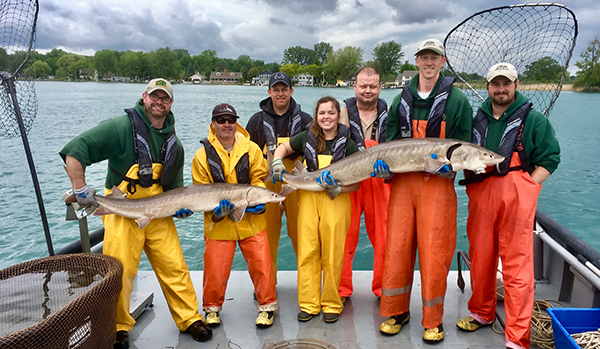
Surveying the largest lake sturgeon population in the Great Lakes
By: Andrew Briggs, fisheries research biologist at the Lake St. Clair Fisheries Research Station
 Lake sturgeon are the largest fish species found in the Great Lakes, reaching lengths of more than 7 feet and weights that can exceed 200 pounds. They have a unique life history compared to other native fish, with late maturity (around 15 years for males and more than 20 years for females), multiple-year intervals between spawning and lifespans that can extend past 100 years. Lake sturgeon are the largest fish species found in the Great Lakes, reaching lengths of more than 7 feet and weights that can exceed 200 pounds. They have a unique life history compared to other native fish, with late maturity (around 15 years for males and more than 20 years for females), multiple-year intervals between spawning and lifespans that can extend past 100 years.
Unfortunately, due to overfishing, habitat loss, dam construction and pollution, Great Lakes lake sturgeon populations are estimated to be at only 1% of their historic levels. The St. Clair-Detroit River System, which is the focus of annual fisheries assessment work by the DNR Lake St. Clair Fisheries Research Station, is home to the largest naturally-reproducing lake sturgeon population in the Great Lakes. It is estimated that around 30,000 fish reside in the river system.
The research station has been surveying the lake sturgeon population in Lake St. Clair and the north channel of the St. Clair River since 1996. Prior to conducting these surveys, very little was known about this population. Even though a recreational fishery was present for these fish in the system, it was not well-monitored, and no assessments were conducted to monitor the population’s status. The first state-wide lake sturgeon rehabilitation plan, published in 1997, identified numerous information deficits for this species. The lake sturgeon surveys that began in 1996 had three goals: fill these information gaps, annually document the status of the species’ population and aid in the conservation and sound management of the species.
Most of the lake sturgeon caught by the Lake St. Clair Fisheries Research Station have been captured using two methods: setlines in the St. Clair River and trawls in Lake St. Clair. Setlines consist of a 300-foot-long rope, or mother-line, that is tied between two anchors. Attached to the mother-line are 25 hooks evenly spaced about 10 feet apart and baited with dead round goby. Setlines sit on the river bottom for roughly 24 hours before being retrieved – hopefully with at least one lake sturgeon on the line!
Because setlines are better suited to large rivers, bottom trawls are used to target lake sturgeon in Lake St. Clair. The trawl, which is a large net towed behind the DNR's research vessel Channel Cat, is kept open and on or near the lake bottom by two heavy “doors.” The mesh of the net is large enough that most other fish, besides lake sturgeon, can escape through without being caught. Trawls are typically towed behind the boat for 10 minutes before being pulled back in and checked.
Regardless of survey method, once lake sturgeon are caught, research station staff measure the length, weight and girth, record the sex and maturity, note any scars or abnormalities and tag the fish.
Since 1996, Lake St. Clair Fisheries Research Station staff have caught, tagged and released nearly 3,500 unique lake sturgeon. The largest fish caught thus far was about 75 inches (more than six feet!) long. Staff also routinely recapture fish that have been previously tagged, with 15% of all tagged lake sturgeon being recaptured at some point. This June, research station staff caught 100 unique lake sturgeon during the annual setline survey. 37% of these fish were recaptures. The trawling survey will not occur until later this August.
Unlike most bodies of water in the country that contain lake sturgeon, Michigan anglers have the incredible and rare opportunity to target this species in the St. Clair-Detroit River System! Anglers may fish for lake sturgeon between July 16 and March 15. In the Detroit River, all lake sturgeon caught must be released. In Lake St. Clair and the St. Clair River, anglers may harvest one fish per year. The harvest season on these waters takes place from July 16 through Sept. 30 and harvested lake sturgeon must be between 42 and 50 inches (all fish less than 42 inches and above 50 inches must be released).
If an angler harvests a lake sturgeon, they need to register that fish online at Michigan.gov/RegisterFish, over the phone (844-345-3474) or at any DNR Customer Service Center. If anglers happen to catch a lake sturgeon with a tag, they can report it to the DNR and receive a free sturgeon management cooperator patch compliments of the St. Clair-Detroit River Sturgeon For Tomorrow. Tagged fish can be reported online at Michigan.gov/EyesInTheField.
With continued research and monitoring efforts, habitat restoration projects, dam removals, fish passage structures, water quality improvements, stocking efforts and help from the public, many lake sturgeon populations around the Great Lakes are on the mend. In the St. Clair-Detroit River System, spawning reefs have been constructed to replace lost habitat in the St. Clair and Detroit rivers, and lake sturgeon have successfully used them for spawning. Prior to construction of these reefs, much of the spawning habitat in the river system had been removed when the rivers were dredged to allow passage of freighters. Success stories such as this would not be possible if not for the collaboration of many agencies, universities and organizations. Although there is still a long way to go, the future for lake sturgeon in the Great Lakes is looking up!
For more information on recovering lake sturgeon populations across Michigan, check out our lake sturgeon rehabilitation strategy.
BACK TO TOP
Manistee River Hodenpyl Reach fishing opportunities
Written by: Mark Tonello, fisheries biologist in Cadillac
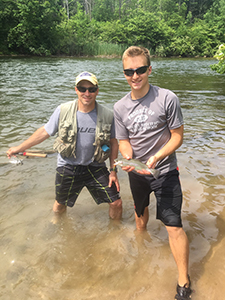 The Manistee River is nationally known for its fishing opportunities. The lower reach of the Manistee River is famous for its huge runs of salmon and steelhead, while the upper reach is renowned for targeting wild resident brown and brook trout, along with its excellent fly hatches. The Manistee River is nationally known for its fishing opportunities. The lower reach of the Manistee River is famous for its huge runs of salmon and steelhead, while the upper reach is renowned for targeting wild resident brown and brook trout, along with its excellent fly hatches.
The Hodenpyl Reach of the Manistee River is not as well known. However, this reach offers a unique fishing experience. This stretch runs from Hodenpyl Dam (a large hydropower dam operated by Consumers Energy) to the downstream Coates Highway crossing, known locally as “Red Bridge.” What makes the Hodenpyl Reach a draw for anglers is that the entire 10-plus mile reach is entirely within the Manistee National Forest and has no buildings of any kind on its banks.
The riverbanks are forested with white pine and northern hardwoods, along with the occasional cedar grove. There are some meadow areas along the river as well. Towering high banks along the river provide magnificent scenery and views that rival anywhere in the Great Lakes region.
Since the Hodenpyl Reach lies upstream of Tippy Dam, no migratory salmon or steelhead can get there. However, the DNR annually stocks 25,000 brown trout and 25,000 rainbow trout into the stretch. The trout fishing is very good in this area. The large, open nature of the reach means all anglers can score here – bait danglers, lure throwers or fly flickers.
One aspect of the brown trout fishery is the trophy potential. Some anglers fish with large crankbaits or streamer flies in search of large brown trout, including some that will even exceed 30 inches. With 50,000 trout stocked each year, harvest is not a problem. Anglers looking to keep some trout for the frying pan should not feel guilty about harvesting trout from this reach.
Another enticing quality of the Hodenpyl Reach is it doesn’t just have trout to catch – there are other species available as well. DNR electrofishing surveys have detected some very large walleye living in the deep pools of the reach, some as deep as 20 feet. There are also numerous smallmouth bass and northern pike around. A few brook trout are even caught each summer, usually near the mouths of the many cold, spring-fed creeks that flow into the reach. When you get a bite in this reach, you never quite know what you’re going to reel up!
The Hodenpyl Reach is regulated as a type 4 trout stream. This means it can be fished year-round, although fish can only be harvested during open harvest seasons. For brown and brook trout, that means from the last Saturday in April through Sept. 30. Rainbow trout can be kept year-round. Size limits are 10 inches for browns and rainbows, and 7 inches for brook trout. The daily limit is five trout per person, with no more than three over 15 inches.
The Hodenpyl Reach can be accessed near Hodenpyl Dam or at Red Bridge. Since this is not a motor-friendly reach, it sees mostly canoes and kayaks, although a few anglers do row McKenzie style drift boats.
Approximately a quarter-mile downstream from Hodenpyl Dam is the Woodpecker Creek access site, administered by the U.S. Forest Service. The site provides a carry-down access for canoers and kayakers and a drift boat slide. There are plenty of wade-fishing opportunities here as well. The Red Bridge launch at the downstream end of the Hodenpyl provides a back-down launch and several rustic campsites.
The other highlight of the Hodenpyl Reach is the Manistee River Trail. This trail runs for 10.5 miles between the Seaton Creek Campground (on Hodenpyl Dam Pond) and Red Bridge. Just above the Woodpecker Creek access site, an impressive suspension bridge over the river allows users to access the eastern bank of the river, which carries the trail. It’s very popular with day hikers, but there are numerous backpacking campsites along it as well. Most of the campsites provide excellent river views. Imagine sitting around the campfire amid the Manistee National Forest, watching the sun set over the Manistee River, while eating a meal of freshly caught trout!
While the Manistee is a large river, it is very wadable along the Hodenpyl Reach. Many backpackers take a fishing rod or two and then wet-wade to get at the fish. Another option would be to launch a canoe at Woodpecker Creek and paddle down to one of the campsites. These backpacking/fishing/floating/camping options are rare in the Lower Peninsula, making the Hodenpyl Reach a true gem for anglers in search of a little more adventure.
For more information, check out the U.S. Forest Service’s map of the Manistee River Trail and Backwaters or the DNR’s Status of the Fishery Resource Report on the Manistee River from Hodenpyl Dam to Red Bridge.
BACK TO TOP
Great Lakes reefs, a valuable place for Michigan fish
Written by: Dave Clapp, fisheries research manager at the Charlevoix Fisheries Research Station
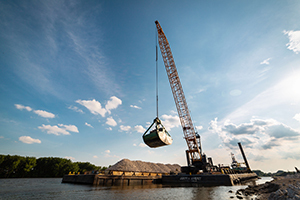 Most people are aware that reefs are an important component of ocean systems and provide food, cover and spawning areas for marine fish. However, not everyone is aware that similar areas exist in the Great Lakes … and are just as important. Most people are aware that reefs are an important component of ocean systems and provide food, cover and spawning areas for marine fish. However, not everyone is aware that similar areas exist in the Great Lakes … and are just as important.
Reefs in the Great Lakes are made of rocks, not coral, but high-quality reef habitat is still critical for native fish including lake trout, lake whitefish, cisco, yellow perch and smallmouth bass. During spawning season, these fish use reefs to deposit and protect eggs. The DNR is working with numerous partners and collaborators throughout the Great Lakes to identify and protect high quality spawning reefs, as well as to restore reefs with degraded habitat or overabundance of invasive species.
Buffalo Reef is located off the eastern edge of the Keweenaw Peninsula, and is vitally important for lake trout and whitefish spawning. Waste from copper ore milling operations from over a century ago threatens to cover the reef, making it useless for fish production. We are working with other state, federal, tribal, academic, municipal, private, corporate and public partners to protect and restore this habitat to ensure future production of Lake Superior fish.
In Saginaw Bay, walleye and lake whitefish historically spawned on reefs in the outer part of the bay, reefs that are currently in a degraded condition. We are working with project partners to place rock to restore reef habitat for these species. This comes on the heels of several years of experimental reef work in Thunder Bay, where multiple reefs were constructed with different configurations to measure fish community responses to habitat restoration.
At Harbor Springs and Elk Rapids, the DNR, along with partners from The Nature Conservancy and Central Michigan University (and with funding provided through the Great Lakes Restoration Initiative), have completed physical habitat restoration (rock placement) at one site and are conducting intensive trapping and removal of aquatic invasive species at two other reef sites. These invasives prey on the eggs of native fish and can have significant negative effects on survival of these species. The goal of the current project is to increase fish production at these reefs, and to promote successful control of aquatic invasive species at other sites across the Great Lakes basin.
Finally, we are working with the National Park Service, University of Wisconsin- Milwaukee and other partners at Good Harbor Reef near Leland with the goal of documenting the effects of Dreissenid mussels on aquatic communities including plants, invertebrates, fish and birds. Our goal is to better characterize fish spawning habitat on the reef, document use of the reef by native fish, and develop management strategies to enhance spawning success. Project partners, through the Invasive Mussel Collaborative, are also involved in a quagga mussel removal demonstration project at the same site in order to determine the feasibility of large-scale mussel removals and identify potential changes in the physical habitat and biological communities associated with removal areas.
Reef habitat restoration in the Great Lakes is built on a long history of research documenting the importance of reefs and how they function, conducted with support from numerous partners and collaborators and has significant implications for Great Lakes fish. With habitat improvement for the fish they pursue, Great Lakes anglers can expect increased success in years to come.
BACK TO TOP
|