App-Based Worker Deactivation Rights Ordinance Resources
The App-Based Worker Deactivation Rights Ordinance (ABWDRO) covers certain app-based workers (sometimes referred to as gig workers) and provides several deactivation-related rights and protections for covered workers. A deactivation is a permanent or temporary blocking of a worker's ability to perform services for a network company.
Key rights and obligations include:
-
The ordinance makes certain types of deactivations unlawful.
-
Network companies must provide app-based workers with a deactivation policy that describes what conduct may lead to deactivation and must be reasonably related to the network company’s safe and efficient operations.
-
Network companies must establish a process for app-based workers to appeal their deactivation with the company.
-
Network companies must provide notice to an app-based worker before most deactivations and provide the worker with access to records substantiating the deactivation.
-
Network companies must affirmatively provide a Notice of Deactivation Rights to each app-based worker.
Covered network companies must comply with this law. Retaliation is illegal. Effective January 1, 2025.
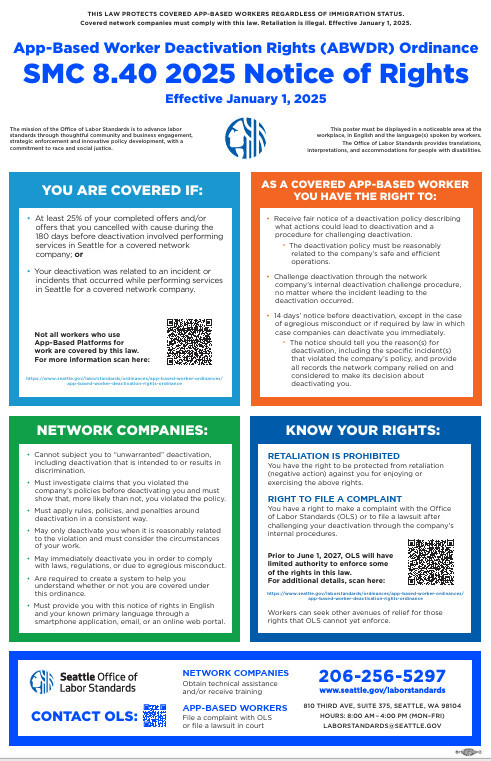
THIS LAW PROTECTS COVERED APP-BASED WORKERS REGARDLESS OF IMMIGRATION STATUS.
2025 Deactivation Notice of Rights
A Deactivation Notice of Rights poster is available in English and 16 other languages that network companies may use and provide in the worker’s preferred language. The Deactivation Notice of Rights details the rights of app-based workers and the responsibilities of network companies to comply with the law. This poster must be affirmatively provided to each app-based worker each year, in English and the language(s) spoken by workers. The poster is also available in a mobile format here.
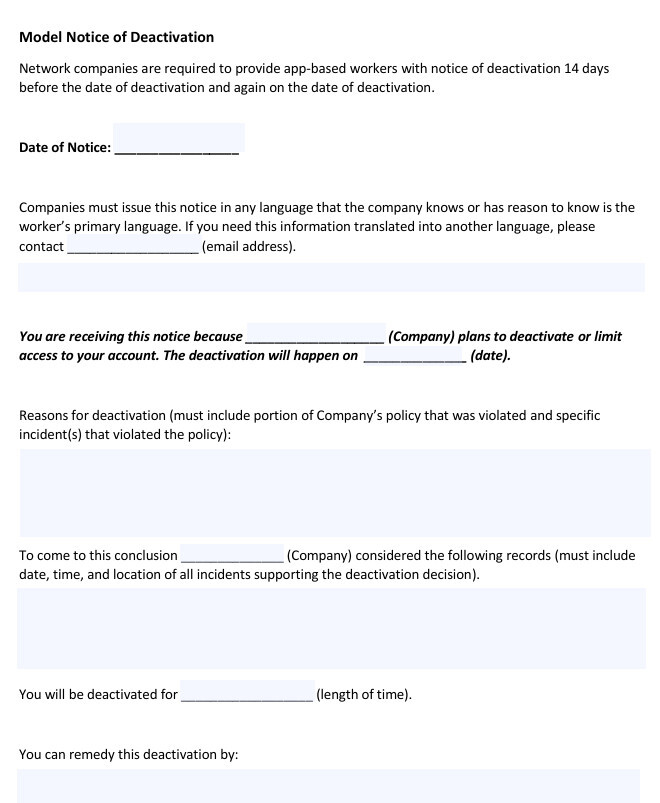
Model Notice of Deactivation
The Model Notice of Deactivation can be used by network companies to provide app-based workers with notice of deactivation 14 days before the date of deactivation and again on the date of deactivation – a requirement under this law. It can also be used in cases of alleged egregious misconduct where companies deactivate a worker immediately. The Model Notice of Deactivation is also available in English and 16 other languages.
To download either of these documents in Arabic, Amharic, Chinese, French, Hindi, Japanese, Korean, Oromo, Russian, Spanish, Somali, Tagalog, Tigrigna, Turkish, Ukrainian, and Vietnamese you can find them on the OLS Languages webpage by clicking here.
Deactivation Videos
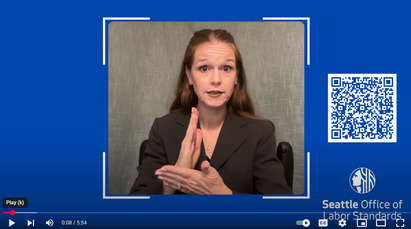
Learn about app-based worker protections in Seattle under the ABWDRO with short explainer videos. Six videos available in English/ASL, Chinese, French, Somali, Spanish, and Vietnamese explain app-based workers’ rights and protections.
New!
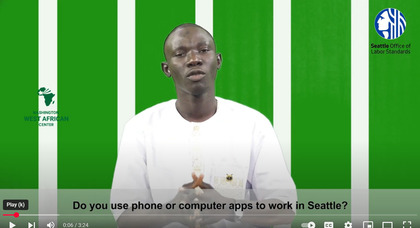
OLS partnered with the Washington West African Center (WAWAC) to create nine additional deactivation rights videos in different West African languages. We are proud to offer, for the first time, materials in Fante, Fula, Jola, Mandinka, Manjako, Sarahule, Muuqaalka and Yoruba.
To view the English version or any of the 15 translations please visit the OLS Training webpage by clicking here.
Deactivation Enforcement
Between January 1, 2025, and May 31, 2027, OLS has enforcement authority over limited requirements outlined in this law. During this time, OLS will Investigate issues such as:
-
Whether a network company provided notice and access to records.
-
Whether they followed the required steps before and after deactivating an app-based worker.
During this period, OLS is not permitted to investigate whether a network company deactivated a worker for a permissible reason.
Eligible workers who are deactivated on or after January 1, 2025 and believe the deactivation is unwarranted can still challenge the deactivation on their own.
-
The worker has the right first, to challenge the deactivation through the company’s internal deactivation challenge procedure.
-
It is important that this is done within 90 days of the worker receiving notice of the deactivation.
-
The worker has the right to bring a private lawsuit after receiving the company’s initial response to the worker’s challenge or 14 days after the worker submits a challenge to the company.
Starting June 1, 2027, OLS may investigate whether a network company deactivated a worker for a permissible reason.
Contact OLS
If you have questions about the law, please visit the OLS “File a Complaint” webpage or call (206) 256-5297.
|