Inside, you’ll find tools and updates you can actually use. Want to understand zoning, critical areas, or activity on a parcel? Start with our Parcel Search tool and explore what’s tied to a property.
This month is also Building Safety Month, and we’re focusing on what that means at home—simple maintenance checks, ways to think about accessibility, why permits and inspections are there to protect you and your investment, and the people who keep our community infrastructure safe.
You’ll also find ways to stay involved in bigger-picture decisions, like the upcoming Comprehensive Plan Remand public hearing, along with a plain-language breakdown of a recent Director’s Interpretation on Farm Stands—a topic that’s come up frequently in rural and agricultural conversations.
Beyond individual properties, this issue looks at how we manage and protect shared resources—from the Natural Resource Asset Management Program Report to hands-on opportunities like the vessel turn-in program for derelict boats and support for tackling noxious weeds on your land.
Take a few minutes to explore what’s here—you may find a tool, program, or answer that saves you time later.
Next issue, we’ll shift to summer readiness, including fireworks safety and practical tips to help you prepare.
Thank you for staying engaged and informed — we’re glad you’re here.

What makes a home safe?
What keeps a school standing strong?
What protects a business when the unexpected happens?
The answer isn’t just building codes—it’s people.
This May, Kitsap County is proud to celebrate Building Safety Month 2026, recognizing the many individuals who help keep our community safe every day, and make our infrastructure, "Built to Last." From inspectors and plans reviewers to builders, engineers, designers—and even homeowners—building safety is a shared effort that impacts all of us.
Celebrating the People Behind the Work
Building safety doesn’t happen behind the scenes—it happens on job sites, at kitchen tables, in permit centers, and out in the field. It’s the careful review of plans, the inspections that ensure work is done right, and the decisions made by property owners to build safely and responsibly.
This month, we’re celebrating all of you who play a role in creating safe, resilient spaces across Kitsap County.
Come Say Hello at Our Events
We’re getting out into the community all month long—and we’d love to meet you.
Whether you’re planning a project, curious about permits, or just want to learn more about what we do, stop by and talk with our team. We’ll be at local events ready to answer questions and share resources.
Explore event details and find us near you:
Kitsap County Building Safety Month 2026 page
Have a project that was completed without permits?
During Building Safety Month, penalty fees are waived for new after-the-fact permits. This is a great opportunity to bring your project into compliance, ensure it’s safe, and gain peace of mind, without the added financial burden of penalties.
Our goal isn’t to penalize, it’s to help ensure your home or project is safe for you and your family.
Stay Connected & Learn More
We’ll be sharing tips, behind-the-scenes looks, event updates, and safety insights all month long.
-
Visit our website for full details, event schedules, and resources:
- Follow us on social media and be part of the conversation
Building safety isn’t just about rules—it’s about people, protection, and community. And this month, we’re celebrating all of it.
 |
Kitsap County residents are invited to a public hearing on Monday, May 11, at 5:30 PM with the Board of County Commissioners. The hearing will take place in the Commissioners Chambers on the third floor of the DCD Administration Building. The proposed Comprehensive Plan amendments address items identified in the 2024 Plan by the State Growth Management Hearings Board.
The draft ordinance and proposed amendments are now available on the Comprehensive Plan webpage. We encourage community members to take a look and share their thoughts.
Have questions or ideas? You can send input through the project’s comment form anytime between April 27 and May 12. All comments will be reviewed before the May 11 hearing.
If you need more information, reach out to compplan@kitsap.gov.
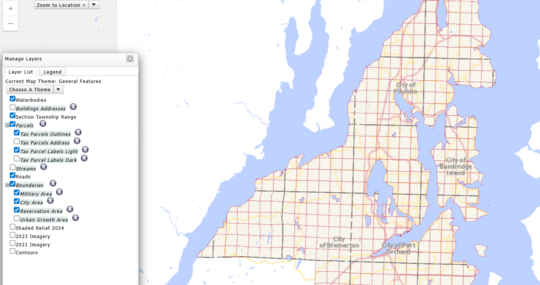
Getting the Most Out of Kitsap County’s Parcel Search Tool
If you’ve ever wondered about the zoning on your property, wanted to explore your neighborhood’s layout, or needed quick details before starting a project, Kitsap County’s Parcel Search Tool is a great reference for information. It’s free, easy to use, and full of information that many residents don’t realize is right at their fingertips. This tool is best viewed on a desktop device.
Here’s a short guide to help you make the most of it.
Understanding the Tool
The Parcel Search Tool is an interactive map that lets you look up any property in Kitsap County. Click on a parcel to find information such as ownership, land characteristics, zoning, and more. You can search by parcel number, site address, and the owner's mailing address, which may vary from the site address. Whether you’re checking on your own lot or exploring the area around you, the tool is designed to be simple and useful for everyday residents—not just planners or surveyors.
 |
|
The Manage Layers Box: Your Information Hub
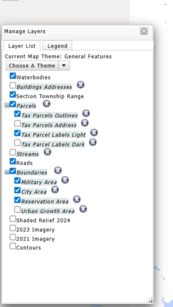
On the left side of the screen, you’ll find the Manage Layers box. Think of this as the tool’s “show me more” menu. Here, you can turn on different layers that display things like parcel boundaries, zoning, environmental features, and other details about the land around you. There are a variety of themes to choose from in the map drop-down menu, with the default being a general features map. There is also a legend tab that helps you identify characteristics.
A few neighborly tips: • Turn on layers one at a time so the map doesn’t get cluttered. • Little plus signs next to each category expand to show even more options. • Some layers only appear when you zoom in, so if you don’t see what you’re expecting, try getting a bit closer to the ground.
|
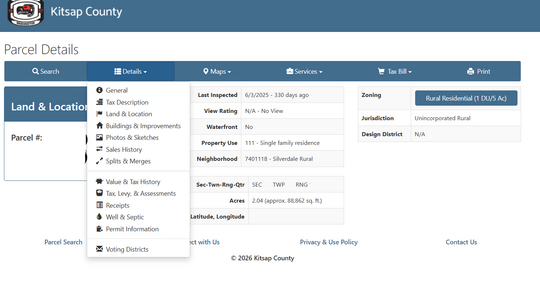 The Land & Location Window
When you click on a parcel, a window will appear. Clicking the Land & Location link inside that window gives you more information about the property. Here you can find information such as the legal description, permit information, zoning, assessed land characteristics, and other practical details. Each menu above has more information you can explore, as shown in the image.
If you’re looking at your own property, it’s a great place to confirm information you may need for permits or planning.
Finding the Zoning Quick Reference Guide
One especially helpful feature is the link to the Zoning Quick Reference Guide. On your parcel details page, you can find zoning information. Right next to the zoning code, you’ll see a link that identifies your zone and, when clicked, takes you directly to more information about the zone.
It’s a great tool if you’re curious about what can be built in your area—or if a zoning abbreviation like “UGA” or “RR” has ever left you scratching your head.
Exploring your community can be surprisingly satisfying—and the parcel search tool gives you a simple way to learn more about the place we call home.
KNRAMP has released its 2025 State of the Natural Assets Report, which documents the condition of natural resources across the county and identifies actions and strategies to protect and improve the condition of natural assets.
View the 2025 State of the Natural Assets Report
 With the 2026 boating season approaching, now is the time to make sure your vessel registration is current!
Vessel Registration Addressed in 2026 Legislative Session
During the 2026 Washington State Legislative Session, a bill was passed revising the definition of a derelict vessel. Beginning June 2026, vessels that have been unregistered for two consecutive years may be declared derelict and taken into custody by an Authorized Public Entity. The update also removes the requirement that an owner be known or located before a vessel is considered derelict, though agencies must still make reasonable efforts to notify owners as part of the custody process.
Keeping your vessel properly registered helps ensure a safe, responsible boating experience for all while protecting our marine environment. Learn more about the new legislation.
Marine Patrols
This season, the Kitsap County Sheriff’s Office, in partnership with local police departments, port districts, and the Washington State Department of Natural Resources, will be conducting marine patrols with an emphasis on abandoned and derelict vessels and vessel registration compliance. Patrols will include a focused effort in Liberty Bay, which has recently seen an increase in abandoned and derelict vessels.
Vessel Turn-In Program (VTIP)
Kitsap County will also host a Vessel Turn-In Program (VTIP) event this summer. Managed by the Washington State Department of Natural Resources, VTIP helps boat owners safely dispose of unwanted vessels free of charge. This event is intended to prevent vessels from becoming abandoned or derelict, protecting our waterways from pollution. View our event flyer.
Need help applying? Kitsap County will offer application assistance during open office hours. Please visit our webpage for details.

Free Weed Disposal
Free disposal of noxious weeds is available now through October at facilities throughout Kitsap County. View our disposal flyer to learn how to participate. Spring is an ideal time to tackle weeds as the soft soil makes pulling easier, and the weeds haven't gone to seed yet. Pull them now and bring them to a participating facility near you! Participating Facilities: - Olympic View Transfer Station - Hansville, Olalla and Silverdale Recycling and Garbage Facilities - Bainbridge Disposal All weeds on Kitsap County's Noxious Weed List can be disposed of for free. We also offer free tool lending to support your weeding efforts, including weed wrenches, loppers, and more. Complete the Tool Lending Agreement & Reservation Request to get started!
--------------------------------------------------
Apply Now: Stewardship Assistance Program
We’re excited to announce a new Stewardship Assistance Program (SAP), designed to help community members effectively control priority weeds and maintain compliance with state and local noxious weed laws. Applicants with one or more of our Priority Species may qualify for up to $2,500 per property each year in direct control assistance performed by a local company under contract with Kitsap County. We also offer a Hardship Funding option for individuals who meet the Senior & Disabled Property Tax Credit. Hardship applicants may qualify for assistance on a slightly expanded list of species. Anyone who helps care for a property, including renters, property managers, and caretakers, may apply. If you don’t own the property, we’ll just need the property owner’s approval before work begins. Funding for this program is limited to $50,000 annually, so projects will be approved on a first‑come, first‑served basis. Participants will sign a two‑year Stewardship Agreement, which includes:
- Following a provided management plan
- Providing periodic updates
- Allowing site visits and follow‑up treatments by county staff or contractors
To see the list of qualifying species and to apply for assistance, please visit our webpage.
Sometimes, our county code doesn’t spell out every possible scenario. When questions arise about how a rule should be applied, the Department of Community Development can issue a Director’s Interpretation (DI).
A DI:
- Clarifies how existing code should be understood
- Helps ensure consistent, fair application
- Does not create new code but explains how current code works.
Think of it as a “how to read this rule in real life” guide.
Latest DI: Farm Stands & Equestrian Facilities
Our most recent Director’s Interpretation focuses on farm stands or farm markets connected to equestrian facilities.
The situation
We’ve received questions about whether equestrian facilities (like boarding or training operations) can sell items like hay or feed on-site—and under what conditions.
What the code already says
Farm stands are allowed as an accessory use to agriculture—but only if they stay closely tied to the farm itself and don’t function like a larger retail business.
What this DI clarifies
This interpretation helps draw clearer lines:
- Farm stands are allowed outright if they meet key criteria:
- At least 50% of products are from the farm itself
- At least 75% are from Kitsap or nearby counties
- Only a small portion (up to 10%) can be related to support items (like tools or feed)
- If those thresholds aren’t met:
- The activity may still be allowed—but it needs to go through a Moderate Home Business permit, which is an Administrative Conditional Use Permit (ACUP)
- It also reinforces that:
- The primary agricultural use must remain dominant
- Activities shouldn’t shift into full-scale retail or impact rural character
In short: Selling farm-related products is allowed—but scale, source, and impact matter.
Want to explore more?
Director’s Interpretations are one way we provide clarity and consistency in the application of code.
Visit our website to view this and other interpretations and determinations.

Kitsap County Department of Community Development
614 Division Street - MS36
Port Orchard, WA 98366
Media Contact: Alicia Adler
DEPARTMENT OF COMMUNITY DEVELOPMENT
The mission of the Department of Community Development is to foster the development of quality, affordable, structurally safe and environmentally sound communities.
|