|
The Washington Fatherhood Council is a group that works together to reduce poverty and inequality by helping fathers feel included and supported. The council helps improve state services for dads, connects fathers to helpful resources, and engages dads with real-life experience to help guide their work.
The council was created in 2018 and includes many people—fathers, organizations, researchers, and advocates. They work together to raise awareness about the important role fathers play and to encourage communities, agencies, and policies to include fathers in meaningful ways.
While DCYF has been a partner in this work from the start, recent budget cuts at DSHS threatened to end this important work. DCYF is excited to announce that we are now supporting this work as much as we can manage with existing staffing.
This will include the convening of the Fatherhood Council as well as the Dad Allies Provider Learning Series.
You can receive information about the Fatherhood Council and the Provider Learning Series by subscribing to the new link. We are also currently working to bring over website materials to the DCYF website, which will include past trainings as well as other opportunities to engage with fathers.
Our first hosted Provider Learning Series is coming up soon, and registration has just opened for the second one. You can register for both below.
New Washington State Maternal Mortality Report – Including Dads in Prevention
11:30 a.m. – 1 p.m. Thursday, Dec. 4, 2025
Maternal mortality has a deep and inequitable impact on loved ones and communities left behind. So, how do we prevent it? This session will discuss data, findings and recommendations from the Washington State Department of Health’s October 2025 Maternal Mortality Review Panel report. Washington’s MMRP reviews deaths of Washington residents in pregnancy through one year postpartum to identify deaths that are pregnancy-related and preventable, and to make recommendations to prevent future deaths. From decision-makers to dads, knowledge can help everyone understand what’s needed to prevent maternal mortality.
Partnering with DCS and the Prosecuting Attorneys to Establish Parentage in Washington State
Thursday, February 19, 2026, 11:30 a.m. – 1 p.m.
Prenatal substance exposure, defined as the exposure of a fetus to alcohol or drugs during pregnancy, can impact a range of infant health outcomes and lead to long-term negative effects on child development. This report summarizes recent trends in prenatal substance exposure among infants in Washington’s Medicaid program (Apple Health); in maternal substance use during pregnancy; and in access to treatment during pregnancy and postpartum. Opportunities to supplement treatment with additional supports are also discussed.

2026 Unsung Hero Award Nominations Now Open!
The Washington State Department of Children, Youth, and Families (DCYF) is now accepting Unsung Hero Award nominations for 2026!
Do you know a parent, caregiver, guardian, or community member you’d like to recognize? Send us your nomination to strengtheningfamilies@dcyf.wa.gov.
Nominations must be received by Jan. 6, 2026. Nomination forms are available in English, Spanish, and Somali.
Twenty-eight new Unsung Hero Award recipients (one for each day of the month) will be honored at an in-person “Parent Recognition Month” dinner event in February.
Since 2011, nearly 400 parents and caregivers across Washington have received the Unsung Hero award.
Please share this message with your Washington networks. DCYF appreciates your ongoing support. Let us know if you have any questions. Thank you.
To read this message in Spanish and Somali, visit DCYF's What's New blog.
|
Please Ask: Babies Can’t Wait.
View, download and order the updated Please Ask: Babies Can't Wait brochure from ESIT about early screening and support services for infants and toddlers, including a growth and development screening tool.
Home Visit Readiness Training
When: Jan. 29 (1-3 p.m.)
Register Here *Note: This training is recommended for all home visitors and supervisors.
After completing this training, participants will:
- Have strategies to address unique field related concerns around physical well-being while providing home visits.
- Know field-readiness procedures that should be in place before and during a home visit.
- Understand how other agencies handle emergency field concerns and the policies they have in place to support staff and families’ well-being.
- Understand how to reflect on cultural norms and biases embedded in field-related concerns.
Guiding Growth: Introduction to Ages and Stages for Home Visitors and Supervisors
When: March 3 and 4 (10 a.m. to noon)
Register Here *Note: This training is designed for new home visiting staff as well as experienced home visiting staff seeking a refresher on using the ASQ-3 screening tool in partnership with families.
After completing this training, participants will:
- Understand the ASQ-3’s purpose and process for families receiving home visiting services.
- Adapt the ASQ-3 questionnaire items to align with families’ beliefs and settings.
- Be able to score and discuss results with families in an empowering way.
- Facilitate referrals for further evaluation and developmental resources.
PICCOLO in Practice
When: March 25 – April 8 (1-3 p.m.)
Register Here *Note: This training is intended for new or experienced home visiting staff, new to using the PICCOLO screening tool in their program.
After completing this training, participants will:
- Identify positive interactions between caregivers and children.
- Connect positive interactions to positive child development, socio-emotional growth and school readiness skills.
- Communicate with parents about their strengths and ways to build on successes.
Foundational Perinatal Mental Health for Home Visitors
When: April 23 – May 7 (1-4 p.m.)
Register Here *Note: This three-part training is designed for new home visiting staff who administer the PHQ-9 screening tool.
After completing this training, participants will:
- Understand the biological, individual, social and societal impacts that parenthood has on mental health.
- Feel comfortable talking with parents and caregivers about their mental health, including using screening tools such as the PHQ-9.
- Connect families to resources that can provide additional support within the context of family values and culture.
- Be equipped to provide non-clinical mental health supports that are within the scope of home visiting, such as active listening and wellness planning.
Strengthening the Foundation: Elevating Mental Health Support in Home Visiting
When: May 14 – 28 (1-4 p.m.)
Register Here *Note: This three-part training is designed for home visitors who have had at least six months of experience working with children and families and administering the PHQ-9 Questionnaire.
After completing this training, participants will:
- Develop culturally specific wellness plans and activities in partnership with clients.
- Use evidence-based mental health strategies for non-mental health providers.
- Understand and discuss medication during the childbearing period
- Develop strategies to support clients not engaged in mental health therapy
- Implement a crisis assessment and intervention plan within the home visitor’s scope.
- Recognize signs of vicarious trauma and strategies to support the professional self.
For more training information or questions, contact Adrienne Matthias at amatthias@startearly.org
WSCADV Training Series
Free virtual Home Visitor Training series with presenters from a wonderful team of experienced and wise home visitors and WSCADV staff!
The two-day DV Assessment and Response training is offered three times per year, and Safety Planning is offered three times as well.
- First - please register for a DV Assessment and Response training
- Second - please register for a Safety Planning training
| |
| |
| |
|
DV Assessment and Response (Zoom Webinar)
Jan. 22, 2026 (part 1) Jan. 23, 2026 (part 2)
10-11:30 a.m., both days
|
|
|
|
| |
| |
| |
|
DV Assessment and Response (Zoom Webinar)
Feb. 24, 2026 (part 1) Feb. 25, 2026 (part 2)
10-11:30 a.m., both days
|
|
|
|
|
Safety Planning with Families (Zoom Meeting)
March 20, 2026 9:30 a.m.-2:30 p.m. Break from Noon-1 p.m.
|
|
|
|
|
Safety Planning with Families (Zoom Meeting)
May 27, 2026 9:30 a.m.-2:30 p.m. Break from Noon-1 p.m.
|
|
|
|
Home Visitor Peer Connection
Home Visitor Peer Connections provide an open space for home visitors across the state to connect with each other about their work. During this time there will be a focus on the Washington State Home Visiting Core Competencies.
Upcoming: Thursday, Jan. 22 (2-3pm)
Participation is flexible—you’re welcome to join sessions as your schedule allows. Each session stands on its own. Register Here
*Note: Peer connections are offered every other month. Upcoming dates will be posted on an ongoing basis.
Contact Adrienne Matthias (amatthias@startearly.org) or Alex Patricelli (apatricelli@startearly.org) with any questions.
Perinatal Mental Health in Practice: Extended Learning Opportunity (ELO) is open to all home visitors and supervisors who carry a caseload. In this one-hour session, facilitated by Mia Edidin LICSW, home visitors and supervisors receive real-time support and learning opportunities. Participants will have the opportunity to take part in case consultation and resource sharing, ensuring home visitors have the tools they need to provide high-quality, family centered screening and support.
Groups are held from Noon-1 p.m.:
ELO: November 18
ELO: December 4
ELO: February 26
ELO: April 9
2026 National Home Visiting Summit- Call for Proposal
The Summit is seeking proposals that advance the home visiting field and systems of care through innovations, diverse perspectives, and a focus on impact.
We are excited that the National Home Visiting Summit will be happening September 29-30, 2026 in Baltimore, MD! Our Call for Proposals just opened last week and we’re sure to have a lot of great workshop submissions. The Call for Proposals will close on Sunday, Jan. 4, 2026.
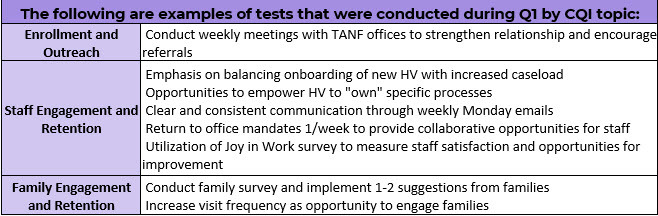
Leveraging Ongoing Opinions and Perspectives
We’re excited to introduce a new way to keep your voice at the center of our work!
As part of our Training and Technical Assistance support, we’re committed to continuous improvement through your feedback and reflection. The LOOP Survey (Leveraging Ongoing Opinions & Perspectives) gives you a simple, anonymous way to share insights that help shape our internal CQI efforts. Your input matters, and it drives meaningful change!
Each month, DCYF ESIT Tribal Program Consultant Brian Frisina will provide a key topic to help support us all in getting to know our Tribal Nations partners better.
This month’s topic is:
Let Us Celebrate American Indian Heritage Month
National Native American Heritage Month
November 2025 is Native American Heritage Month, a time to honor the history, culture, and contributions of Indigenous peoples of the Americas. Key observances include #RockYourMocs Day on November 15 and Red Shawl Day on November 19, which highlights the Missing and Murdered Indigenous Women, Girls, and Two Spirit people crisis. Many organizations, like the Smithsonian Institution and various libraries, host events, exhibitions, and online resources to celebrate the month.
Washington Tribes Explained
From the unique agreement with local, state and federal governments to the sources of income, Washington state tribes operate differently. Protecting the environment, building communities, and preserving culture are just a few of the main guiding principles that Native people in Washington live by. Learn about how for tribes, "the bottom line isn't always the bottom line" (watch time 5:53):
Washington Tribes explained
John Trudell: Columbus Day & "The Virus"
"... we look at economic systems as being power but in reality, the economic system is basically a system of authority [...] power really is about our relationship to life." Listen to John Trudell's insights on today's world and our connection to the earth (12:21):
John Trudell: Columbus Day & "The Virus"
DVD Recommendation
Noho Hewa: The Wrongful Occupation of Hawai'i: In the Hawaiian language, hewa means “wrong” and noho means “to occupy”. This documentary is a contemporary look at Hawaiian people, politics and resistance in the face of their systematic erasure under U.S. laws, economy, militarism, and real estate speculation. It is a raw, unscripted story that makes critical links between seemingly unrelated industries and is told from the perspective of Hawaiians. Watch the trailer.
About The Filmmaker
Anne Keala Kelly is a Hawaiian filmmaker who documented the Hawaiian sovereignty movement during the first decade of the 21st century. As a journalist, she has covered Hawaiian and other indigenous peoples issues and the environment. Learn more about the filmmaker.
Sources
An official website of the U.S. Department of the Interior
Understanding Native American Heritage
In 1914, Red Fox James, a Blackfoot Native American, rode [over 4,000 miles] on horseback across America rallying state governments to approve an official day to honor Native Americans. A year later, with the support of 24 states, he presented his proposal to the White House, but there's no record that anything came of it... then one year later...
How did the month get its start? What is the history of Native Americans in the U.S.? Why is this month so important? (watch time 4:01):
Understanding Native American Heritage
Everyone’s History Matters: The Wampanoag Indian Thanksgiving Story
This Land is Their Land: The Wampanoag, Plymouth Colony & The Troubled History of Thanksgiving
In this talk, Dr. David J. Silverman revealed the distortions of the Thanksgiving Myth and dived into the often overlooked history of the Wampanoag people. Dr. Silverman explored how the traditional Thanksgiving Myth has promoted the idea that Native people willingly ceded their country to the English to give rise to a white, Christian, democratic nation. The talk traced how the Wampanoags have lived—and told—a different history over the past four centuries.
Listen to the full talk (1:21:52):
This Land is Their Land: The Wampanoag, Plymouth Colony & The Troubled History of Thanksgiving
Everyone’s history matters: The Wampanoag Indian Thanksgiving story deserves to be known
The Thanksgiving story deeply rooted in America’s school curriculum frames the Pilgrims as the main characters and reduces the Wampanoag Indians to supporting roles. It also erases a monumentally sad history. The true history of Thanksgiving begins with the Indians.
Read full article by Lindsay McVay:
The Wampanoag Indian Thanksgiving story deserves to be known
Below are resources and opportunities to engage:
Governor Bob Ferguson signed an executive order at his first Centennial Accord meeting, hosted by the Cowlitz Indian Tribe. The press release says: "It requires agencies to take a number of measures to engage with tribes, establishes training requirements for state leadership and employees, and requires agencies — including the Governor’s Office — to establish Tribal consultation policies." You can read the press release on the Governor's website.
New Resources for Tribal/State Case Managers & ICWA Advocates: The National Indian Child Welfare Association (NICWA) has announced several new resources to support compliance with the Indian Child Welfare Act (ICWA) and responding to the needs of Native children and families. These include the ICWA Quick Resource Guide and Resources for Parents Facing Incarceration, and their Children, Families, and Caregivers.
Stay Updated on Hispanic Children and Families Research: One in four of today’s children have Latino backgrounds. You can be among the first to know about the latest research highlighting the strengths and experiences of Latino families and children by signing up for both of these resources: The National Research Center on Hispanic Children & Families Newsletter | Updates from the Latino Families Flourishing project at Child Trends.
|