|
“In every instance, the Indian position is fragile because it ultimately depends on the capacity and willingness of the majority society to explore unfamiliar intellectual terrain.”
-Charles Wilkinson, professor of law, renowned scholar and author
Each week, DCYF ESIT Tribal Program Consultant, Brian Frisina, provides a key topic to help us get to know our Tribal Nation Partners better.
This week’s term is:
What is the Tribal Supreme Court Project (TSCP)?
[...] in September 2001, Tribe Leaders met in Washington, D.C. and established the TSCP as part of a larger Tribal Sovereignty Protection Initiative. The Project’s purposes are to improve strategy and promote greater coordination in SCOTUS cases that may affect the rights and interests of Indian tribes.
Read more about the Tribal Supreme Court, why it was formed and what the TSCP does:
What is the Tribal Supreme Court Project?
The American Declaration on the Rights of Indigenous Peoples
On June 15, 2016, after nearly 30 years of advocacy and negotiation, the Organization of American States (OAS) adopted the American Declaration on the Rights of Indigenous Peoples. The OAS is a regional intergovernmental organization of 35 member countries of the Americas, including the United States.
Read more about the specific protections The American Declaration offers:
The American Declaration on the Rights of Indigenous Peoples
Dr Albert K. Barume, United Nations Special Rapporteur on the rights of Indigenous Peoples, explains the Declaration on the Rights of Indigenous Peoples, adopted by the UN General Assembly in 2007, and critical issues shared by Indigenous Peoples around the world (watch time 2:43):
What is the Declaration on the Rights of Indigenous Peoples?
-
Ghost Dancing with Colonialism: Decolonization and Indigenous Rights at the Supreme Court of Canada by Grace Li Xiu Woo: Some assume that Canada earned a place among postcolonial states in 1982 when it took charge of its Constitution. Yet despite the formal recognition accorded to Aboriginal and treaty rights at that time, Indigenous peoples continue to argue that they are still being colonized. Grace Woo assesses this allegation using a binary model that distinguishes colonial from postcolonial legality. She argues that two legal paradigms governed the expansion of the British Empire, one based on popular consent, the other on conquest and the power to command. Ghost Dancing with Colonialism casts explanatory light on ongoing tensions between Canada and Indigenous peoples.
-
The Law and Society Series: Explores law as a socially embedded phenomenon. It is premised on the understanding that the conventional division of law from society creates false dichotomies in thinking, scholarship, educational practice, and social life. Books in the series treat law and society as mutually constitutive and seek to bridge scholarship emerging from interdisciplinary engagement of law with disciplines such as politics, social theory, history, political economy, and gender studies.
Sources

Did you know that there is a subsidy available to support children who have special needs in child care?
Find out how you can support child care and family access to this funding stream for ESIT enrolled children who may be eligible.
Matt Judge, Department of Children, Youth, and Families' (DCYF) Child Care Administrator, and Jason Ramynke, DCYF's Child Care Subsidy Program Administrator, will share the latest information about requirements, who may qualify, and answer questions about the Child Care Subsidy for Children with Special Needs.
Who should attend?
We recommend any ESIT staff, especially those who support service coordination, education and therapy services with families whose children are in, or might enroll in, child care. Registration is open now!
Thursday, Sept. 18 | 10 - 11 a.m.
Register for Child Care Subsidy for Children with Special Needs
Accommodation Requests
ASL, live captioning, and other accommodations to fully participate in this webinar are available to you upon request. Please submit the Training and Event Access Support request form at least two weeks prior to the event. DYCF may not be able to fulfill requests made less than two weeks in advance.
Questions?
Email ESIT Technical Assistance Manager, Laurie Thomas, at Laurie.Thomas@dcyf.wa.gov, or ESIT Technical Assistance Specialist, Michelle Baker, at michelle.baker@dcyf.wa.gov.
|

DCYF and King County are partnering to host an ongoing meeting space to support ESIT Providers who work with immigrant and refugee families. The space will provide best practice training, guidance, resources, and reflective practice to ESIT Providers, in response to the evolving needs of families. Providers will have the opportunity to process, connect, and reflect with one another.
This statewide group will be held on the fourth Monday of each month, 9:30 - 11 a.m. The September session will include resources, discussion, and reflection with the Family Separation Rapid Response Team.
Who should attend?
Any Provider who works with immigrant and refugee families! We recommend any ESIT staff, especially those who support the intake/referral, service coordination, and evaluation/assessment process, to attend. Registration is open now!
Monday, Sept. 22 | 9:30 – 11 a.m.
Supporting Providers Working with Immigrant and Refugee Families
Accommodation Requests
ASL, live captioning, and other accommodations to fully participate in this webinar are available to you upon request. Please submit the Training and Event Access Support request form at least two weeks prior to the event. DYCF may not be able to fulfill requests made less than two weeks in advance.
Questions?
Contact Technical Assistance Specialist, Molly Stryker, at molly.stryker@dcyf.wa.gov or King County Program Manager, Norma Renteria Lobo, at nrenteri@kingcounty.gov.
|

*CLAs and ESIT Provider Agencies, please widely share with your ESIT contractors*
ESIT's Resource and Sustainability Team is hosting several Fiscal Learning Opportunities! Priority registration will be given to budget/fiscal staff.
Revenue/Expenditure Year-End Report Sessions
Year-End Revenue/Expenditure Report Sessions will include guidance on completing your organization’s FY24 ESIT Revenue & Expenditure Year-End Report using the updated instructions and template within the Fiscal Workbook.
Dates and Times
- Tuesday, Sept. 23 | 10 – 11 a.m. | Registration
*For County Lead Agencies and their affiliated ESIT Provider Agencies.
Fiscal Workshops
Fiscal Workshops will include guidance on the following topics:
- Part C Purpose and Fiscal Requirements,
- State Lead Agency (SLA) Responsibilities, and
- ESIT Fund Sources and Contracts.
* Workshops are two hours. All workshops will cover the same material (no need to attend all four).
Dates and Times
Accommodation Requests
ASL, live captioning, and other accommodations to fully participate in this webinar are available to you upon request. Please submit the Training and Event Access Support request form at least two weeks prior to the event. DYCF may not be able to fulfill requests made less than two weeks in advance.
Questions?
Email ESIT Resource Allocation Manager, Kali Wraspir, at kali.wraspir@dcyf.wa.gov.
|

Are you a parent or caregiver of a child, or children, receiving early intervention services through the Early Support for Infants and Toddlers (ESIT) program?
Do you want to grow your leadership, public speaking, and advocacy skills, to help tell your lived-experience story and influence systems of support for infants and toddlers with disabilities across Washington state?
Join the Department of Children, Youth, and Families’ (DCYF) Parent Institute for Engagement’s (PIE) cohort 8!
As an incentive, DCYF provides reimbursement to PIE cohort members for child care, travel, and lodging costs.
Applications are due: Sept. 25, 2025.
Chosen applicants will be notified: the week of Sept. 29.
Follow the link below to apply:
PIE Cohort 8 Application
Flyers are available for providers and partners to distribute to families. To request flyers, application links, or for any questions, please contact Vanessa Allen, Family Engagement Coordinator. For more information about PIE, visit the ESIT Parent Rights page.
Let’s continue building strong family leaders, one cohort at a time.
|

SICC Member Application
The Washington State Department of Children, Youth, and Families (DCYF) is recruiting members for two open positions on the State Interagency Coordinating Council:
- (1) Public or private provider of Early Intervention Services,
- (1) Member of the State Legislature.
Apply on the Governor's website, and under 'Board Information,' select Infants and Toddlers with Disabilities and Their Families, State Interagency Coordinating Council:
Apply here for SICC board
SICC Sub-Committees Application
The SICC Data, Finance, Personnel & Training, Public Policy, and Service Delivery Committees are accepting applications from qualified and interested individuals:
Complete Sub-Committee Interest form
If you have any questions, please contact DCYF ESIT Community Collaboration Coordinator, E Renae` Antalan.
|

Grandparents Publish Book Inspired By Kinship Care Experience
September is Kinship Care Month, a time to celebrate and appreciate caregivers who are providing stability and love to relatives and close family friends who are unable to live with their parents.
Read about grandparents Shaun and Brenda in Snohomish County who care for their grandson, Jaxon. The grandparents wrote a book called “Jaxon and the Magic of the Forest,” which was inspired by the beauty of nature and the strength of kinship and foster families.
Read their story on the DCYF What’s New blog and learn more about kinship care.
|

Resources for Families Impacted by Immigration-Related Concerns
DCYF is excited to announce that the Family Separation Rapid Response Team Resource Flyer is now available in multiple languages on the DCYF website.
This is a comprehensive list of trusted resources for families at risk of separation due to immigration-related detention or deportation.
View and download the flyer here: Resources for Families Impacted by Immigration-Related Concerns
To learn more, read the web article.
|
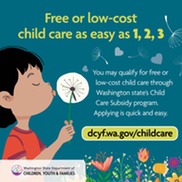
Spread the Word about Free/Low-Cost Child Care
Many families living in Washington state qualify for free or low-cost child care, but they may not know about it. You can help by sharing information with parents, caregivers, and your community.
The Washington state Department of Children, Youth & Families (DCYF) has put together a toolkit with ready-to-use materials that make spreading the word easy!
Visit www.dcyf.wa.gov/childcare/toolkit to access printable flyers, sample social media posts, and email templates.
Whether you work directly with families or want to help your community stay informed, these resources make it easy to connect families to the support they need.
Want to know more about the Working Connections Child Care Subsidy Program? Visit www.dcyf.wa.gov/childcare or call 844-626-8687. Help is available by phone in multiple languages.
|

The Washington State Department of Health, Early Hearing Detection, Diagnosis and Intervention (EHDDI) program worked with ESIT, OSPI, early support providers, and school district personnel to create a training module. The training module provides Part C (birth to three) and Part B (school aged) providers with information and resources that can be helpful when a child who is deaf or hard of hearing transitions from early support services to school district services.
To access the training and other helpful trainings, please visit the EHDDI WaPortal webpage.
|

From the Barnard Center Free Lecture Series, this talk will explore how a mother’s unresolved trauma stemming from abuse or the loss of significant others can affect the quality of care she provides for her child. Specifically, we will describe frightening and anomalous caregiving behaviors over their child’s first two years of life and show video examples. We will discuss how these early experiences relate to emotional and behavior problems in middle childhood. Finally, we will discuss the implications of this research for clinical intervention.
Register, read more, and learn about the presenter, Deborah Jacobvitz, Ph.D., the Phyllis L. Richards Endowed Professor in Child Development at the University of Texas:
Sept. 22 | 9 - 10:15 a.m. | Free
Frightening and Anomalous Maternal Behavior in the First Two Years of Life and Its Impact on Children’s Development
|

The current cohort of Tribal Early Learning Initiative (TELI), which started in early 2022, will end in December 2025. In addition to providing universal technical assistance to 41 TELI Network Tribes, Administration for Children and Families (ACF) has been partnering with 8 TELI Collaborative Tribes to provide intensive support to assist them in planning and carrying out their priorities to improve efficiencies and be more responsive to the needs of young Native children and their families. The new TELI cohort will run from January 2026 to December 2028 and will emphasize food security and nutrition. To learn more about TELI, view the TELI informational flyer.
To apply to participate in the TELI Collaborative, please fill out the Statement of Interest and submit to TribalECD@acf.hhs.gov by Friday, Oct. 31.
|
For more updates, subscribe to these newsletters:
|