|
In honor of Juvenile Rehabilitation(JR) Appreciation Month, we would like to thank and celebrate our outstanding staff. It takes a village to provide care and support for the young people we serve. JR staff, volunteers, and community partners are positively impacting individuals and communities through their dedication and commitment to improving the lives of young people and families in Washington!
Throughout the year, young people express the profound impact staff and partners have on their ability to grow, heal, and achieve futures they never knew they could have. Thanks to these individuals, young people in JR earn college degrees, create art, learn to cook, receive treatment and mental health services, and plan their futures.
During the month of July, we celebrate those who spend their time making our community a safe, secure, and therapeutic space for our young people. They are Creating Bright Futures for those they work with.

Six young people at Green Hill School (GHS) won a nationwide anti-fentanyl contest hosted by the Substance Abuse and Mental Health Services Administration, as part of an effort to prevent drug overdose deaths.
“Dark Roads,” the music video produced by young people at GHS, was among 200 videos submitted to the Fentanyl Awareness Youth Challenge. Six videos from across the nation were selected as winners, each receiving a $5,000 prize to share among the youth who produced them. The challenge was open to teens across the country ages 14 to 18. GHS was the only winner that included youth from a juvenile rehabilitation facility.
“I feel this win from my perspective is a win for not only me, but all the youth at Green Hill,” said Conner, one of the recipients. "It’s a voice for youth who are struggling with addiction and a voice from a group of people who they can relate to. I wish I had a voice like this when I was younger."
Read the full article.
|
Young People Make History Earning Bachelors at Juvenile Rehabilitation Facility
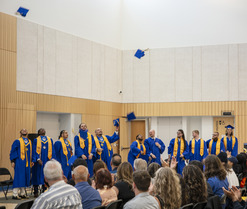
The Washington State Department of Children, Youth, and Families (DCYF) celebrated the first cohort of young people to earn their bachelor’s degree while at a juvenile rehabilitation (JR) facility.
Caya, Guillermo, Blake, Mondrell, and La’Kendrick joined six others who received college degrees from Centralia Community College at the June 18 ceremony hosted at Green Hill School (GHS) in Chehalis.
“These graduates have not just earned degrees; they've gained tools to rewrite their life stories,” said DCYF’s Assistant Secretary of Juvenile Rehabilitation Felice Upton. “It proves that with the right opportunities, transformation is possible.”
This academic year, 28 young people earned a college degree, 16 earned a high school diploma, and another 16 obtained their General Educational Development (GED) while at GHS and Echo Glen Children’s Center in Snoqualmie.
“If you would have told me before I got locked up that I would be going to college, I would have laughed,” said Caya, who is the first in their family to earn a college degree. “Now, thanks to Green Hill and everyone who has supported me, I have taken advantage of this opportunity and am now one step closer to achieving my goals.”
Read the full article.
|
Echo Glen Children’s Center Celebrated their First College Graduation
Echo Glen Children’s Center celebrated its first college graduation on June 20, 2024. One young person received her Associate of Arts degree (Magna Cum Laude) in Legal Studies from Highline College with a 3.85 GPA. She has already begun studies at Washington State University and is on track to graduate in April 2025 with her bachelor's degree in Criminal Justice.
She finished her AA while working 10-20 hours a week as a Library Clerk for the Echo Glen branch of the Washington State Library and as a policy intern for Team Child.
Her graduation ceremony was held in the Echo Glen State Library, with family, friends, and various staff present to celebrate and honor her hard work.

A Responsible Renters class was offered at Green Hill School for the first time.
“We had 50+ young people sign up, but based on space, we limited it to 16 young people scheduled to release soon. The students were excited to attend and had fun during the class. The instructors made the class interactive and interesting,” said a Green Hill School Program Manager. “This is such valuable information for the youth we serve. They all have asked me to pass on a huge thank you for your time in teaching them life skills. We are excited for this program to return.”
The Responsible Renters class helps participants address the barriers to getting and keeping permanent housing. Participants create a budget, learn about credit scores and loans, practice talking to landlords, discover how to find the home/apartment they want, and review the laws and rights they have as renters in Washington state. After completing the class, participants received a certificate, workbook, local housing agency contacts, and other community resources. The class is helpful for first-time renters, home buyers, and anyone with multiple barriers, including a criminal history or an eviction record. In some cities, the class is a requirement to access housing vouchers or any other housing assistance, and it can also be presented to landlords as a show of good faith effort by renters. For JR young people, this class is an amazing opportunity for them to learn more about the realities of living independently while also providing them with an advantage to hopefully find stable and permanent housing on their own.
Every participant received a certificate of completion. A few young men even won prizes for going above and beyond in their participation efforts while encouraging their peers to do the same.
We hope this class will become a reoccurring option for young men at GHS and be shared with the rest of JR's young people as they leave our care system.
|
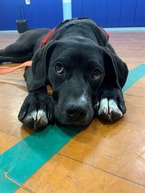
From therapeutic dog time to the simple joy of seeing dogs walking around campus, Canine Connections makes a powerful impact on the young people at Echo Glen Children’s Center.
Through this program, young people can obtain an accredited grooming certification and learn how to train rescue dogs through the Canine Connections Rescue Training Program. This unique initiative pairs young people with a rescue dog for an 8-week training session. This program mirrors the skills and tools used throughout JR to encourage positive behaviors.
Canine Connections is more than just dog training. It's a structured teaching environment where young people work with our staff to modify their dog’s unwanted behaviors using reinforcement. At the end of the training, the dogs are available for adoption. The residents also provide care, learning responsibility, and accountability by regularly cleaning, feeding, and spending quality time with their dogs. They even get to meet the dog’s adoptive family for the “puppy reentry meeting” and coach the new family, a rewarding experience.
This process teaches young people communication skills, patience, anger management, accountability, and responsibility.
A dog can give unconditional love and nonjudgmental support. This support allows young people to build a bond and empathic relationship with them, giving them the foundational skills to build future relationships. Canine Connections makes a positive impact on the participants' self-esteem and provides emotional support.
|

Community Assisted Reentry (CAR) is a voluntary program available to young people without parole obligations for up to 12 months of support to transition back into their communities successfully following release from JR. In 2021, the legislature provided funding for the “Community Support for all Young People” Decision Package, that featured community transition and reentry services. With this funding, Juvenile Rehabilitation (JR) hired six regional specialists dedicated to building relationships in communities with resources about mental health, housing, transformational mentors, faith-based info, and local communities to connect young people with resources. Staff also became trained in a family-based and relational approach model to work with people who may be hesitant.
Since this is a voluntary program, staff had the challenge of engaging a new population of young people with no obligation to work with them. CAR specialists started building relationships with youth within JR before they were released, allowing staff to share resources and tools.
When speaking about the CAR program, a 16-year-old released from Echo Glen Children’s Center said, “It gave me someone to lean on and know that someone was behind me and there was someone I could call if I needed help... My parents didn’t really help me build my life up and give me the tools I needed to be me and live a better life, and you guys did.”
Although many young people initially said no, many reached out for help remembering the program and staff when they faced barriers to success upon release.
Read the full article.
|
|