 One of our favorite times of the year is approaching - - PARENT RECOGNITION MONTH - - in February!
As 2024 is quickly approaching, we are gearing up for our annual Unsung Hero campaign in honor of Parent Recognition month (February) and we are hoping you can help us spread the word far and wide.
Since 2011, with your help, we have honored 337 parents and caregivers in Washington for the roles they have taken with their families, schools and communities. They have been recognized because they have shown strength, courage and empathy in their communities. Parents and caregivers around Washington State are supporting their children, families, and communities in exceptional ways and we want to show our appreciation. Please help us in honoring 29 more in February 2024 by nominating a parent/primary caregiver/guardian for the Unsung Hero award. The nomination form is available in three languages (English, Spanish and Somali). A parent panel will select one honoree for each day in February and then all honorees (including their family or supporters) and their nominators will be invited to an in-person celebratory dinner event in Olympia.
All nominations must be submitted by January 5, 2024. The nominations can be emailed to strengtheningfamilies@dcyf.wa.gov.
There will be no office hours in December. We will see everyone January 18, 2024 3 p.m. Join here.
We are however offering an orientation to new programs and new supervisors on Concrete Goods additions to your contract and the options for Workforce Incentives On Thursday, Dec. 7 at 10 a.m. You can join that meeting here.
For decades, American Indian and Alaska Native (AI/AN) communities have struggled with high rates of assault, abduction, and murder of women. A 2016 study by the National Institute of Justice found that more than four in five AI/AN women have experienced violence in their lifetime, including 56.1% who have experienced sexual violence.
H.R. 2438 (Not Invisible Act) was passed to address the crisis of violence committed against AI/AN men and women. The act brings together a committee of law enforcement, tribal authorities, and federal partners to find solutions and establish better systems of coordination.
In Washington State, our Legislature created the Washington State Missing and Murdered Indigenous Women and People (MMIWP) Task Force in 2021 to coordinate a statewide response to this urgent crisis of Indigenous people who go missing, are the victims of homicide, or experience other types of gender-based violence in urban and tribal communities.
Furthering this mission, last year Governor Inslee signed into law a bill that created a first-in-the-nation statewide alert system for missing Indigenous people. Spearheaded by Rep. Lekanoff, this law has established a system – like an Amber Alert for missing children – called the M.I.P.A. or Missing Indigenous Person Alert System.
“We will continue to fight for the rights of all Indigenous peoples,” said Tleena Ives, Director of Tribal Relations at DCYF. “Thank you to those who participated in this year’s Native American Heritage Month and followed along with us as we shed light on these critically important topics.”
There are still spots available for WA-AIMH’S Introduction to Reflective Supervision for Supervisors Training. This online learning series is open to Supervisors, Program Managers and Administrators from HVSA funded home visiting programs. It’s highly recommended for LIA leaders and home visiting supervisors new to Reflective Supervision Practices and training participants will be invited to join in a monthly 90-minute Reflective Supervision Consultation Group of five supervisors, to receive support in implementing what’s been learned and to hear from other supervisors’ too. Facilitated by Martha Stebbins-Aguiniga, MA, LMHC, IMH-E4 this online series is scheduled for:
Jan 8, 11, 19, 22, 2024
9 a.m. to 12:30 p.m.
To claim one of the remaining spots, please contact Nina Evers @ nina.evers@dcyf.wa.gov or call 360.522.0982.
Are you a front-line home visitor or supervisor seeking to enhance your skills and stay ahead in the ever-evolving field of family support? Join Rapid Response and NICHQ for an immersive webinar experience that unveils groundbreaking learning paths designed for self-directed learning through a selection of Rapid Response-Home Visiting Modules and Webinars. This webinar is your passport to professional excellence, offering a unique opportunity to choose your own path toward growth. Whether you're a seasoned home visitor or a supervisor looking to upskill, this is your chance to amplify your impact.
Wednesday, December 13th, 2- 3:00pm (CST)
Click Here To Register
|
Please join us for the Virtual Home Visitor Training Series with presenters from a wonderful team of experienced and wise home visitors and WSCADV staff!
The Domestic Violence Assessment and Response training is followed by the Safety Planning with Families training.
Please register for each event you wish to attend.
|
|
DV Assessment and Response
Jan. 30, 2024
Jan. 31, 2024
10:00 - 11:30 am both days
Register here!
|
Safety Planning with Families
Feb. 9, 2024
9:30 a.m. – 2:30 p.m.
(break from 12-1 p.m.)
|
|
Additional trainings will continue throughout the fiscal year and we will continue to post registration links as we get closer to events.
Depression Screening and Referrals
Identifying potential caregiver mental health issues and providing services and referrals is a key role for home visitors. Caregiver depression is a serious and widespread condition that not only affects the caregiver, but may have a lasting, detrimental impact on the child’s health. Past research has shown that children of caregivers who are struggling with depression are at increased risk of attachment issues, child abuse and neglect, and developmental delays (Earls, 2010). Caregiver depression screening and treatment is an important tool to protect the children from the potential adverse effects of caregiver depression.
Measuring Performance
Home visiting model best practices encourage multiple screenings and referrals depending on the situation of the family and caregiver. To uniformly assess screening across the HVSA, we have defined an aligned screening measure to meet a minimum requirement.
 To assess referrals provided and completed by caregivers with a positive screen, the HVSA follows the MIECHV performance measure 17, below, for MIECHV clients. This measure requires that the positive screen is completed during the 3-month window defined above. The HVSA also agreed that a positive screen requiring additional mental health services or referral would be a PHQ9 score of at least 10 and/or noted suicidal thoughts.
 In SFY 2019, depression screenings and referrals were added as Performance Milestones in an effort to elevate the importance of timely screening. The goal of the depression screening performance award was to incentivize screening for all newly enrolled caregivers within three months of enrollment or three months following the birth of their child if the caregiver enrolled prenatally. The depression referral performance award is designed to incentivize appropriate follow-up and connection to services for caregivers who screen positive or disclose depressive symptoms. This may include making a new referral for mental health services, completing a referral, or confirming the caregiver is receiving the recommended services and documenting the work.
How are we doing?
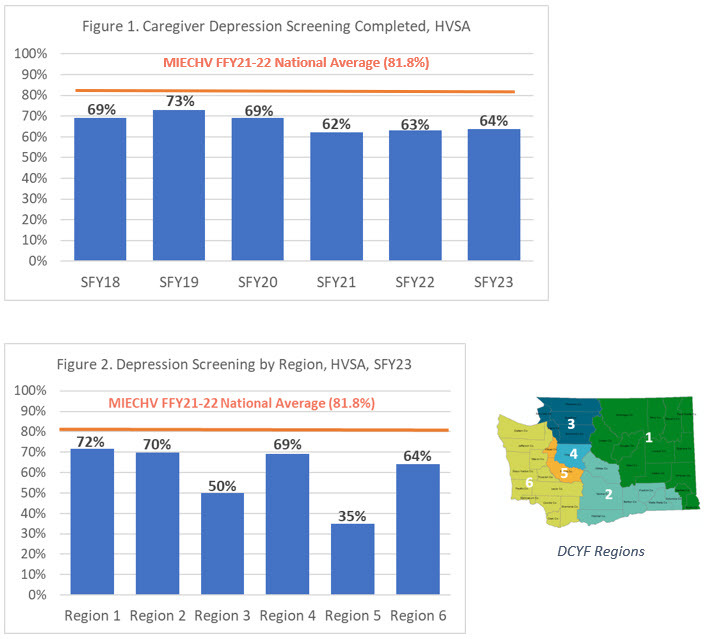
Depression screenings and referrals were especially relevant during the pandemic when many caregivers struggled with mental and emotional health issues. However, depression screening rate for the HVSA declined from 73% in SFY19 to 62% in SFY21 (Figure 1), which may be associated with stressful situations families and home visitors faced during the pandemic and the challenges administering screenings during remote and virtual home visiting. Since SFY21, there has been a slight increase in depression screening from 62% In SFY21 to 64% in SFY23. In SFY23 there was regional variation in screening rates from 35% to 72%, which suggests there may be room for improvement (Figure 2).
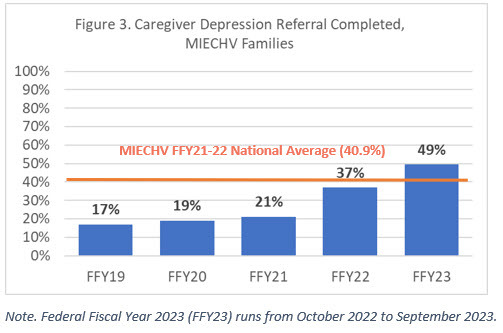
 The MIECHV performance measure for depression referral completion is monitored among MIECHV clients for all positive screens completed during the 3-month window. The rate of caregiver depression referral completed increased from 21% in federal fiscal year 2021 (FFY21) to 49% in FFY 23 (Figure 3).
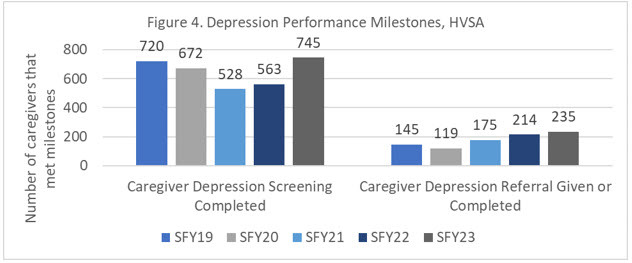
 For SFY 2023, LIAs received incentive awards for the 745 caregivers screened for depression during the screening window in the fiscal year (increasing from 528 caregivers and 563 caregivers in SFY 2021 and SFY 2022, respectively). There was also an increase in caregivers referred for needed mental health services since SFY21.
 Need a refresher on how to enter in VisitTracker and on which Forms to use for FLO? Please follow these links for step-by-step instructions for VisitTracker and FLO.
Home Visiting Role in Addressing Maternal Wellbeing in Washington
Washington State is experiencing an opioid crisis and concurrent mental health crisis. There is an urgent need to identify individuals with perinatal mental health or substance use disorder and to ensure they receive appropriate levels of care.
-
Behavioral health conditions, including death by suicide and overdose, are the leading cause of pregnancy-related deaths in Washington as reported by the Washington State Maternal Mortality Review: Maternal Deaths 2017-2020 report. (Washington State Maternal Mortality Review)
-
Lack of screening, appropriate follow-up for risk factors, care coordination or continuity of care, or access to health care and behavioral health treatment contributed to pregnancy-related deaths. Factors were exacerbated by social and structural determinants of health such as housing instability and systemic racism. (Washington State Maternal Mortality Review)
-
Washington’s Maternal Mortality Review Panel determined that almost 1-in-5 (19) of preventable pregnancy-related deaths might have been potentially impacted with increased availability of home visiting and telehealth services. The Panel recommended increased access to mental health and substance use disorder prevention, screening, and treatment for pregnant and parenting people; including a call to expand access to home visiting programs (Rec. 2.5). (Washington State Maternal Mortality Review)
- Home visiting programs offer family-focused services to expectant parents and families with new babies and young children to support the physical, social, and emotional health of the child and parent. In Washington, home visiting programs prioritize outreach to families experiencing stressors such as poverty, housing instability, depression, drug use, and family violence.
-
Home visiting is known to reduce maternal depression and parental stress and reduces mothers’ experiences with intimate partner violence (MIHOPE Study). Screening for maternal depression and screening for intimate partner violence are the first steps to identifying women who are at risk. Source: Department of Health, Home Visiting Unit. November 2023
Suicide Awareness
Suicide is a serious public health problem in Washington. It affects people of all ages in communities across the state. Because suicide is one of the leading causes of early death in Washington, preventing it improves the health of Washingtonians and our communities. The Washington State Department of Health is taking many actions for suicide prevention and guides implementation of the WA State Suicide Prevention Plan (PDF).
The Department does not provide crisis intervention services. If you are thinking about suicide, you are not alone. Please call the National Suicide Prevention Lifeline at 800-273-TALK (8255). Counselors are available 24 hours a day, seven days a week.
On July 16, 2022, the National Suicide Prevention Lifeline was launched. You can reach the Lifeline by dialing 988. Learn more at the 988 Suicide and Crisis Lifeline webpage.
For more information about Suicide Prevention, visit the Washington State Department of Health Suicide Prevention website.
Source: The Washington State Department of Health's Injury and Violence Prevention (IVP) Program
Data Sharing Agreements Update
Our Data Sharing Agreements have moved to the next steps in our process and will be sent to your agencies for electronic signatures in the coming days. Please keep an eye out for these and remind your business contacts that these will be coming to your offices and need signatures as soon as possible as existing agreements expire at the end of 2023. Thank you for your partnership in keeping these agreements up to date!
Quarter 1 Dashboards:
Quarter 1 dashboards were posted to MFT recently and are available for two weeks from their posting date. If you have any trouble accessing them, please contact homevisiting@doh.wa.gov for assistance.
October Webinar Summary – Identifying Changes to Test
In the most recent webinar participants shared examples of changes using the change concept to generate specific ideas used in PDSA cycles. Using the List of Change Concepts small groups reflected and shared PDSA cycles projects are currently using or plan to use. Starting small, considering manageable timelines, and championing volunteers were a few tips for right sizing PDSAs. Differences in doing a tasks vs. testing a change and collecting useful data rather than perfect data were are also important in reflecting how a change you're introducing or change you're making works under different context, circumstances, and conditions.
Change Concept
A general notion or approach to change that has been found to be useful in developing specific ideas for changes that lead to improvement.
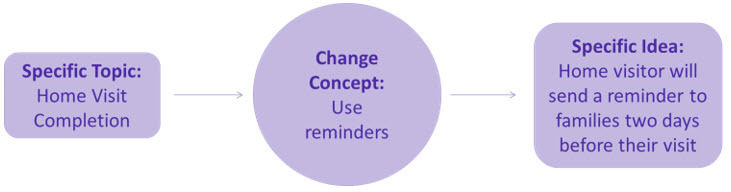 9 Categories of Change Concepts
- Eliminate Waste
- Improve Work Flow
- Optimize Inventory
- Change the Work Environment
- Enhance the Client Relationship
- Focus on Time
- Manage Variation
- Mistake Proofing
- Focus on a Product/Service
Resources (found on Basecamp – CQI Project Folders)
Looking Ahead - SFY24 Webinar Structure
- December: No webinar-winter break
For questions or support or to be added to CQI listservs:
Camille Carlson: ccarlson@startearly.org
Start Early’s national home visiting team is hiring for two new positions. Please spread the word!
Bilingual Home Visiting Manager Part Time
Workforce Development Specialist
Each month, DCYF ESIT Tribal Program Consultant Brian Frisina will provide a key topic to help support us all in getting to know our Tribal Nations partners better.
This month’s topic is:
A Proclamation on National Native American Heritage Month, 2023
During National Native American Heritage Month, we recognize the invaluable contributions of Native peoples that have shaped our country and honor the hundreds of Tribal Nations who continue exercising their inherent sovereignty as vital members of the overlapping system of governments in the United States. We also recommit to supporting Tribal sovereignty; upholding the Federal Government’s solemn trust and treaty responsibilities; and working in partnership with Tribal Nations to advance prosperity, dignity, and safety for all Native peoples.
Read the full Governor's Proclamation on Native American Heritage Month 2023:
Understanding Native American Heritage
How did the month get its start? What is the history of Native Americans in the U.S.? Why is this month so important? Little Cheiis explains (watch time 3:59):
Haudenosaunee Thanksgiving Address
This video, filmed on location at the Onondaga Nation School in Onondaga Nation, focuses on the purpose and uses of the Haudenosaunee Thanksgiving Address. Representatives from the Onondaga Nation talk about the history of the Address and how the Address changes depending on who is saying it (watch time 3:51):
Haudenosaunee Thanksgiving Address
National Survey of Children’s Health: New Data, Opportunities, and Directions Webinar
Tuesday, December 5 from 1—2 p.m. EST
The National Survey of Children’s Health (NSCH) stands as the largest national survey of children in the US. This survey offers invaluable data on a spectrum of indicators crucial for informed decision-making. Led by experts Dr. Reem Ghandour and Dr. Ashley Hirai, the webinar will break down the survey's design, highlight key findings related to the new "Healthy and Ready to Learn" measure, and explore cutting-edge innovations driving the survey's continued evolution.
By the end of the session, participants will gain an understanding of the National Survey of Children’s Health's design, be able to report on key findings from the new school readiness measure, and learn about innovations being implemented or tested in the annual survey. Register today.
|
News
Washington state capital gains tax collects nearly $900M in first year, GeekWire
WSDA Awards Farm To School Purchasing Grants, Pacific Northwest AG Network
Families gain new members in Lewis County Adoption Day celebration, The Chronicle
|