Attention Boaters in Massachusetts: Be on the Lookout for Right Whales

Having trouble viewing this email? View it as a Web page.

NOAA Fisheries - New England - Mid Atlantic Bulletin

April 15, 2025

Attention Boaters in Massachusetts: Be on the Lookout for Right Whales

The public and mariners are asked to report sightings to the NOAA hotline.

NOAA and partners received reports of endangered North Atlantic right whales in Boston Harbor, Broad Sound, Nahant Bay, Cape Cod Canal, and other surrounding areas over the last week. Also due to the presence of persisting aggregations of right whales in Cape Cod Bay, many are likely to be in the area.

The public and mariners are asked to report all sightings immediately to the Greater Atlantic Regional Fisheries Office’s Stranding Hotline (866) 755-NOAA (6622) or to USCG VHF Channel 16.  Please give whales space and keep a safe distance (at least 500 yards is the law) for their sake and yours.
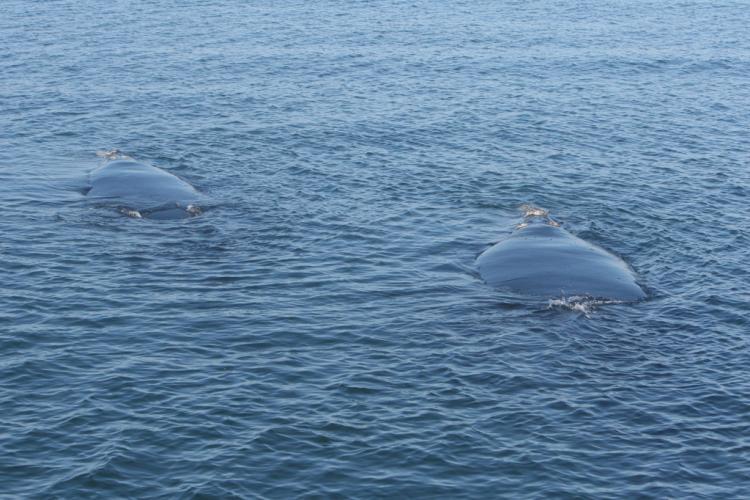
NARW, Credit: Florida Fish and Wildlife Conservation Commission (NOAA Permit # 775-1875)

Photo: Unlike most other whales and dolphins, right whales do not have a dorsal fin. They often rest at the surface of the water and can be difficult to see from boats because their backs are broad and flat. Credit: Florida Fish and Wildlife Conservation Commission (NOAA Permit # 775-1875).

How you can help

  • Keep a lookout: Right whales can be difficult to spot at the surface, putting them at increased risk for vessel collisions.
  • Report: Send all sightings immediately to the NOAA hotline (866) 755-NOAA (6622) or USCG VHF CH16. Remember to note the time and location and take photos and videos if possible, but please do not approach closer than 500 yards.
  • Go slow
    • In Seasonal Management Areas: Most vessels 65 feet or longer must travel at 10 knots or less in these locations along the U.S. East Coast at certain times of the year.  These speeds are also recommended for smaller boats.
    • In Dynamic Management Areas/Right Whale Slow Zones: All vessels are requested to go 10 knots or less in these temporary speed restriction areas where right whales have been detected. 
    • Separate from the federal speed regulations in the Cape Cod Bay SMA, Massachusetts state law requires most vessels less than 65 feet to travel at 10 knots or less in the Cape Cod Bay Vessel Speed Restriction Area from March 1 to April 30. Speed restrictions may be extended by the Massachusetts Division of Marine Fisheries (DMF) if right whales continue to remain present in Cape Cod Bay. Please visit the Massachusetts DMF website for information on state speed restrictions and advisories.
    • Learn more about speed restrictions here. Sign up for text or email alerts here.  

How to identify right whales

  • V-shaped blow.
  • Stocky bodies and a broad, flat back with no dorsal fin.
  • Their heads have a black and off-white pattern that is unique to their species. Lumpy, rough skin patches, called callosities, appear light in color due to a small crab-like creature, called cyamids, living on the patches.
  • Look for black/dark patches, whitewater, and splashes. Right whales tend to swim just below the surface and rest at the surface, making them difficult to spot.
  • Shiny black skin, like killer whales and manta rays (some also have a black and white belly pattern).
  • Wide, paddle-shaped flippers and a tail/fluke with smooth edges.

Questions?

Media: Contact GARFO Public Affairs