|
July 18, 2025
FSIS’ New Administrator Sworn In
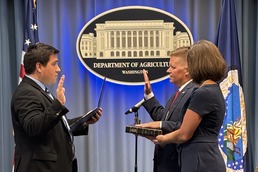
On July 3, 2025, Dr. Justin Ransom was announced by Secretary of Agriculture Brooke L. Rollins as a presidential appointment to serve as FSIS Administrator. He assumed leadership of the agency on July 14, 2025.
As Administrator, Dr. Ransom will oversee FSIS’ mission to ensure the safety, wholesomeness, and proper labeling of America’s commercial supply of meat, poultry, and processed egg products. He will lead the agency’s modernization efforts, streamlining inspection systems, strengthening public health protections, and advancing science-based policies.
Dr. Ransom brings more than 20 years of executive leadership in food safety, quality systems, animal welfare, and sustainability. Immediately before his appointment, he served as Senior Director of Sustainable Food Strategy at Tyson Foods, where he spearheaded enterprise-wide sustainability programs. His diverse industry experience includes leadership roles at McDonald’s and OSI Group, where he managed and advanced complex food supply chains across global markets.
|
USDA Announces Five-Point Plan to Strengthen Food Safety

On July 15, 2025, USDA announced a new, comprehensive Five-Point Food Safety Plan to advance public health and modernize how FSIS protects the nation’s meat, poultry, and egg supply.
The plan includes key initiatives aimed at enhancing foodborne illness prevention, strengthening inspection programs, and improving regulatory oversight. Highlights of the plan include:
- Enhancing microbiological testing and inspection oversight, including more robust Listeria testing and in-person Food Safety Assessments;
- Equipping inspectors with updated training and tools to proactively identify and address food safety risks;
- Launching a new, practical approach to reduce Salmonella illnesses while minimizing unnecessary regulatory burdens;
- Strengthening partnerships with state inspection programs through updated cooperative agreements and $14.5 million in new funding;
- Empowering inspectors to take stronger compliance actions, including increased enforcement activity and required follow-up visits.
For more information, see the press release announcing the new plan.
|
FSIS Leadership Changes
FSIS is pleased to welcome Dr. Justin Ransom as the new FSIS Administrator, with Dr. Denise Eblen continuing her service in the Office of the Administrator as Deputy Administrator.
FSIS is also announcing strategic senior leadership updates that pull from our great bench of internal talent and demonstrate our broad depth of experience and expertise. We are dedicated to building a team that allows us to continue to achieve our food-safety mission, to work with industry, to instill confidence in and support making hard decisions, and to develop talent within the agency.
We are proud of our team and appreciate their willingness to be in Acting roles as noted below, and we will work to create more permanence in the coming months.
Office of Field Operations (OFO)
-
Melissa Moore has resumed the role of Acting Assistant Administrator (AA) for OFO, transitioning from her previous role as OFO Deputy AA (DAA). Ms. Moore’s deep understanding of field operations and regulatory enforcement will continue to ensure the effective management and administration of FSIS’ largest program area.
-
Karen Hunter now serves as Acting DAA for OFO. Her role as an OFO Executive Associate for Regulatory Operations (EARO) in addition to her previous positions across FSIS give her a wealth of experience in communication, coordination, and managing operational and policy priorities within the agency, at the department level, and with external stakeholders.
-
William Griffin remains an Acting DAA for OFO and will continue to apply his extensive FSIS experience and steady leadership to support field personnel and mission critical field activities. He previously served as an EARO with OFO and District Manager (DM) of the Alameda District.
-
Robert Bane continues as an EARO overseeing the Springdale and Dallas Districts. Mr. Bane has nearly 3 decades of experience with FSIS. Starting out as a Food Inspector in Texas, Mr. Bane has also served as a Deputy District Manager (DDM) and DM for the Springdale District, as well as AA for the Office of Investigation, Enforcement and Audit (OIEA).
-
Dr. Sheryl Shaw will continue as FSIS’ Chief Public Health Veterinarian while serving in a new role as an Acting EARO overseeing the Des Moines District. Dr. Shaw has more than 30 years of experience in private practice and public service, including serving as Acting AA for the Office of Public Health Science (OPHS), a Director in OPHS, and in field operations in both slaughter and processing.
-
Dr. Soumaya Tohamy is now Acting EARO overseeing the Chicago District. Dr. Tohamy has been with FSIS since 2009, previously serving as Acting AA for OIEA, AA for the Office of Employee Experience and Development, and other leadership roles within the agency.
-
Dr. Gabby Eddings has assumed the role of Acting EARO overseeing the Alameda and Denver Districts. Dr. Eddings has served as the Alameda District DM since 2024. Dr. Eddings joined FSIS as a Supervisory Public Health Veterinarian (SPHV) in the Denver District following her Pathways internship. She also previously served as a Frontline Supervisor for the Boise circuit as well as a Veterinary Medical Officer.
-
Dr. Phyllis Adams is now Acting EARO overseeing the Atlanta and Raleigh Districts, transitioning from her role as Atlanta District DM. Dr. Adams began her FSIS career in 1990 as a Supervisory Veterinary Medical Officer and Frontline Supervisor in the Fresno and the Central Valley area of California. She also previously served as DDM in the Minneapolis District.
-
Dr. Damon Ranftle is now Acting EARO overseeing the Philadelphia District and will also oversee FSIS’ national humane handling enforcement coordination. Dr. Ranftle joined FSIS in 1999, having held multiple leadership roles including SPHV; Frontline Supervisor; Enforcement, Investigation and Analysis Officer; Jackson District DDM and Office of Planning, Analysis and Risk Management DAA.
OIEA
-
Dr. Hany Sidrak is now serving as Acting AA for OIEA. Dr. Sidrak joined FSIS in 1991 as an in-plant veterinarian covering large volume poultry establishments in the Delmarva and Shenandoah areas. Most recently OFO’s DAA and Acting AA, Dr. Sidrak previously served as a staff officer with OPPD, Director of RMTAS, an OFO Program Manager, and EARO.
OPHS
-
Dr. Joanna Zablotsky-Kufel has assumed the role of Acting DAA for OPHS. Dr. Zablotsky-Kufel has been an OPHS Director since 2019 and serves on steering committees for two key interagency analytics collaborations. Dr. Zablotsky-Kufel began her journey with FSIS in 2009 as a Food Safety Fellow and public health specialist.
FSIS and Mexico Collaborating on Future eCert of Eligible Products
FSIS and Mexico are collaborating to prepare a paperless electronic certification (eCert) direct data exchange between FSIS’ Public Health Information System (PHIS) and Mexico’s system, for products under FSIS’ jurisdiction. The discussions are covering both U.S. imports and U.S. exports, with a goal of sending and receiving eCert data directly between the two countries’ systems without the need for an accompanying paper certificate.
This effort follows Mexico’s onboarding into the PHIS export component in November 2024, for digitally signed FSIS Form 9060-5 series certificates, and is designed to further advance FSIS’ goals of modernizing and digitizing certification processes wherever possible. A significant difference with the November 2024 onboarding is that eCert will allow Mexico to receive and view required data and information directly in Mexico’s electronic system.
E-cert with Mexico through electronic data exchange will enhance traceability, reduce fraud, and modernize U.S.-Mexico trade in meat and poultry products.
FSIS will continue to share important updates on this collaboration with Mexico, including timelines for implementation, in future Constituent Updates.
FSIS Releases FY25 Research Priorities
FSIS has released its fiscal year (FY) 2025 research priorities, outlining key research needs that support FSIS’ public health mission.
The FY25 priorities reflect data gaps, laboratory method development needs, and research studies that can advance food safety science and inform future policy decisions.
Highlights of the FY25 research priorities include:
-
Eliminate Data Gaps – FSIS has identified critical data gaps, including the need for scientific support for corrective actions following under-processing of meat and poultry patties, effectiveness of pasteurization methods at lower pH levels for liquid egg whites, effectiveness of traditional processes like curing and fermentation in the destruction of Toxoplasma gondii in pork products, and expansion of genomic analysis of pathogen isolates from both clinical and non-clinical sources, beyond existing sources of data.
-
Enhance Laboratory Methods – FSIS identified the need for enhanced methods for allergen detection using Liquid Chromatography Mass Spectrometry, as well as tools to better detect highly virulent strains of Campylobacter in poultry.
-
Proposed Research Studies – FSIS is interested in exploring foodborne illness source attribution for enteric pathogens, particularly their presence in water sources near regulated facilities. FSIS proposes studies focused on antimicrobial resistance, including multidrug-resistant Salmonella Infantis and decreased susceptibility to ciprofloxacin in Salmonella Enteritidis.
The agency encourages researchers, public health experts, and other stakeholders to review the full list of priorities and collaborate on advancing science-based solutions that protect consumers and strengthen America’s food safety system.
To view the full list of FY25 research priorities, visit the FSIS Research Priorities webpage.
Reminder: Onboard Peru and Papua New Guinea in PHIS Export Component
As announced in the May 2, 2025, Constituent Update, Peru and Papua New Guinea will be onboarded into FSIS’ Public Health Information System (PHIS) export module on July 28, 2025. Industry users are encouraged to use the Industry Test Environment to test application submittals for export to Peru and Papua New Guinea prior to implementation.
As a reminder, to ease preparation and ensure a successful industry testing period, FSIS has provided industry users with testing instructions for export requirements unique to Peru. These instructions can be found on the Industry Testing Instructions: Peru PHIS Export webpage, or by navigating to the PHIS components page, under the heading “Export,” then “Information for Industry,” and subsequently under “Constituent Updates.” Industry users are encouraged to test for Papua New Guinea as well, noting that Papua New Guinea accepts the 9060-5 only and does not require additional statements.
Contact internationalcoordination@usda.gov with questions regarding these changes. Technical questions can be directed to PHISTechnicalQA@usda.gov.
FSIS Updated Import Presented Refused and Import Refusal Reason Datasets
Today, FSIS updated the Import Presented Refused and Import Refusal Reason datasets on the Import and Export Data page. The Import Presented Refused dataset includes lot-level information for import volume along with import refusal data at the lot-level. The Import Refusal Reason is provided as a secondary dataset, providing each refusal reason as its own row to facilitate analysis.
The Import Presented Refused and Import Refusal Reason datasets are updated monthly and posted the third Friday of each month, with data broken out by FY, starting with data from FY 2014 (starting on October 1, 2013) through the most recent FY. These datasets are released in an open, non-proprietary comma separated values (csv) format. Instructions on how to open csv files using Excel are available on the FSIS Sampling web page in the Comma Separated Values Guide section.
Upcoming Events
- July 30, 12:00 - 3:00 p.m. CT: FSIS South Dakota Small Plant Roundtable
Export Requirements Update
The Library of Export Requirements has been updated for products for the following:
- Hong Kong
- South Africa
- Turkey
- North Macedonia
- French Polynesia (Tahiti)
- Costa Rica
- Japan
- Colombia
- Mexico
- Hong Kong
- Canada
- Namibia
Complete information can be found at the FSIS Import & Export Library.
|