|
FEMA published the notice of funding opportunity for the Fiscal Year 2026 National Urban Search and Rescue Readiness Cooperative Agreement. The agreement makes nearly $55.6 million available for teams within the National Urban Search and Rescue System to train, buy supplies and prepare to deploy to federally supported disasters.
The National Urban Search and Rescue Response System coordinates 28 task forces of search-and-rescue professionals, enabling them to support state, local, tribal and territorial leaders responding to disasters anywhere in the country. These state and locally managed teams primarily serve their own communities but are trained and qualified to deploy as a federal asset when state and local capabilities are exceeded. In 2025, task forces deployed to seven major disasters, where they searched over 5,000 buildings and rescued over 200 people.
The application period opened on August 24 and will close on Monday, August 31.
To read the Notice of Funding Opportunity, visit Grants.gov. For more information on the National Urban Search and Rescue Response System, contact your FEMA Regional Office or visit FEMA.gov.
On August 18, FEMA announced a $7.4 million funding opportunity to promote dam safety around the nation.
Through the National Dam Safety Program’s Fiscal Year (FY) 2026 State Assistance funding opportunity, FEMA is empowering states and territories to manage programs critical to ensure safety in their communities.
Because many American communities rely on dams to prevent catastrophic flooding, state- and territory-managed dam safety programs are essential for disaster mitigation and prevention. This funding opportunity helps states and territories manage these critical programs so they can meet their unique dam safety needs and protect human life and property.
State and territory dam safety programs may use these funds to help identify and mitigate risk before disasters occur. Eligible actions include training, increasing dam inspections, reviewing and issuing permits, safety coordination and identifying dams in need of repairs or removal.
This funding follows another National Dam Safety Program announcement from earlier this summer. Earlier this month, FEMA posted approximately $11.4 million in FY2026 Rehabilitation of High Hazard Potential Dams funding to provide grants to states and territories to support technical, planning, design and construction activities to rehabilitate, repair and remove dams.
These two funding opportunities bring the total amount of funding for dam safety this fiscal year to approximately $18.8 million.
Only state dam safety programs from eligible states and territories may apply. The funding opportunity, open from August 18 to September 2, may be viewed on Grants.gov.
For more information, visit FEMA's National Dam Safety Program webpage.
FEMA recently recorded and published an informational webinar for the Fiscal Year 2026 Flood Mitigation Assistance Swift Current funding opportunity. This $600 million opportunity helps states, territories and Tribal Nations make their communities safer from flooding.
Mitigation activities save lives and reduce the cost of future disasters. This funding opportunity is specifically designed to expedite federal grants to states, territories and Tribal Nations that recently experienced a severe flooding disaster. Foods are the most common and costly type of natural disaster, making this funding critical for communities across the country.
FEMA funds community-led projects to reduce or eliminate the risk of repetitive flood damage to structures and buildings insured by the National Flood Insurance Program. This grant is made available after presidentially declared emergency or major flood-related disasters.
This new funding opportunity includes program changes aimed at reducing administrative burden, removing hurdles for applicants and expediting the delivery of funding. These changes include removing project scoping activities as an eligible project type and allowing activation application periods to be combined when multiple qualifying disasters occur during this funding opportunity cycle.
Application deadlines vary. States, tribes or territories must have received a flood-related emergency or major disaster declaration between June 1, 2025, and May 31, 2027, to qualify. For each qualifying flood event, FEMA will provide a deadline for eligible applicants. Local governments interested in this funding opportunity should contact their State Hazard Mitigation Officer.
Comprehensive information on the Flood Mitigation Assistance Swift Current funding opportunity—including eligibility criteria, application deadlines, cost-share and other essential details—is available online at Grants.gov. In addition to this webinar, FEMA published additional resources for potential applicants and subapplicants on FEMA's Swift Current webpage.
FEMA’s updated Resilience Analysis and Planning Tool (RAPT) web application is now available online.
This free, easy-to-use, browser-based mapping application supports emergency managers and community partners ability to assess their community’s resilience to threats and hazards. This tool helps empower states and local communities to prepare for and respond to disasters by providing critical information that supports state and local officials and increases understanding of disaster impacts and potential resilience challenges.
The tool includes U.S. Census Bureau American Community Survey population data. RAPT users can adjust the view to show important infrastructure information, including the location of hospitals, schools and possible hazard types for specific locations.
The 2026 update of RAPT includes three new ready-made dashboards that provide immediate situational awareness: the RAPT Disaster Declaration Dashboard, the RAPT USA Storm Reports Dashboard and a dashboard where they can explore an area’s infrastructure.
The update also includes the refreshed options that allow users to see detailed information about residents in any location they choose. Users may take a tour to explore the new look and added functionality of FEMA’s RAPT mapping application.
RAPT Webinars
FEMA will host six, 90-minute interactive webinars for potential users. Webinar topics include a general overview of the RAPT tool and an overview of the advanced or standard RAPT versions.
Anyone interested in RAPT should attend one general information webinar and then a webinar about the standard version, the advanced version or both. The webinars are scheduled for:
-
Public Webinar 1: 2026 RAPT General Update Overview, Option 1 of 2: August 26 from 5-6:30 p.m. ET.
-
Public Webinar 2: 2026 RAPT General Update Overview, Option 2 of 2: August 27 from 2-3:30 p.m. ET.
-
Public Webinar 3: 2026 RAPT Update, Standard Version Focus, Option 1 of 2: September 1 from 3:30-5 p.m. ET.
-
Public Webinar 4: 2026 RAPT Update, Standard Version Focus, Option 2 of 2: September 3 from 1-2:30 p.m. ET.
-
Public Webinar 5: 2026 RAPT Update, Advanced Version Focus, Option 1 of 2: September 9 from 3:30-5 p.m. ET.
-
Public Webinar 6: RAPT Update, Advanced Version Focus, Option 2 of 2: September 10 from 3-4:30 p.m. ET.
Visit the RAPT Resource Center to access supporting materials, learn more about RAPT functionality and see how it can improve resilience planning in your community. For questions and feedback, email FEMA-TArequest@fema.dhs.gov.
FEMA has released an updated edition of Engineering Principles and Practices for Retrofitting Flood-Prone Residential Structures, also known as FEMA P-259. The publication provides engineering design, economic guidance and best practices to engineers, architects and local code officials who work on retrofitting flood-prone residential structures.
Retrofitting flood-prone residential structures supports an important goal of the National Flood Insurance Program: breaking the cycle of repetitive flood damage. Many buildings have been flooded, repaired and flooded repeatedly. In some floodplains, this cycle occurs every few years.
FEMA estimates buildings that meet or exceed the program's minimum floodplain management requirements have, on average, 65% less flood damage than buildings built before local floodplain management requirements were adopted. In general, older buildings constructed before local floodplain management requirements may not include constructed features that reduce flood damage. Owners of these buildings may be interested in the retrofitting measures and best practices described in this publication.
The publication focuses on retrofitting one- to four-family residences that may flood but are not exposed to wave action, such as waves from coastal storms or large bodies of water. It describes several ways to reduce flood damage, including active measures that require people to take before a flood, and passive measures, which are techniques that work on their own. It also explains dry floodproofing, which helps keep water out of a building, and wet floodproofing, which allows water in while reducing damage.
These techniques include:
- Elevating the structure in place.
- Relocating the structure.
- Building barriers.
- Dry floodproofing, including sealants, closures, sump pumps and backflow valves.
- Wet floodproofing, including flood damage-resistant materials and protection of utilities and contents.
The updated publication uses existing data and current standards. It includes detailed sections on evaluation, planning and retrofitting design measures, along with updated case studies of completed retrofitting projects.
The publication was used to update content for the FEMA Qualification System training course related to retrofitting flood-prone residential structures.
To download the updated publication, visit FEMA's Building Science Resource Library webpage.
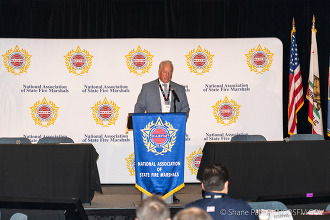
On August 18, FEMA Administrator Cameron Hamilton and U.S. Fire Administrator Paul Matheis addressed fire and life safety leaders during the National Association of State Fire Marshals’ 36th Annual Fire Prevention and Safety Symposium in Garden Grove, California.
The annual symposium brings together state fire officials, code policy experts, life safety leaders and industry manufacturers to discuss emerging hazards, code developments and new safety technologies. This year’s discussions focused on several timely issues affecting communities nationwide, including modern building and fire code developments, wildland-urban interface challenges and battery energy storage system safety.
FEMA Administrator Hamilton opened the symposium virtually and underscored the essential role of local and state leaders in preparing for, responding to and reducing the impacts of disasters. He emphasized that effective emergency management depends on strong partnerships across all levels of government, including the fire service, code enforcement community and public safety officials. U.S. Fire Administrator Matheis reinforced that message, highlighting the critical partnership between the U.S. Fire Administration and state fire marshals in preventing fires, improving life safety and reducing community risk.
State fire marshals are often among the first to identify emerging risks in the built environment. Their work helps reveal where codes are effective, where codes may not be keeping pace with changing conditions and where real-world construction, occupancy, technology or land-use trends may create new hazards.
U.S. Fire Administrator Matheis urged attendees to use every incident as an opportunity to learn before similar events become tragedies. That includes applying better data, stronger fire investigations, improved training, modernized codes and preparedness efforts to support communities in identifying risks earlier and act more effectively.
The U.S. Fire Administration continues to support these efforts through national leadership, education and training through the National Fire Academy, expanded fire investigation capabilities, the National Emergency Response Information System and work to strengthen wildfire evacuation and preparedness planning.
State fire marshals lead critical work to protect lives, strengthen communities, reduce risk and prevent today’s hazards from becoming tomorrow’s tragedies. The U.S. Fire Administration and FEMA will continue to support that work through national leadership, training, data, fire investigation support, preparedness planning and partnerships across all levels of government.
|
Dams are a critical part of the nation’s infrastructure. On August 5, FEMA published a funding opportunity for states and territories to make dams safer. The application period is open until Monday, August 31.
The Fiscal Year 2026 Rehabilitation of High Hazard Potential Dams grant program is open to eligible states, territories and non-governmental organizations. Funding may be used to rehabilitate non-federal dams that are classified as high-hazard potential by their state or territory’s dam safety program. Dams must also be located within communities that participate in the National Flood Insurance Program.
For more information on the funding opportunity, review the full Notice of Funding Opportunity on Grants.gov. Additional information about the National Dam Safety Program is on FEMA's website.
....................................................................................................................................................
Join FEMA for the September Business and Industry Call
FEMA will host the September Business and Industry Call at 3 p.m. ET, Tuesday, September 1. Participants should register in advance through Zoom for Government.
The call will provide updates for National Business Emergency Operations Center members, business and industry organizations, and FEMA partners on tools and initiatives across the disaster lifecycle. Each month features different topics presented by experts from FEMA and other stakeholders.
This month's session will focus on artificial intelligence in business processes, including resources and analysis to support emergency and crisis management while keeping people in control. Presenters will also share practitioners’ perspectives on building organizational capacity and using artificial intelligence to better serve individuals and communities.
If you have questions or want additional information, email OB3I@fema.dhs.gov.
....................................................................................................................................................
FEMA Corps Resumes, Application Period Open for 2027 Class
The FEMA Corps program has resumed and is accepting applications for its next class of future emergency managers. The FEMA Corps program is restarting after being carefully reviewed and refocused to align with FEMA’s core mission and the Trump Administration's priorities. About 80 members and 10 team leaders will be selected to serve from February 2027 to November 2027.
Apply to be a FEMA Corps Team Leader:
Apply to be a FEMA Corps Member:
FEMA Corps graduates may receive an education award upon completion, which can be used for tuition or student loans, and relocation expenses. Additionally, FEMA Corps members receive paid housing and a weekly stipend for food and living expenses, all while being deployed to serve communities in need across the country. To learn more, visit AmeriCorps NCCC.
....................................................................................................................................................
|


