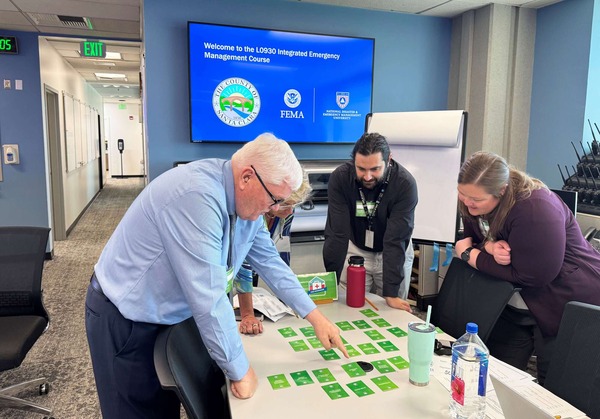
 FEMA’s National Disaster and Emergency Management University recently delivered courses to help four cities hosting FIFA World Cup 2026™ matches keep fans and residents safe.
The four courses—in Santa Clara County and Inglewood, California; Boston, Massachusetts; and Philadelphia, Pennsylvania—brought together local officials, emergency management partners and subject-matter experts to simulate incidents that could happen during FIFA World Cup 2026™ events, letting them practice coordinating, communicating and decision-making in a controlled environment.
Each course covered a range of critical topics, including:
-
Joint Information Centers/Joint Information Systems: Best practices for setting up, collecting and sharing information, with emphasis on large-scale event communications.
-
Family Assistance Center Setup: Guidance on establishing support centers for families during emergencies.
-
Local Recovery Planning: Strategies for post-disaster recovery, tailored to the unique challenges of hosting an international sporting event.
-
Evacuation Planning: Best practices for safe and efficient evacuations, especially for large crowds.
-
Documentation: Techniques for accurate record-keeping during incidents, including those related to event-specific scenarios.
-
Foundations of Emergency Management: Core principles and frameworks for effective response.
-
All-Hazards Emergency Planning: Comprehensive approaches to managing diverse threats, including those relevant to FIFA World Cup 2026™ activities.
-
Incident Command System (ICS) and Emergency Operations Center (EOC) Interface: Integration of ICS with EOC operations to ensure unified command and control during major events.
Jurisdictions also selected additional topics tailored to their needs, ensuring the training addressed local priorities and challenges.
These courses underscore FEMA’s commitment to help communities across the nation build emergency management capabilities and prepare for the unique demands of the FIFA World Cup 2026™.
FEMA continues its renewed commitment to those affected by Hurricane Helene, awarding more than $59 million to eliminate flood risks for severely damaged properties in North Carolina.
The state will use this funding, administered through FEMA’s Hazard Mitigation Grant Program, to buy more than 150 damaged properties in Buncombe, Haywood, Mitchell and Madison counties, bringing needed relief to the homeowners. These awards deliver on a promise made by Secretary of Homeland Security Markwayne Mullin last month during his visit to Western North Carolina.
Funding announced today will cover property acquisitions in the following North Carolina communities:
- 142 damaged properties in Buncombe County for $51.7 million.
- 11 damaged properties in Haywood County for $2.4 million.
- Nine damaged properties in Mitchell County for $2.4 million.
- Three damaged properties in Madison County and in the town of Carrboro totaling $1.38 million.
Property buyouts are critical for individuals who survived the storm, but whose homes were repeatedly damaged by floods or landslides. After a disaster, homeowners are often still required to pay mortgages, property taxes and other expenses on their homes even if they are unlivable. By buying the properties from the homeowners, state and local officials lessen the financial burden on these survivors and ensure that the community is more resilient to future flood damage.
These acquired properties are demolished and deed-restricted, and the land will be returned to green space which maintains natural floodplain functions. This also reduces or eliminates future disaster losses to properties. FEMA coordinates directly with the state on all hazard mitigation projects. This aligns with FEMA’s principles of ensuring that disaster recovery and mitigation is state-led and federally supported.
 On May 2-3, FEMA’s National Emergency Training Center in Emmitsburg, Maryland, hosted the 45th-annual National Fallen Firefighters Memorial event at the National Fire Academy. More than 3,000 people attended the event to honor the men and women who died in the line of duty protecting communities, airports and natural resources.
During the event, 97 firefighters who died in 2025 and 107 firefighters who lost their lives in previous years, were placed on the academy’s Roll of Honor for fallen responders. The ceremony also commemorated the 25th anniversary of 9/11, the firefighters who lost their lives during the response and those who died from 9/11-related illnesses and injuries.
“Your loved ones dedicated their lives to helping others,” said U.S. Fire Administrator Paul Matheis. “And their generosity of spirit, bravery and kindness inspire each of us to live by their example.”
The National Fallen Firefighters Memorial, located on the National Emergency Training Center campus, is the nation’s official monument for honoring firefighters who have made the ultimate sacrifice. The National Fallen Firefighters Foundation hosts the annual event that unites firefighter families, fire service leaders, government officials and supporters for ceremonies of remembrance, reflection and tribute.
On May 7, the FEMA Review Council approved its final report. The recommendations result from approximately a year of meetings, deliberations and public input. They focus on empowering state, local, tribal and territorial governments to assume control over their disaster management and recovery efforts.
The FEMA Review Council members, appointed by President Donald J. Trump, conducted a thorough review of FEMA. Comprised of top disaster response experts, including individuals from states ravaged by recent natural disasters, the Council provided actionable recommendations to streamline federal response to national emergencies. The report and all Council documents are available at DHS.gov/FEMA-Review-Council.
The report provides recommendations to the President. The public can submit comments on the report until June 8 on the Federal Register website, Federal Register: Federal Emergency Management Agency Review Council; Notice of Meeting.
Adjusters seeking authorization to handle National Flood Insurance Program (NFIP) claims can register and attend a six-hour NFIP Claims Adjuster webinar to gain essential training. Successful completion is required to attain a certificate, earn Continuing Education (CE) credit and apply for your Flood Control Number card.
The presentation closely follows the NFIP Claims Manual, ensuring clarity and consistency for adjusters and policyholders alike. This course provides a comprehensive overview of NFIP flood insurance claims handling, policy provisions, adjustment procedures and documentation standards.
This course is approved as 2026 NFIP Claims Adjuster Presentation for six hours of CE credit in multiple states, including Alabama, Arkansas, California, Delaware, Florida, Georgia, Indiana, Kentucky, Louisiana, Mississippi, New Hampshire, North Carolina, Oklahoma, Texas, Utah and Wyoming. CE credits are processed at no charge in one state only. For more information on how to renew or obtain a Flood Control Number, visit National Flood Insurance Program Claim Forms for Adjusters.
Spots are limited, so register now to reserve your spot. To find and register for an available webinar, visit the National Flood Insurance Program events calendar.
Webinar Schedule:
-
Webinar Opens: 9:30 a.m. ET
-
Start Time: 10 a.m. ET
-
Lunch Break: 30 Minutes
-
End Time: 4:30 p.m. ET
How to Register:
- Choose your preferred date and register for one session only.
- After registering, you’ll receive a confirmation email with details and a link to edit or cancel your registration if needed.
- If you do not receive a confirmation email, check your spam folder or contact the NFIP training team.
To edit or cancel a registration, use the link in your confirmation email. For registration help or further information, send an email to FEMA-NFIP-Adjuster-Help@fema.dhs.gov.
FEMA’s Office of Business, Industry and Infrastructure Integration hosts monthly business and industry calls to update organizations and FEMA partners on the tools available during all stages of the disaster lifecycle. The next call will be held virtually from 3-4 p.m. ET., Tuesday, May 19.
May Business and Industry Call Agenda:
- 3:00-3:10 p.m. ET | Opening Remarks
- 3:10-3:30 p.m. ET | Transportation Hours of Service Waivers
- Presented by the Federal Motor Carrier Safety Administration
- 3:30-3:50 p.m. ET | Transportation Oversize/Overweight Permits
- Presented by the Federal Highway Administration
- 3:45-4 p.m. ET | Q&A and Closing Remarks
- Facilitated by FEMA’s Office of Business, Industry and Infrastructure Integration
Each month the calls feature different topics presented by experts from FEMA, other interagency partners and business and industry organizations. For organizations interested in joining the National Business Emergency Operations Center, please visit FEMA.gov/NBEOC.
Webinar Details:
-
Date: Tuesday, May 19
-
Time: 3:00-4 p.m. ET
-
Location: Virtual
-
Registration Link: FEMA Zoom Webinar
Questions for our presenters? Please submit questions to OB3I@fema.dhs.gov no later than May 15.
$1B in Federal Funding to Help States Mitigate Impact of Disasters
On March 25, FEMA published the funding opportunity for the Fiscal Years 2024 and 2025 Building Resilient Infrastructure and Communities (BRIC) program. Through this program, the agency is making $1 billion in federal funding available to states, local, tribal and territorial governments to protect communities from potential disasters like fires, floods, earthquakes and hurricanes. No single applicant may receive more than 15% of the total available funding across all BRIC categories and includes the combined total of all funding category requests. The deadline to submit applications is July 23.
Interested applicants and subapplicants may review the Notice of Funding Opportunity on Grants.gov. For more information on the BRIC program, applicants should contact their FEMA Regional Office or visit the Building Resilient Infrastructure and Communities webpage.
To learn what the new BRIC funding opportunity is specifically designed for and to the view the available categories for the funding cycles through Fiscal Years 2024-25, read the full press release: $1B in Federal Funding to Help States Mitigate Impact of Disasters.
....................................................................................................................................................................
Flood Mitigation Assistance Amendment Notice of Funding Opportunity
Up to $600 million is available to states, local communities, tribes and territories to reduce or eliminate the risk of repetitive flood damage to buildings insured under the National Flood Insurance Program.
The funding opportunity was originally published on January 6, 2025. Then on April 30, FEMA published an amendment to the funding opportunity that incorporates recent federal guidance and aligns with overarching national goals.
Applicants have until 3 p.m. on August 6, to submit or revise and re-submit their application to FEMA. Applications received after this deadline will not be considered. Learn more about this funding opportunity and its recent amendments.
....................................................................................................................................................................
|


