|
|
Newsletter
Our monthly update for everyone interested in health and social care
|
|
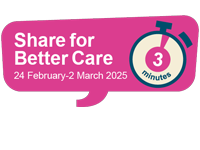
Share for Better Care Week
This week is Share for Better Care Week. Join us to help more people speak up about their care.
Your feedback about health and social care matters. It helps services to spot and identify what’s working well, and what areas need to improve.
You can help make a difference by supporting Share for Better Care Week, which runs until 2 March.
Whether you work in health and social care or receive support from these services, you can play your part by encouraging others to give a few minutes of their time to share feedback about their care.
|
|
|

Join us! Work for CQC
CQC staff have a wide range of skills and work across many disciplines.
Find out about roles within CQC, Healthwatch England and the Office of the National Guardian.
Current vacancies include:
- Inspectors (various specialisms and regions)
- Deputy Clinical Director, MNSI
- Policy Manager
- Specialist Advisor
Benefits include generous leave entitlement, NHS or Nest pension schemes and a wide range of employee discounts.
Most roles offer flexible locations with the choice to be home-based. See the individual job listings for more information.
|

Tell us what maternity care was like for you in 2025
CQC’s 2025 national maternity survey is happening soon. The annual survey asks women and other people who have used maternity services about their experience of maternity care.
NHS hospital trusts will be inviting people to take part in this year’s survey from April. Taking part is voluntary and all answers are confidential and anonymous.
Nicola Wise, our Director of Secondary and Specialist Healthcare, said:
“If you are invited to complete the survey, we really want to hear from you. We need you to tell us what works well and what you think needs to change. Please help us to drive the action required, so everyone using maternity services can have a positive experience every time.”
If you are invited to take part, you will be sent a letter from the NHS hospital trust where you received your maternity care. The letter will include a link to complete the survey online. It will also explain how to complete the survey in an alternative format if you prefer.
|

Our response to the Care Provider Alliance's review of the single assessment framework
We have given our response to the Care Provider Alliance's review of our single assessment framework.
We commissioned the review last autumn to gather the views of adult social care providers about the assessment framework and ask what they want from regulation. This work sits alongside the review by Professor Sir Mike Richards.
The Care Provider Alliance's report is built on feedback from over 1,200 survey respondents and the views of more than 100 providers shared through 5 workshops.
Sir Julian Hartley, our Chief Executive, said:
“We welcome this report which has been instrumental in ensuring we hear the voices of a wide range of adult social care providers, as the findings are a robust reflection of their views and experiences.”
The report includes 11 recommendations and key messages from the survey, which we will now review in more detail to consider their implementation. Some recommendations will be subject to further discussion, policy change or consultation.
We are determined to improve providers’ experience of regulation through developing a handbook which describes what we expect from providers, what they can expect from CQC, as well as giving our staff the tools and time to do their job. We are strengthening sector leadership in CQC and want to continue to work with the CPA to oversee progress. This report provides a good agenda for shared work over the coming months.
|

New framework launched to help integrated care systems reduce inequalities
Working in partnership with National Voices and the Point of Care Foundation, we have developed a self-assessment and improvement framework for integrated care systems (ICSs) to help them address health inequalities.
The aim of the framework is to support ICSs to improve how they tackle health inequalities through honest conversations, gathering insights and developing practical actions through engagement linked to people and community strategies.
The framework is the result of extensive co-design, involving input from public health practitioners, ICS leaders, engagement experts, voluntary, community and social enterprise (VCSE) partners, and people with lived experience.
This work was funded with a grant from the Regulators’ Pioneer Fund. The fund is currently being delivered by the Department for Science, Innovation and Technology (DSIT).
|

Do you work in health or social care?
Sign up to our other newsletters and follow us on X/Twitter to make sure you always get the latest information from us.
|
|
|