|
 |
|
Oct/Nov 2024: Issue 23
In this issue
- Rock to Road
- GPS Maps the Future
- A Roadmap to Paving
- I-35 NEX Central Progress Report
- Active Construction Sites
- Contact Us
|
The I-35 Northeast Expansion (NEX) Program covers approximately 20 miles of I-35 from N. Walters Street to FM 1103 in Bexar, Comal, and Guadalupe Counties. The I-35 NEX Program–including Central, South, and North projects – involves the construction of two elevated structures that will carry two general purpose lanes and one HOV lane in each direction. The elevated structures will be constructed between the existing I-35 mainlanes and frontage roads. The program also includes incidental construction necessary to transition the elevated lanes and connectors with the existing highways including revisions to ramps and frontage roads and accommodations for drainage, utilities, signs, and other highway improvements.
|
|
|
At peak construction, the team on the first phase of I-35 NEX South Project (one of five projects that make up the 20-mile I-35 NEX corridor), will pour 40 mixer trucks of concrete a day, each with a capacity of 10 cubic yards.
Volume alone would make having a dedicated concrete plant for the project useful. But it’s precision that makes the plant necessary. The plant produces mixes based on TxDOT specifications for different applications.
A mix includes one or more of five different types of aggregate, from one-inch crushed rock to silica sand. The video above shows two sizes of rock and two grades of sand going into a batch. (Click on the photo to play the video.) The binder can be cement, fly ash, or slag. And there are seven chemicals that can be added to change the way a batch cures and its finished properties, like durability and load-bearing capacity. Those ingredients are mixed with water from an insulated tank with a 90-ton chiller that keeps it cooled to 35 degrees.
Concrete Fun Fact:
Concrete is the second-most-used substance in the world after water, and it is the most widely used building material. Ton for ton, concrete usage is twice that of steel, wood, plastics, and aluminum combined.
|
|
|
Your GPS telling you to exit in 100 feet is fine for driving directions.
However, that level of accuracy is not very useful when you’re building an exit ramp.
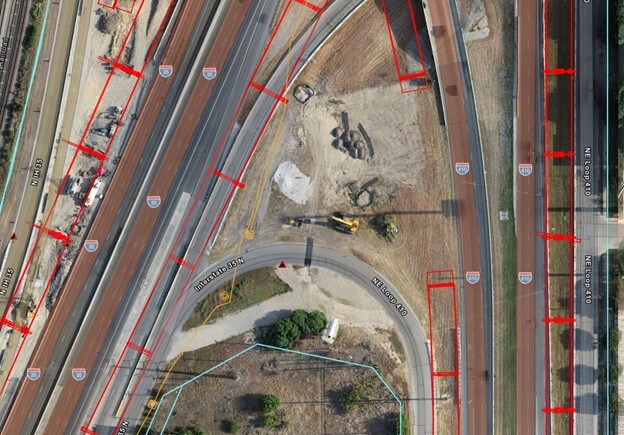
Still, did you know that GPS (Global Positioning System) is a critical highway construction tool? By combining GPS signals with the beacon from its base station, a drone can map points to centimeter-level precision.
The drone takes thousands of pictures that are stitched together and overlaid on commercial satellite maps and engineering plans, providing a high-definition view of the state of construction at a moment in time, with context for the surrounding area provided by the commercial map. The red marks on the photo below show where elevated roadway will be built.
Survey crews on the ground verify the accuracy of the data and ensure that all measurements meet the required standards and specifications.
That level of precision and accuracy are critical when the project involves building roadways 50 feet off the ground that connect in midair with spans built by another company, as we’re doing on I-35 NEX.
Fun Fact: “precision” and “accuracy” are often used interchangeably, but they have distinct meanings.
Precision refers to the consistency of a measurement.
Accuracy refers to how close a measurement is to the true value. The survey crews verify that the very precise drone data is accurate.
|
|
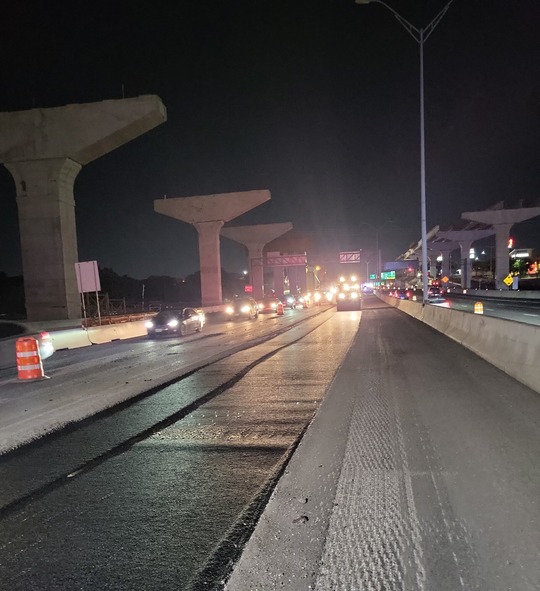
Repaving, also called milling and overlay, is a two-step process in which the top layer of asphalt is "milled" or removed, and a new, fresh layer of asphalt is laid, the "overlay," which creates a new, smooth driving surface.
One lane of milling, typically covering 4,000 feet or three-fourths of a mile, takes place in one night. But milling is more than just removing the top two inches of asphalt. Inspections and repairs of the base layer, which can go as deep as six-and-a-half inches, along with any repairs to drainage, are done. This process takes one whole night of work. So, if there are four lanes on the road, the 4,000-foot-long section will require four nights for the milling process.
The following night, the milled lane is paved with new asphalt while the next lane is simultaneously milled and repaired. The process is repeated until all lanes are done.
Another reason milling and paving are not done in one night is to avoid any current or future problems on the new lanes. Milling and paving the same night would add more seams between the new lanes of asphalt, which are associated with poorer-quality roads, uncomfortable driving, and potential maintenance issues in the long run.
There is also the issue of efficiency: milling and paving the same night would only accomplish about half the distance, thus doubling the amount of time for the operation and extending construction time.
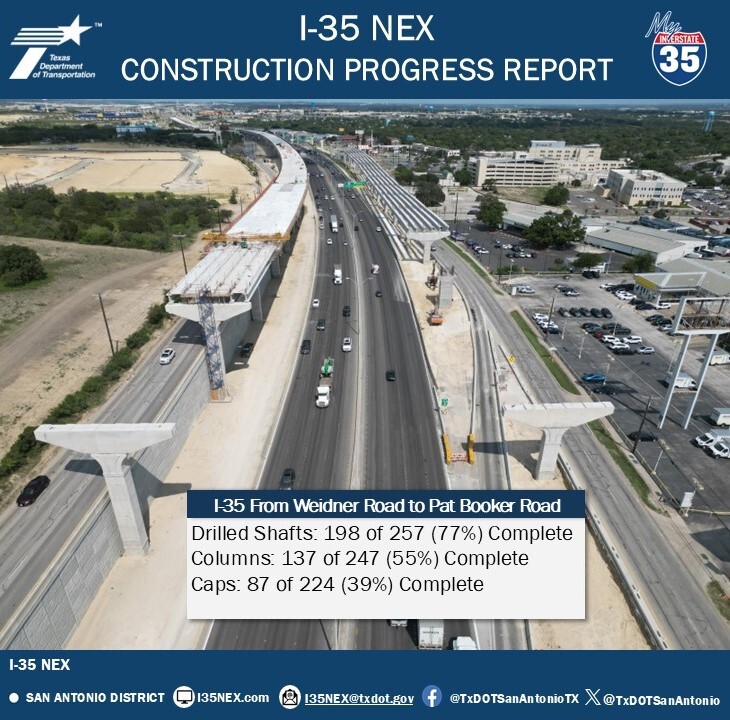 There are more completed drilled shafts, columns, and caps from Weidner Road to Pat Booker Road, both northbound and southbound, than any other stretch of the I-35 NEX project. This photo was taken looking north from the area near Methodist Hospital Northeast.
Below is a list of notable active and upcoming construction work. Click on maps for more information. Please note that closures are subject to change.
|
|
 |
|
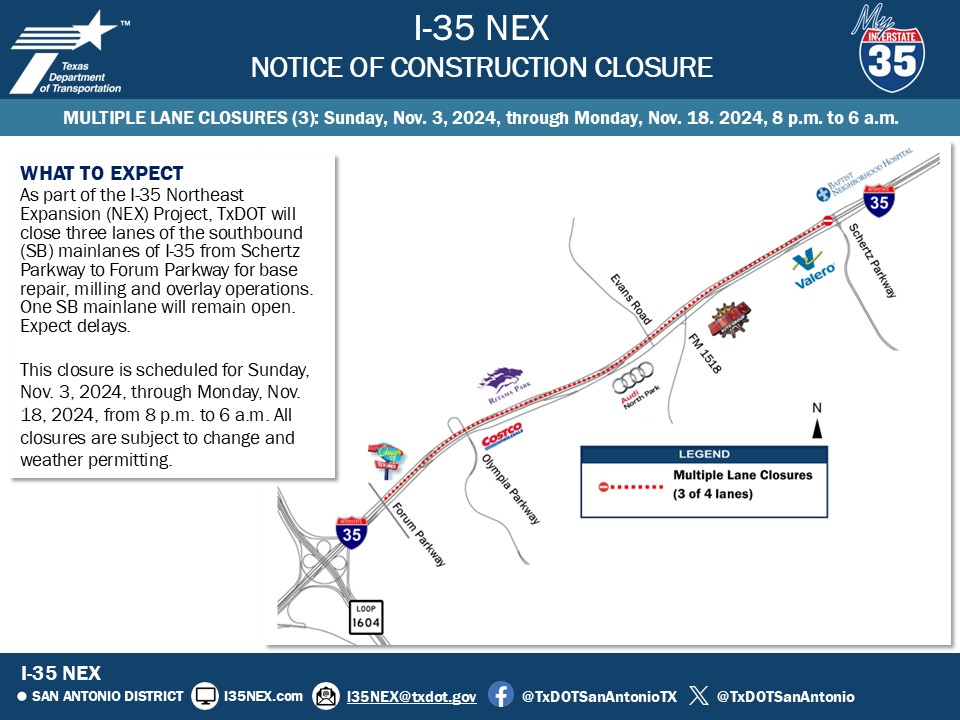
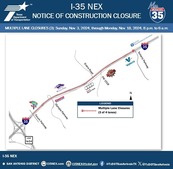
Three lanes of the southbound mainlanes of I-35 from Schertz Parkway to Forum Parkway will be closed for base repair, milling and overlay operations. One southbound mainlane will remain open. Expect delays.
This closure is scheduled for Sunday, Nov. 3 through Monday, Nov. 18, 2024, from 8 p.m. to 6 a.m.
|
 |
|
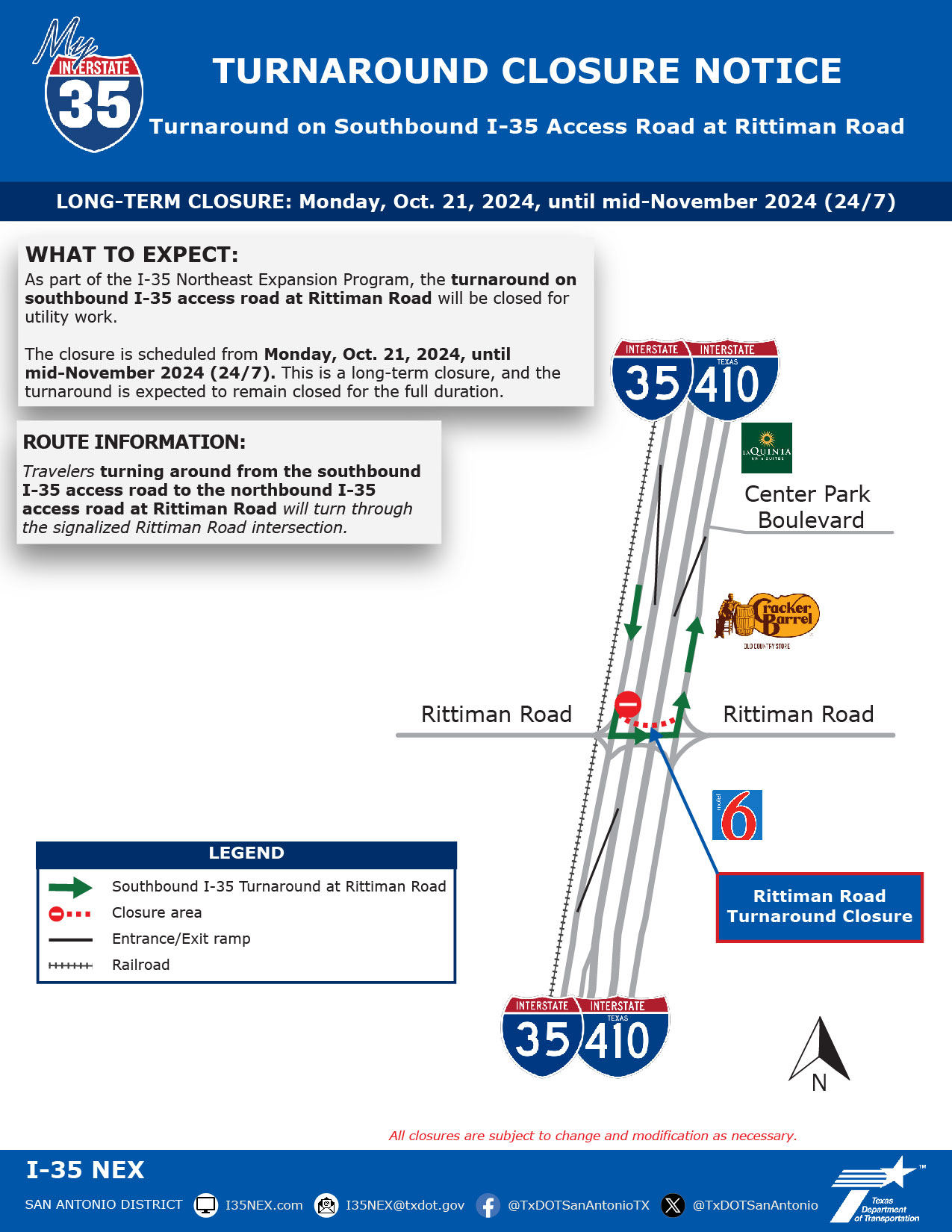
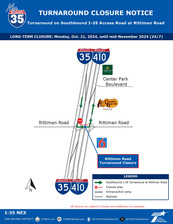
The turnaround on southbound I-35 access road at Rittiman Road will be closed for utility work.
The closure is in progress until mid-November 2024 (24/7). This is a long-term closure, and the turnaround is expected to remain closed for the full duration.
|
 |
|
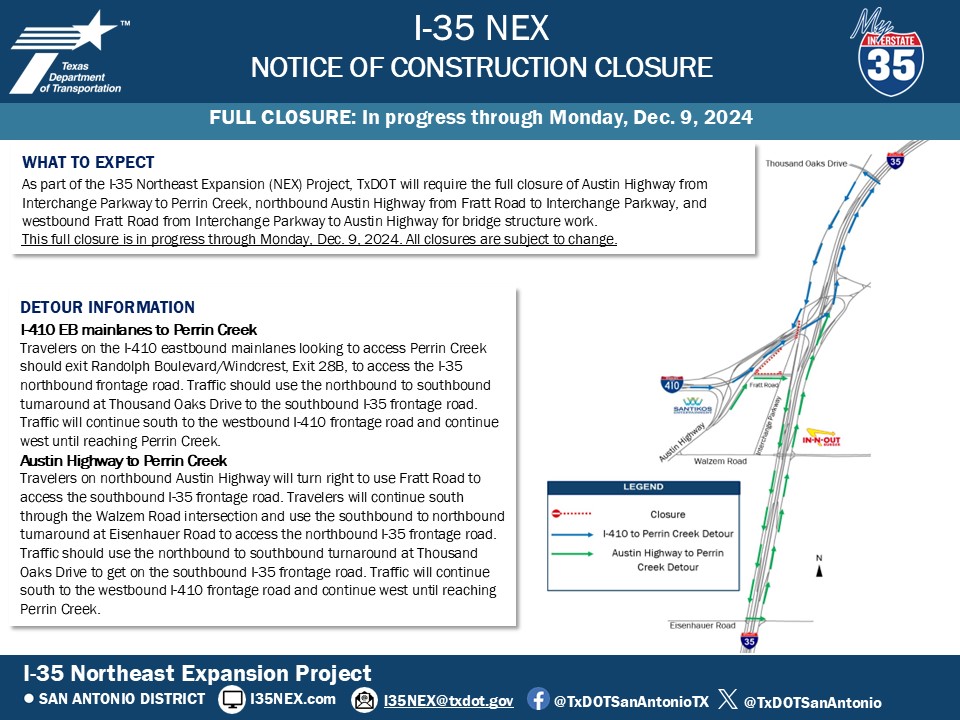
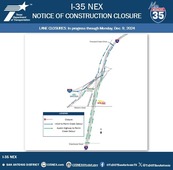
Full closure of Austin Highway from Interchange Parkway to Perrin Creek, northbound Austin Highway from Fratt Road to Interchange Parkway, and westbound Fratt Road from Interchange Parkway to Austin Highway for bridge structure work.
This full closure is in progress through Monday, Dec. 9, 2024.
|
 |
|
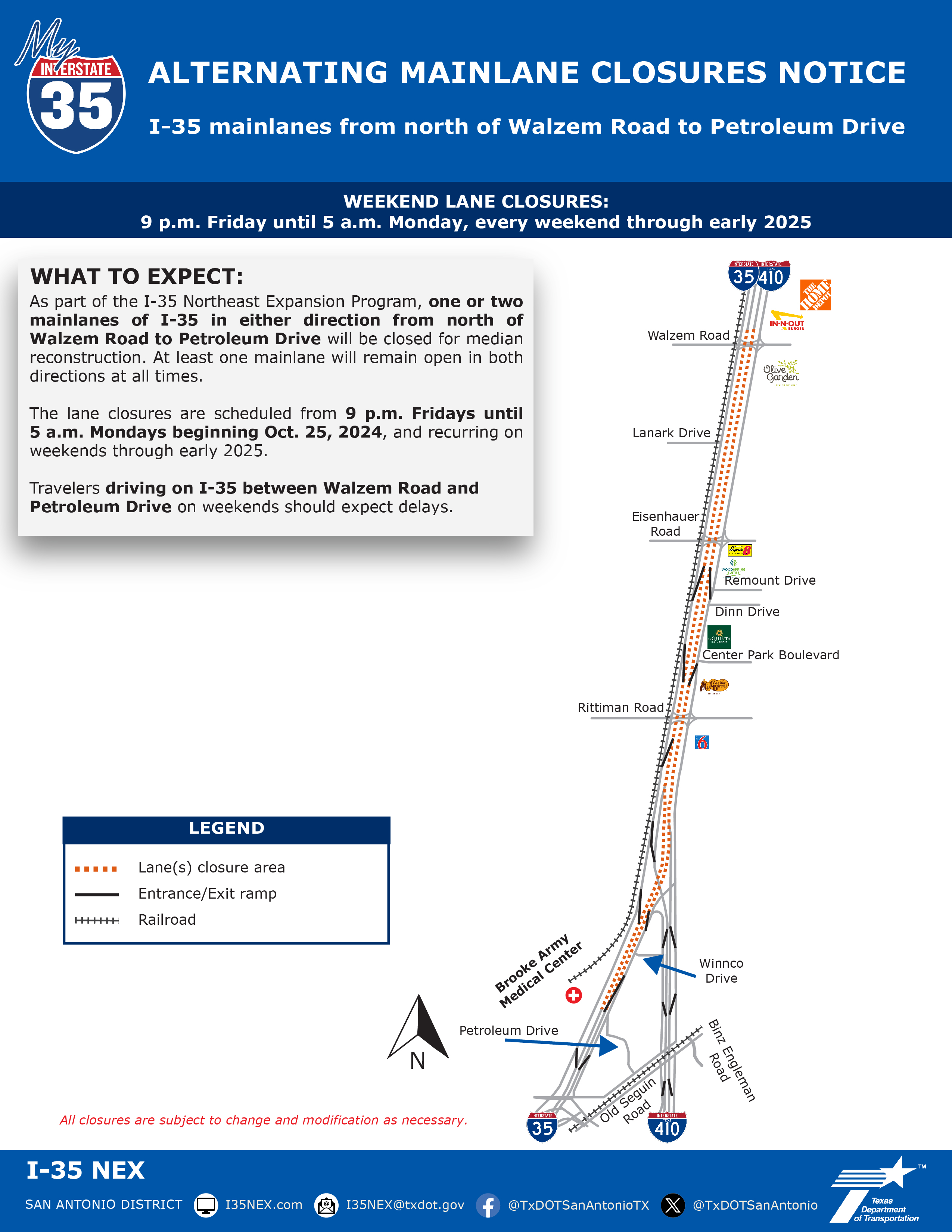
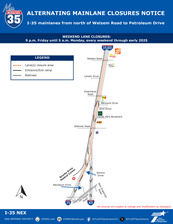
One or two mainlanes of I-35 in either direction from north of Walzem Road to Petroleum Drive will be closed for median reconstruction. At least one mainlane will remain open in both directions at all times.
The lane closures will occur on weekends (Friday through Monday) 9 p.m. until 5 a.m. through early 2025.
|
 |
|
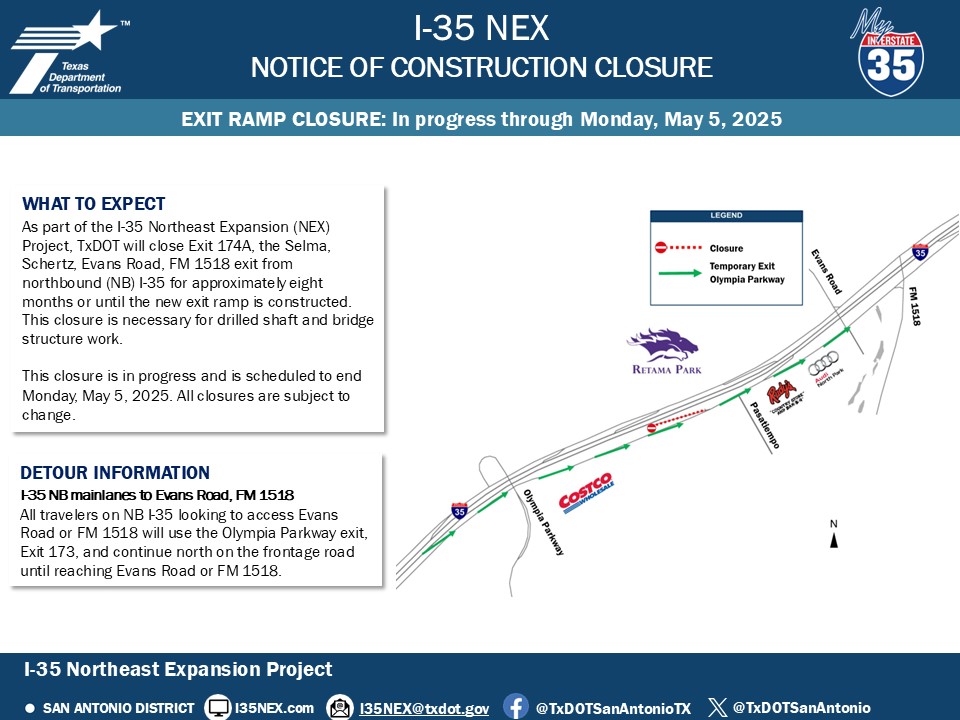
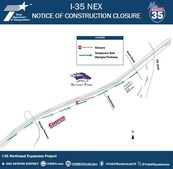
Exit 174A, the FM 1518/Evans Road exit on northbound I-35 will be closed for approximately eight months or until the new exit ramp is constructed. This closure is necessary for drilled shaft work.
This closure is in progress and is scheduled to end Monday, May 5, 2025.
|
|
|
|
TxDOT San Antonio District
Public Information Office
4615 NW Loop 410
San Antonio, TX 78229
|
|
E-alert
Sign up for weekly lane closure notices and newsletters by emailing us at i35NEX@txdot.gov
|
|
Scan here to access our website.

|
|
|
|
|