|
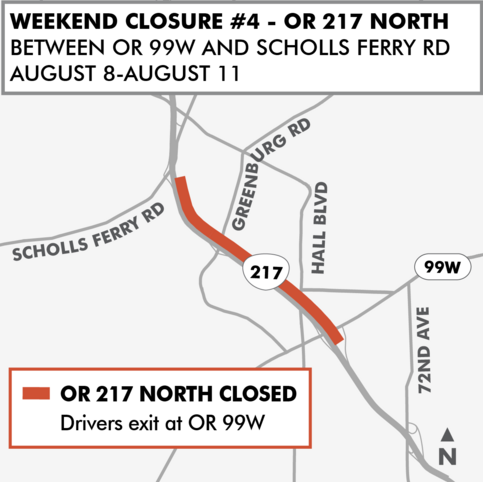
This section of northbound OR 217 will close for the weekend Aug. 8-11 as final paving continues the Auxiliary Lanes Project.
Northbound OR 217 to close from OR 99W to Scholls Ferry Road weekend No. 4 of paving
News media contact: David House, 503-551-8641
Highway will close at 9 p.m. Friday, Aug. 8, and reopen by 5 a.m. Monday, Aug. 11
Aug. 4, 2025
TIGARD – Northbound OR 217 will close from OR 99W to Scholls Ferry Road from 9 p.m. Friday, Aug. 8, to 5 a.m. Monday, Aug. 11 for paving.
This is the fourth of five weekend closures in the Auxiliary Lanes Project. We scheduled the fifth and final weekend directional closure for Aug. 15-18 on the same northbound section of the project.
Paving and striping are dependent on weather and equipment availability, which means details may change. Please check Tripcheck.com for current travel and closure information on Oregon highways. You can also sign up for email updates on the project website.
During this weekend’s closure, all northbound drivers will exit OR 217 at OR 99W, and these ramps will be closed:
- OR 99W on-ramps
- Greenburg Road off-ramp
- Greenburg Road on-ramp
- Scholls Ferry Road off-ramp
Detour
The recommended detour is to use Interstate 5 through Portland, Interstate 405 and U.S. 26.
Background
The OR 217 Auxiliary Lanes project will improve safety and reduce bottlenecks on the highway by adding auxiliary lanes, or ramp-to-ramp connections, between Beaverton-Hillsdale Highway and OR 99W. We are also making targeted improvements to local bicycle and pedestrian routes.
Work began in 2021 and is on pace to finish on time by the end of 2025. The $174 million project is funded mostly by House Bill 2017. The City of Beaverton and Washington County also contributed money toward the project.
ODOT funding crisis
While ODOT’s funding crisis is having a profound impact on maintenance and operations, most projects will continue. These projects are typically funded through separate programs, often with state or federal funds that are legally restricted to project development, and cannot be used for maintenance or day-to-day operations.
|