Rising Costs
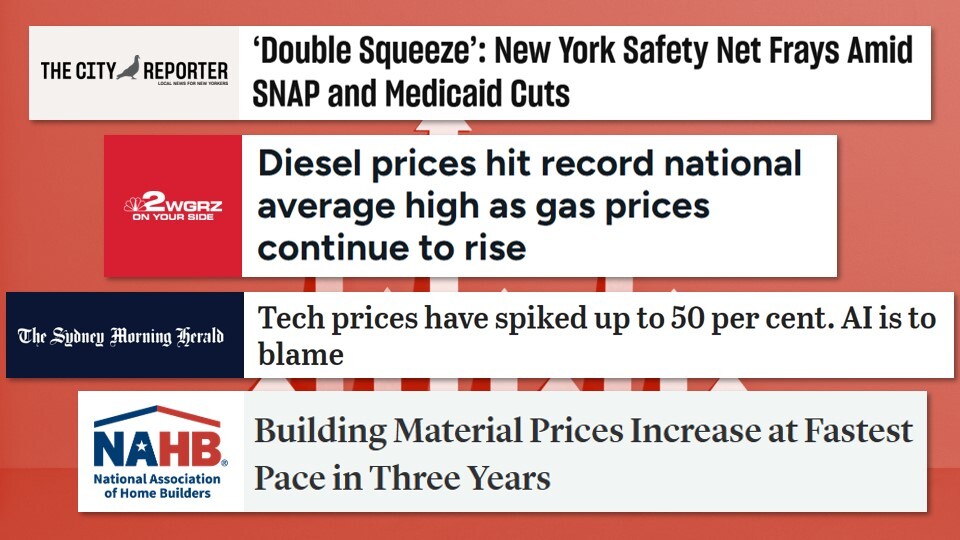
In 2027, federal cuts to SNAP will result in a $1.4 million loss in SNAP administrative revenue, along with an estimated $1.7 million in SNAP program obligations that begin accruing in the fourth quarter. For the first time, the County is expected to directly finance a portion of the benefits that appear on residents’ SNAP cards — an unprecedented shift in responsibility by the federal government to pay for tax cuts benefitting wealthy households the most.
The U.S. war in Iran is driving up fuel costs to heat County buildings and power vehicles, buses, and heavy machinery. (We’re projecting a $170K increase for diesel-powered vehicles, alone.) The County’s energy bills would be even higher without our ongoing investments in solar and electrification, which we will continue to expand to reduce energy costs and protect the planet.
At the same time, information technology costs are surging, with global AI‑driven demand causing some computer parts and equipment to triple in price. And bridge repairs and other capital projects have become significantly more expensive due to tariffs and the trade war with Canada. The capital reserves we established in 2024 and 2025 are helping cushion the impact on debt service, but the underlying cost pressures remain substantial.
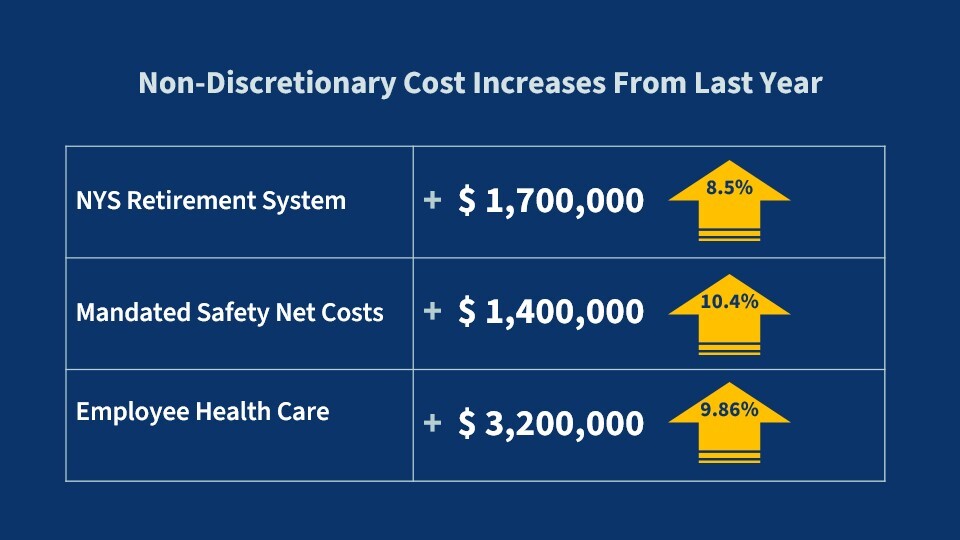 We’re also seeing a significant increase in a number of non-discretionary costs in 2027, including:
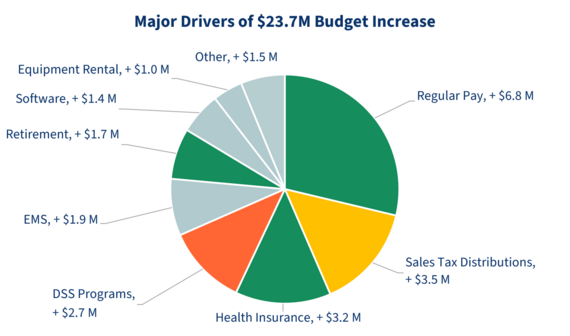
- NYS Retirement System: a nearly $1.7M increase — up 8.5% from 2026 and 23% from 2025;
- Mandated Safety Net Costs: an additional $1.4M — over a 10% increase;
- Employee healthcare: $3.2M — a nearly 10% increase.
Budget Overview
We have kept property taxes flat for many years even as economy-wide costs have risen year after year. This is simply no longer sustainable.
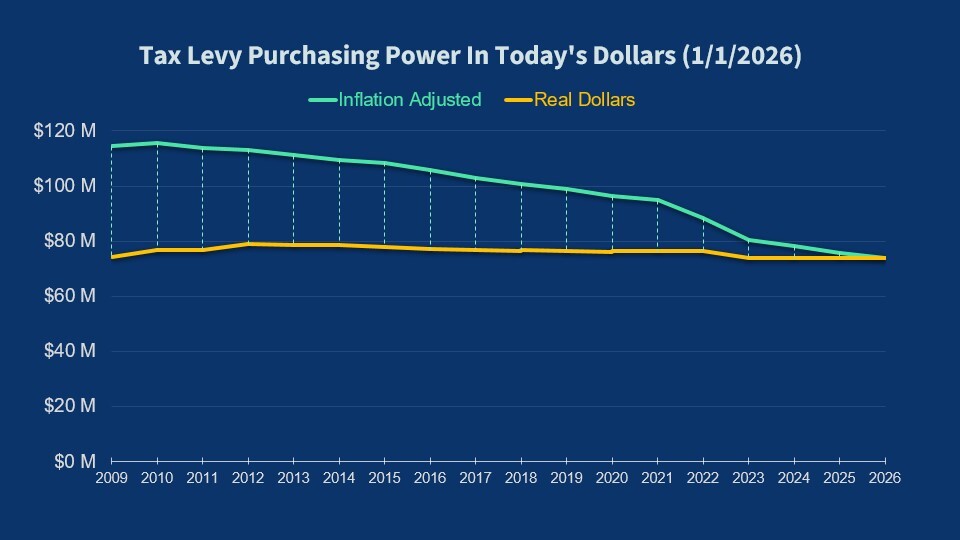 To help keep us on a sound fiscal footing, the Executive Budget includes a 1.5% increase in the property tax levy. While household valuations vary greatly, the increase for many homeowners would be approximately $20.
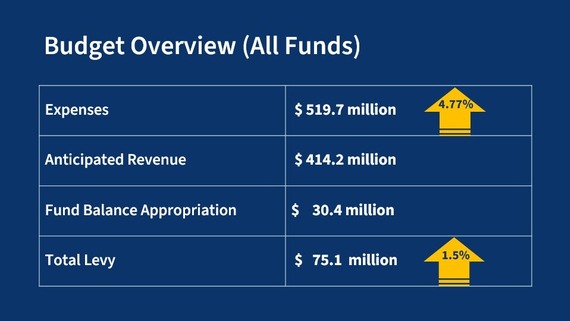 The 2027 Executive Budget totals $519.7 million, a $23.7 million increase from 2026. Many of these costs are covered by increased revenue
Ulster County currently has an unrestricted general fund balance of $73 million as of December 31, 2025.
Cost Management
Staffing
 The 2027 Executive Budget carefully balances fiscal responsibility with staffing needs to maintain essential services across mental health, public health, public safety, transit, infrastructure, emergency response, and more.
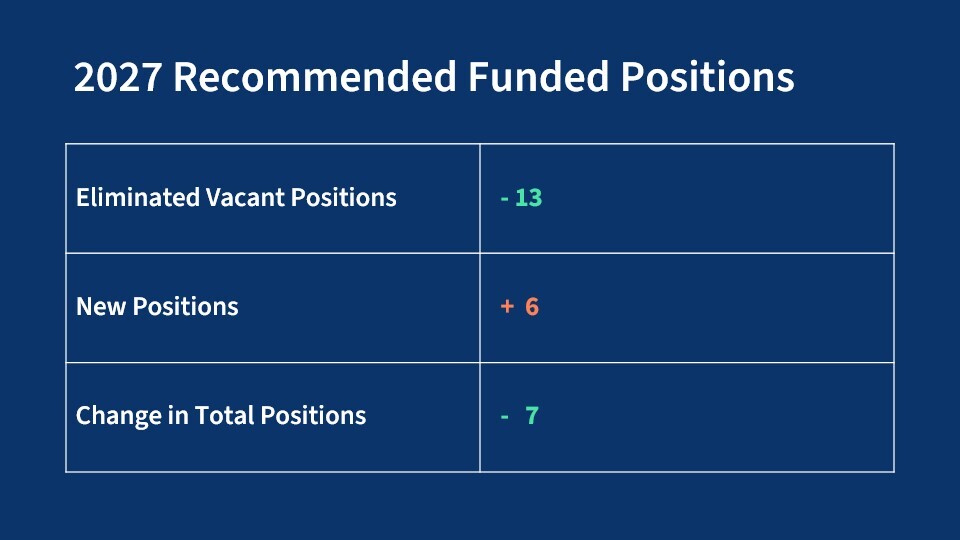
To help control costs, the Legislature enacted a freeze on new positions under Resolution 457. The 2027 Executive Budget goes further by reducing the total number of funded positions, eliminating 13 vacant positions while adding six new positions for a net reduction of seven. The six new positions are either state- or federally-funded or meet needs consistent with Resolution 457.
Reining in Overtime Pay
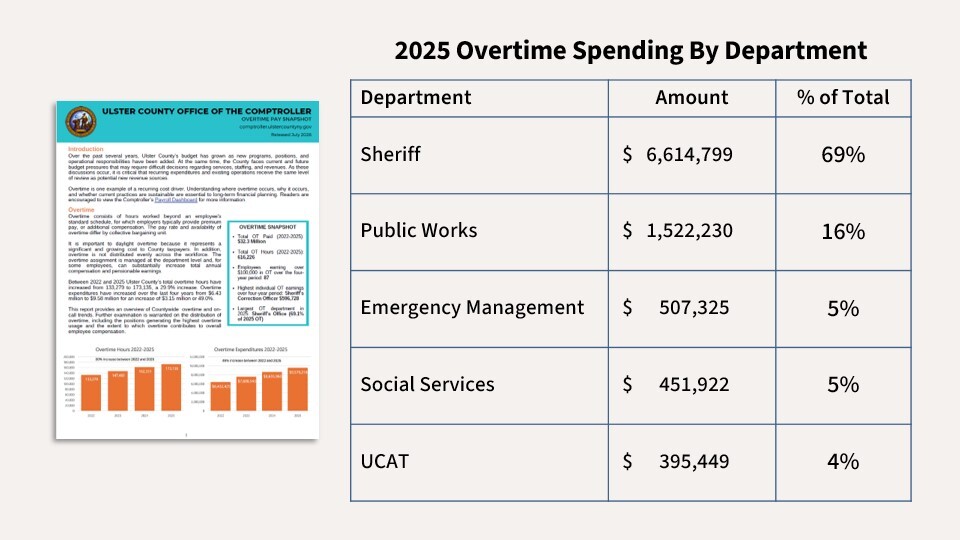 In July, County Comptroller March Gallagher issued a report documenting a nearly 30% increase in overtime hours from 2022 to 2025.
It's important to keep in mind that for certain types of work, overtime can be an operational necessity for reasons of public safety. This is why Sheriff's personnel, DPW road crews, and Emergency Services rank first, second, and third in overtime spending.
The new salary plan and new labor contracts should help us fill vacancies, which will reduce the need for overtime, and we are doing more across our many departments through scheduling and management practices. In this budget, we have cut overtime by nearly 4% from 2026, saving $250,000 from 2026 adopted budget levels.
Programmatic Priorities
Combatting Domestic Violence
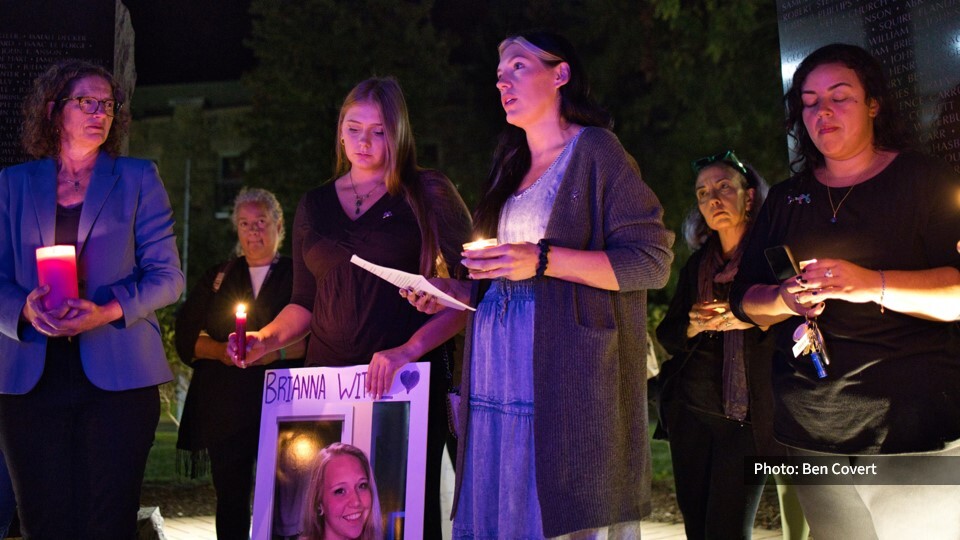 Domestic violence is by far the most common form of violent crime in Ulster County, accounting for more than 80% of individuals receiving support from Ulster County’s Crime Victims Assistance Program. Ulster County continues strengthening its multidisciplinary approach to domestic violence through earlier intervention, improved protection, and stronger accountability.
Key initiatives in the 2027 Executive Budget include:
- Implementation of Lethality Assessment Protocol (LAP) training to ensure all law enforcement agencies are trained to assess danger on scene and connect high-risk individuals to immediate support through a new “LAP line” that will be created for this purpose: $250,000.
- Establishment of a Domestic Violence Task Force to center survivor input and identify gaps in prevention and protection.
- Recommendation that the next round of Housing Action Fund grants incentivize affordable housing for survivors and their children.
Educating the Public About Kratom
 The Executive Budget dedicates $25,000 in opioid settlement funding for the Department of Mental Health to launch a public education campaign on kratom, ensuring residents understand what it is, the risks associated with its use, and where to get help.
E-mobility Public Education
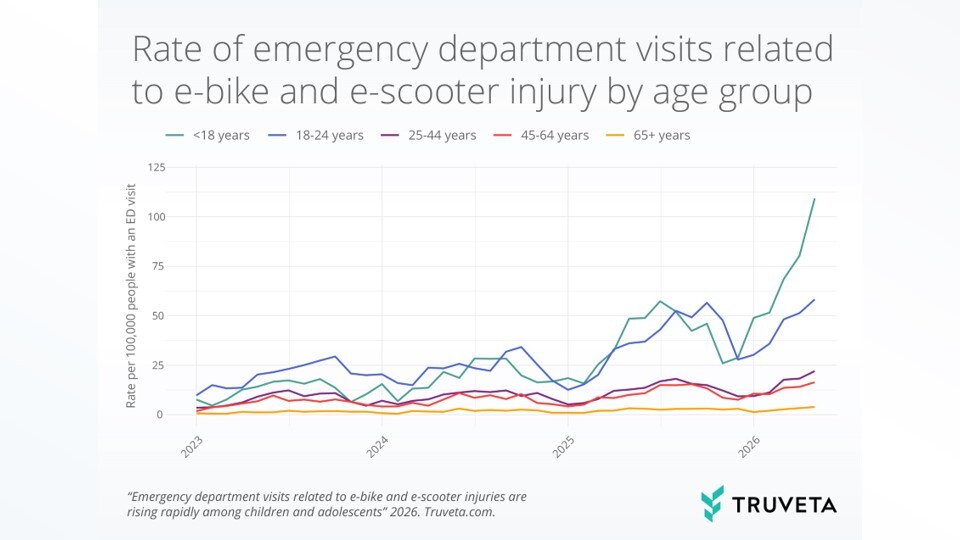 E-bike use is rising, along with conflicts, crashes, and serious injuries — especially among young riders.
The Executive Budget dedicates $15,000 in traffic safety funding to a County-wide e-bike safety campaign to ensure young people, drivers, and riders understand both the law and the risks.
Supporting Our Emergency Food System
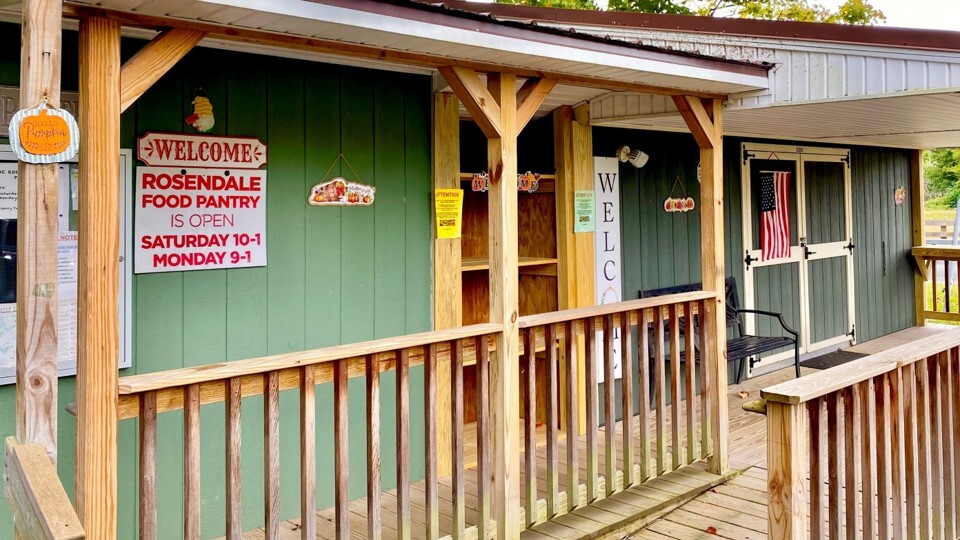 Rising food and energy costs are straining household budgets, and food pantries are seeing increased demand with fewer residents receiving SNAP benefits due to stricter eligibility requirements from the federal government.
The Executive Budget includes funding for emergency food system grants to local pantries, and adds a new category to support Victory Gardens at community centers to help residents grow and share fresh, affordable food.
-
Emergency food grants — Funding continued in 2027: $250,000
Addressing Emergency Housing Challenges
 Ulster County continues to face rising emergency housing needs, with growing reliance on motel placements due to limited housing options and state requirements.
In 2027, the County is advancing a more stable, supportive emergency housing system by:
- Moving forward with $2 million in Housing Action Fund-supported family shelters developed by HONOR and Community Housing Innovations, reducing long-term dependence on motels by creating smaller, community-based shelters that keep families close to schools, jobs, and support networks.
- The Executive Budget establishes a new Emergency Housing Coordinator to work directly with motels, conduct regular on-site inspections, and coordinate rapid response to issues: $62,000
Investing in Permanent Solutions: Housing Our Residents Can Afford
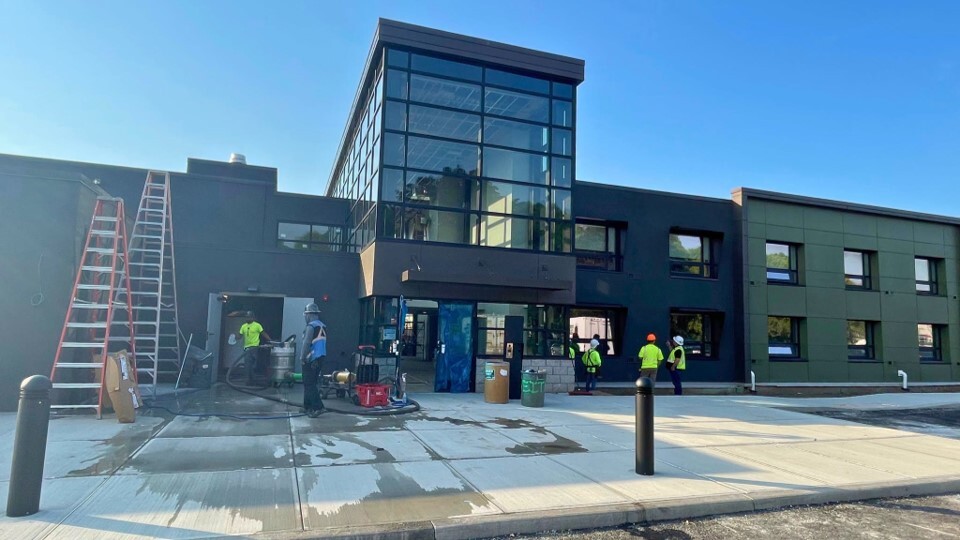 The County’s Housing Action Fund is one of our strongest tools for building homes our residents can actually afford. It supports affordable homes for our lowest-income neighbors and working families priced out of today's housing market, and has expanded supportive housing for people moving out of chronic homelessness, like with RUPCO’s Willow Landing, which will begin leasing next month!
The County continues major investments through the Housing Action Fund to build affordable, supportive, and workforce housing, with a 2027 annual allocation of $2 million.
Supporting Our Working Parents
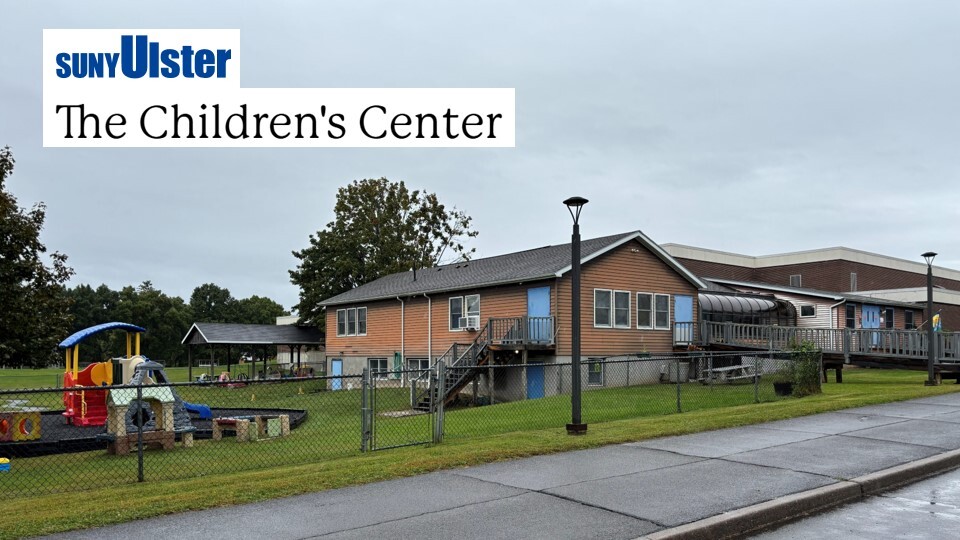 Since 2007, Ulster County has seen a 45% decline in licensed childcare providers, straining the budgets of working families and preventing primary caretakers, most often mothers, from returning to the workforce.
The Executive Budget pilots a home-based childcare start-up program and includes in the proposed Capital Plan a new Children’s Center at SUNY Ulster to expand affordable childcare options for working families.
-
Childcare start-up program – training, certification, and support: $130,000
-
SUNY Ulster Children’s Center – expanded on-campus childcare; a recommendation of the Reimagining SUNY Ulster Committee: $5.25 million (50% state share, 50% County share)
Preparing Our Future Workforce for Success
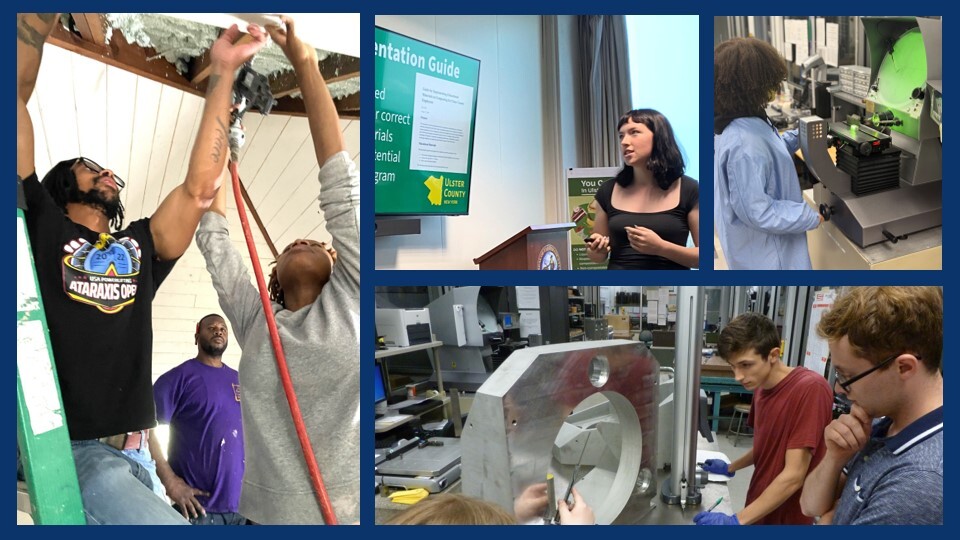 In partnership with NoVo in Kingston, the Ulster County Office of Employment and Training will launch the Ulster YouthWorks Academy, a 24-week program to provide high school-age youth and young adults with mentorship, coaching, skill-building, and paid, hands-on job experience in partnership with local employers. Grant-funded; zero County share.
Increased Support for SUNY Ulster
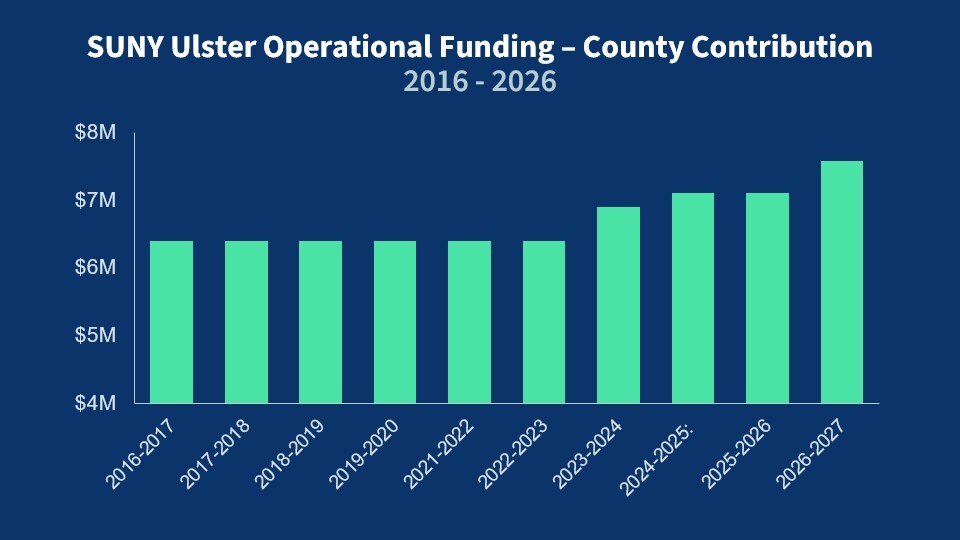 The Executive Budget increases operational support for SUNY Ulster (a $475,000 increase for the 2026-2027 academic year), and advances capital projects aligned with the Reimagining SUNY Ulster Committee’s recommendations.
Since 2023, Ulster County has increased funding by 18.5%, reflecting the County’s strong commitment to affordable educational opportunities for our residents.
Strengthening Workforce Pipelines & Expanding Local Job Opportunities
 Under Economic Development Director Leslie Wellington and Office of Employment and Training Director Sharon Williams, the County is launching sector-by-sector mini-summits with SUNY Ulster, SUNY New Paltz, Ulster BOCES, and industry leaders, culminating in an Economic Futures Summit in the spring of 2027 that will shape the County’s Economic Development Strategic Framework and strengthen workforce pipelines.
New & Improved DMV Services
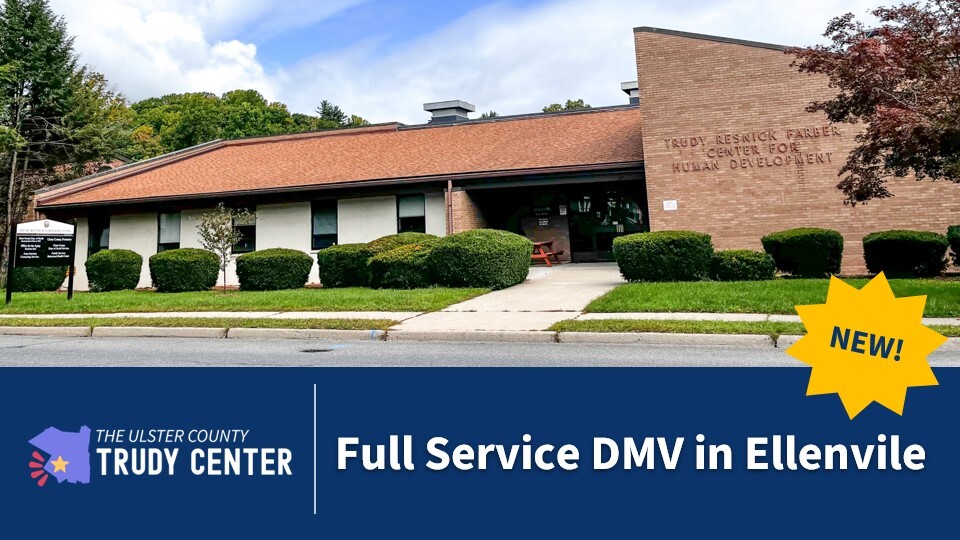 In partnership with County Clerk Taylor Bruck, the Executive Budget proposes to open a full-service DMV office at the Trudy Farber Center in Ellenville, and reorganize mobile DMV services by retiring the bus and bringing services into municipal buildings. These changes would enable expanded services and improve the overall experience of DMV customers, and are proposed to be rolled out in the second half of 2027.
- Full-time DMV Supervisor position: $77,410
Ulster County is ThinkingDIFFERENTLY
 The Executive Capital Improvement Program adds $300,000 annually to make County programs, services, and facilities more accessible by people of all abilities.
|