Freshwater Fishing, Fisheries Management, and Fishing Access News
In This Issue:
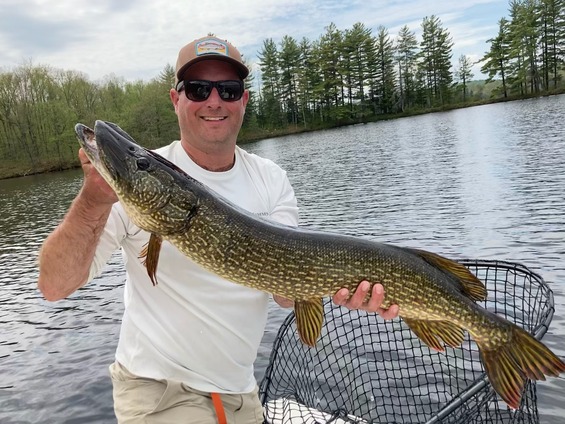
May 1st is the statewide season opener for most of the coolwater sportfish species in New York. This includes walleye, northern pike, chain pickerel, and tiger muskellunge. (Muskellunge season opens on June 1 for inland waters and June 15 for Great Lakes and Tributaries.)
Spring is one of the best times of year to fish for these species because not only are they feeding aggressively, but they’re usually found in shallower water during and just after their spawning season. Effective baits for walleye can include artificial lures such as jigs, crankbaits, stickbaits, as well as live bait harnesses. For northern pike casting swimbaits, crankbaits, spinnerbaits and spoons along and around structure works well in the spring.
Learn more about fishing for these toothy predators:
How to Fish for Walleye
Walleye Fishing in New York
Pike, Pickerel and Tiger Musky Fishing in New York
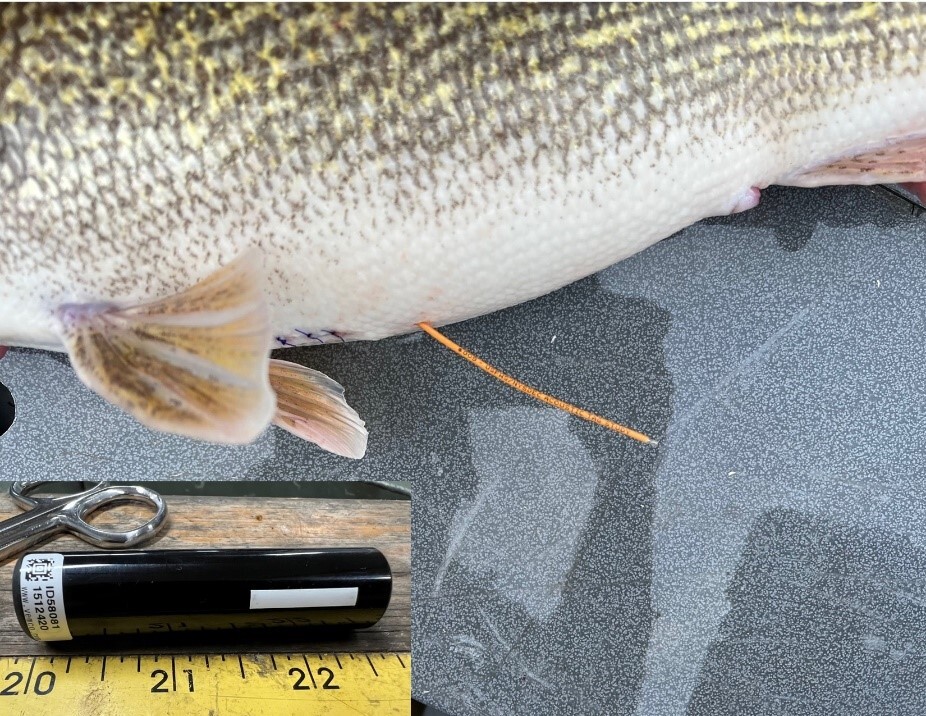
Several walleye in the St. Lawrence River and Lake Ontario have a two-inch long acoustic “tag” inside its abdomen and an orange Floy® tag sticking out of its belly. The tagged walleye are from spawning runs in the Black River, Chaumont River, Kents Creek, Oswegatchie River, Brandy Brook and Little Sucker Brook and are being detected by the numerous acoustic receivers that are deployed throughout the system on the bottom of the river and lake.
The tagged walleye are part of a U.S. Fish and Wildlife Service (USFWS) and DEC Region 6 Fisheries walleye acoustic telemetry study that is helping us to better understand walleye populations in the St. Lawrence River and the Eastern Basin of Lake Ontario. The study will provide information on walleye movements, use of important spawning sites, and how different spawning populations mix within the system. This information is important for management and habitat restoration decisions needed to protect and enhance this important fishery.
If you catch a walleye with the orange Floy® tag sticking out of its belly, it is one of the fish tagged for this study. You are not required to release the fish, but we strongly encourage it. Releasing it will allow the fish to continue to be part of the ongoing research project as the tags have a ten-year battery life. If you catch a tagged fish or harvest a tagged fish, please report the tag number and capture location to the USFWS at 607-753-9334.
 |
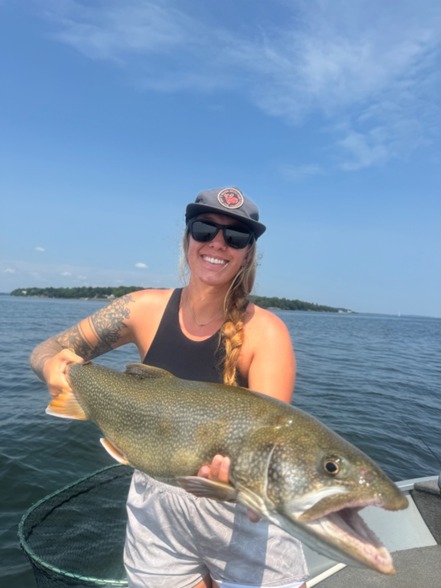
Thanks to a successful, decades-long collaborative effort between DEC, Vermont Fish and Wildlife Department and the U.S. Fish and Wildlife Service, lake trout are restored to Lake Champlain. As a result, the wild population no longer needs to be augmented by hatchery-reared fish, and stocking will end after this spring. The lake trout restoration program began in the 1950s when the state agencies began stocking the lake annually with yearling lake trout. It quickly became apparent that invasive sea lamprey were severely impacting the population. A sea lamprey control program was established in 1990 which involved adding physical barriers in Lake Champlain tributaries, applying lampricides that target and kill larval sea lamprey before they prey on fish and trapping and removing adults before they can spawn. Fortunately, wounding rates on lake trout have decreased significantly thanks to these efforts. The health of the lake trout population will continue to be monitored, and a plan will be prepared which will include benchmarks for reinstituting stocking should wild lake trout numbers appear to be declining.
 |
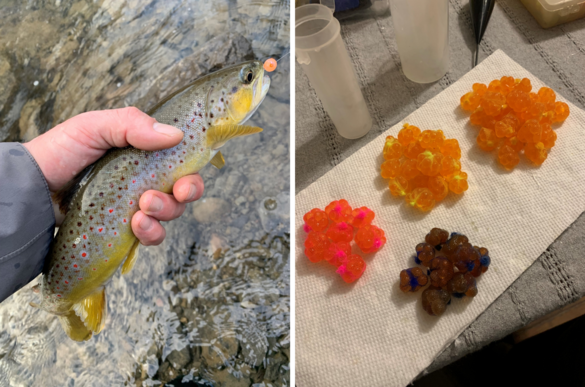
Fish eggs or baits that imitate fish eggs can be very effective offerings for Spring trout in rivers and streams. Fish eggs are an energy-rich food source and are often naturally available in streams during the Spring. Rainbow trout, steelhead and suckers all spawn during the Spring months, providing a buffet for fish residing in streams where this spawning occurs. Commonly used baits include spawn sacks (tied with durable mesh), soft or hard trout beads, moldable dough baits and a variety of egg imitating flies such as glo bugs and sucker spawn. To fish these offerings effectively, they should be drifted as naturally as possible within a foot or two of the stream bottom to imitate eggs that are naturally drifting through the system. Float or indicator fishing and bottom bouncing with spinning or fly gear are effective ways to present baits to eager fish waiting for an easy meal. Bait color can be adjusted to water clarity, with brighter shades of yellow, green and pink working well in stained water or low light conditions and more natural translucent yellow, orange and pink baits working well under clear conditions. Egg imitations are also a great way to fool stocked trout into biting. Don’t be afraid to add egg imitations to your Spring trout fishing tackle box... you won’t be disappointed!
 |
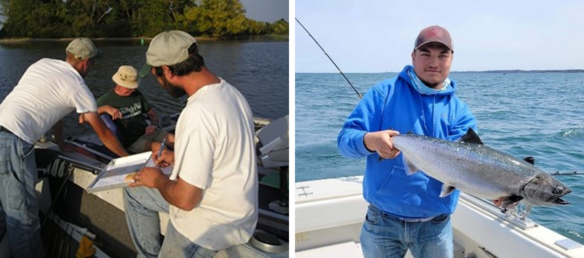
The DEC Lake Ontario Fishing Boat Survey has been conducted annually since 1985 to track New York’s world class fishery which attracts anglers from dozens of states and several countries each year to experience the trophy salmon, trout, walleye, and smallmouth bass fisheries, among other species that this amazing resource offers.
The Fishing Boat Survey tracks angler effort, angler catch rates and harvest and monitors average weights of species to inform the public and fishery managers about the status of Lake Ontario’s fish community and the quality of the fishery.
In 2025, creel survey agents will be stationed at one of 14 popular fishing ports every day, rotating among these ports to count fishing boats and to interview anglers returning from their fishing trips. The interview only takes a few minutes, and if anglers have fish onboard, agents measure and weigh the boat’s catch.
The success of the Survey relies on the outstanding cooperation of our angling public to provide the information and data necessary to manage our fishery, which annually contributes hundreds of millions of dollars to the economies of our local communities. Several thousand fishing boats contribute to interviews each year. If you see the DEC Angler Survey boat on the water, please slow down and be one of the lucky ones to give back to the fishery.
The survey starts in April and continues through September. In next month’s Fishing Line, we will run the numbers and provide a spring report, but early reports suggest brown trout fishing is in full swing with increasing numbers of Atlantic salmon in the mix.
If you have any questions, please email fwfishlo@dec.ny.gov.
Registration is now open for our Beyond BOW Spring Workshops at Great Camp Sagamore.
Choose between a mentored turkey hunting and fly-fishing weekend, or a 3-day intro to fly-fishing bootcamp.
Whichever you choose, you'll learn new outdoor skills with a group of amazing women!
*Registration is first come, first served*
Beyond BOW: Cast & Blast
|
Mentored turkey hunt, fly casting instruction, and mentored fly-fishing in the Adirondacks.
When: May 16-18, 2025 Where: Great Camp Sagamore, Raquette Lake, NY Cost: $440 Who: Women age 18+
All equipment is provided, or you may bring your own. All meals and 2 nights lodging included.
|
|
 |
You must have a valid NYS hunting license to attend this workshop.
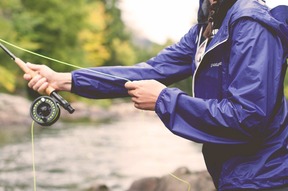
Beyond BOW: Beginner Fly Fishing Bootcamp
 |
|
One-on-one instruction from Cari Ray- FFI Certified Fly-Casting Instructor alongside BOW instructors. Learn the basics of fly casting and fishing while immersed in the beauty of the Adirondacks.
Introduction to equipment, casting, flies, and fishing techniques. Includes angling opportunities to target wild, native Brook Trout on the fly.
|
When: May 30-June 1, 2025 Where: Great Camp Sagamore, Raquette Lake, NY Cost: $500 Who: Women age 18+
Includes lodging, meals, fly fishing bootcamp activities and access to optional daily activities and recreational equipment at the camp. Bring your own fly rod or take home an Echo Lift combo set for an additional $100.
Location: BeeBee Island Dam in Watertown (Jefferson Co.) to the Lyons Falls Mill 3 Dam in Lyons Falls (Lewis Co.)
Length: 61 miles.
Characteristics: From Watertown to Carthage, river flow is interrupted by numerous dams (including 10 in Watertown and 5 in Carthage) with relatively short stretches of free-flowing river. Substrate is primarily rocky from Watertown to Great Bend with more sand-silt substrate from there to Carthage. From Carthage to Lyons Falls the river is low gradient, dropping less than 10 feet in 40 miles, with no dams. Meanders are extensive near Lowville, and the area is commonly referred to as the Black River Flats. Spring flooding is often extensive and problematic in this area. Substrate is mostly clay-sand-silt with rocky areas more common upstream of Greig to Lyons Falls.
Primary Sportfish: Walleye, smallmouth bass, northern pike, chain pickerel, brown bullhead, yellow perch, panfish (pumpkinseed, bluegill, rock bass).
The Fishery: The middle section of the Black River provides fisheries for cool and warmwater species that are sustained by natural reproduction. DEC stocks brown trout between the Beebee Island and Delano Island Dams in the City of Watertown to provide an urban put-and-take fishery. Walleye, smallmouth bass and northern pike are the most sought-after species in the middle section of the Black River; however, rock bass, brown bullhead, yellow perch and chain pickerel are also popular.
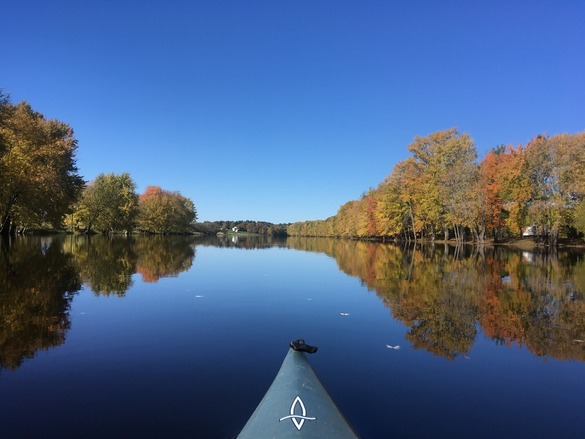
Access: Several access points are available at DEC-, municipal-, and hydropower facility-owned boat launch sites (Boat Launch Sites for Jefferson County, Boat Launch Sites for Lewis County). Recreational boating is popular including long drifts through the Black River Flats area with a canoe, kayak, or small boat.
Current Management/Research: A major fish kill occurred on the Black River in August 2005. DEC conducted a series of electrofishing surveys to evaluate survivorship and recovery of the fish community. By 2010, walleye, yellow perch, and smallmouth bass populations showed signs of recovery and were considered moderately to highly abundant in the area. More recently (through 2023), DEC surveys have focused on the collection of representative species for inclusion in the Toxic Substance Monitoring Program which informs New York State’s Department of Health’s fish consumption advisories. Specific consumption advisories for the middle section of the Black River can be found in the Jefferson County Advisory Listing.
|