|
In this issue:
Duck hunting seasons begin with designated "youth waterfowl hunts" across the state. These special opportunities allow youth hunters to spend time afield with experienced adult hunters and gain necessary knowledge and skills to become safe and responsible members of the hunting community. Junior hunters (12 to 15 years of age) accompanied by a licensed adult hunter with up-to-date Harvest Information Program registration and a duck stamp may participate. During the youth hunt, the adult hunter may not possess a firearm or shoot any birds unless the respective regular season is open. Daily bag limits are the same as those allowed during the regular hunting season for all species (excludes September Canada goose bag limits). The youth hunts are held on weekends in each zone of the state, as follows:
| |
|
|
|
|
|
|
|
|
|
|
|
|
Veteran
and
Active Military Days
|
|
|
|
|
|
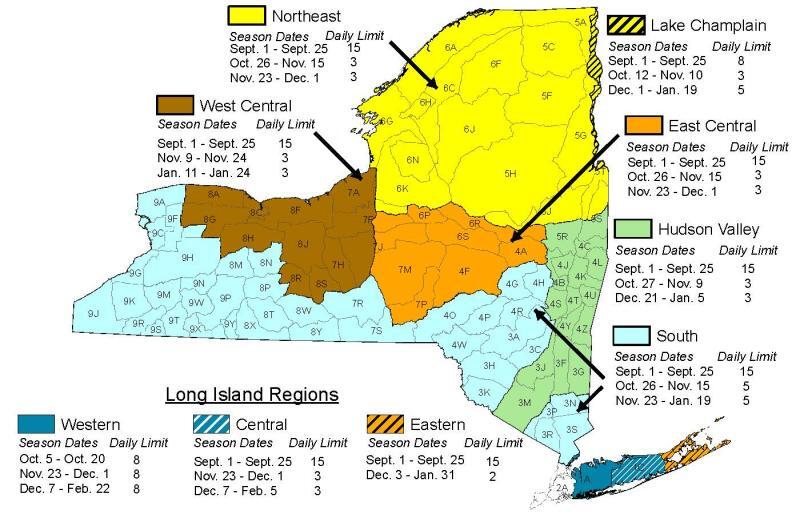
Canada goose hunting regulations can often be confusing because of the number of zones, varied bag limits and season lengths. The season zone boundaries and bag limits were designed using scientific data to maximize opportunity for hunters to take resident Canada geese, but also to protect migratory populations that are much more sensitive to hunter harvest. Season frameworks (e.g., lengths, allowable dates, and bag limits) are, again, developed in collaboration between the USFWS and the Atlantic Flyway Council. Then, DEC gathers input from waterfowl hunters to select dates that maximize opportunity for hunters in each zone. For the 2024-2025 season, the Canada goose bag limit in upstate areas (aside from the Southern Zone) will have a 30-day goose season with a 3-bird bag limit.
2024 Canada Goose Season Map
If you’re heading out to get away from it all, chances are good you’re heading into bear country. There are lots of simple steps you can take to discourage bears from getting into your stuff and avoid bear encounters. Teaching bears to associate cars, trails, campsites and people with food doesn’t just put a damper on your outdoor fun. It also creates unnecessary risk for you and your family and can have deadly consequences for bears. Doing your homework and taking some simple BearWise precautions now can help keep people safe and bears wild.
Lock It, Hide It, Or Lose It
Stash anything you’re leaving behind securely out of sight in your locked vehicle or food storage locker. A glimpse of a cooler or a sack full of snacks could tempt a bear to explore your vehicle while you’re out. Black bears are very strong with nimble claws and can easily open most unlocked car doors or peel down a partially open window. Leaving a window cracked open or an unlocked door is an invitation for a bear to come on in and see if there’s anything good to eat. But once inside, bears often have to chew and claw their way out. Why take chances? Stash, roll up and lock up before you leave.
Earn The Clean Camp Award
Odors of all sorts attract bears, whether you are camping in the backcountry or front country:
-
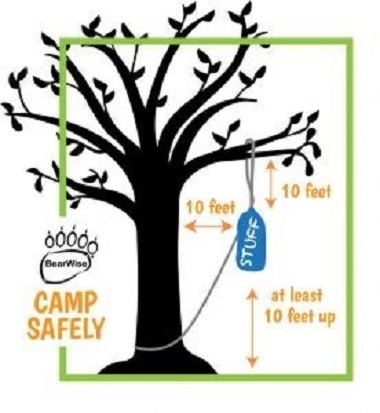
Don’t store food, trash, the clothes you cooked or cleaned fish in or scented products, including toiletries, in your tent. Store these items in an approved bear-resistant locker or canister or properly hung according to local guidelines. For hanging food, BearWise recommends 10′ x 10′ x 10′ (see graphic) because black bears are great climbers and can really stretch out if they think they can snag some food.
-
If you’re in a drive-in campsite, store anything that could attract a bear out of sight in a locked vehicle with the windows rolled completely up.
-
Cook downwind and as far from your tent as practical. The gold standard is a 70-big-steps triangle between your sleeping, cooking and eating areas. Your fire ring or grill isn’t an incinerator; don’t burn food scraps or trash.
-
Don’t store or eat food or spray or slather on anything scented (including lip balm) in your tent. Resist the urge to go to sleep with a midnight snack tucked under your pillow. Keep a flashlight, whistle and air horn in easy reach instead.
NYSDEC is a proud member of BearWise®, a program of the Association of Fish & Wildlife Agencies. For more information on how you can help keep bears wild…and enjoy your time in the great outdoors, visit: DEC's BearWise webpage and the BearWise website for free printable fact sheets and materials.
BearWise "Camp Safely" Graphic
Drivers who see a turtle on the road are encouraged to slow down to avoid hitting it with their vehicle. If the vehicle can safely stop and drivers are able to safely do so, motorists should consider moving the turtle to the shoulder on the side of the road in the direction it was facing. Motorists are advised not to pick turtles up by their tails, which could injure the turtle. Most turtles, other than snapping turtles, can be picked up safely by the sides of their shells. Snapping turtles have necks that can reach far back and have a strong bite, and should be picked up by the rear of the shell near the tail using both hands, or dragged safely across the road on a mat or blanket. Never drag turtles by the tail as doing so can dislocate the tail bones.
A licensed wildlife rehabilitator may be able to help if an injured turtle is found.
DEC reminds people not to take turtles home. All native turtles are protected by law and cannot be kept without a DEC permit. Most of the 11 species of land turtles that are native to New York are in decline. Turtles are long-lived species and it takes many years for a turtle to reach maturity. Losing even one mature female can have a negative impact on a local population. Learn more about New York's native turtles on DEC's website.
|