|
Biweekly Homeland Security Insights for a Safer New Jersey |
|
Recent Agency News
NJOHSP's 2025 Threat Assessment Reveals Emerging Threats in Domestic Extremism and Cybersecurity
NJOHSP released its 2025 Threat Assessment on February 19 to provide an overview of the threat landscape in New Jersey for the upcoming year, highlighting emerging trends in domestic extremism and cybersecurity. The annual assessment, in its 17th year, serves as a critical resource for public- and private-sector partners, aiding them in identifying and mitigating both physical and cyber risks as potential threats continue to evolve. For more information and to view the assessment, visit https://www.njohsp.gov/threat-landscape/threat-assessment.
|
|
NJOHSP Staffers Take the Plunge for Special Olympics
 NJOHSP volunteers raised more than $6,300 for the Special Olympics Seaside Heights Polar Bear Plunge on February 22. The team plunged into the icy waters of Seaside Heights, where this year's event attracted over 7,500 participants and raised more than $2.3 million. The annual event is one of New Jersey’s largest fundraisers benefiting the Special Olympics, bringing together first responders, community organizations, and members of the public to make a difference.
NJOHSP Offers NJSARS Training to Critical Infrastructure Sector Personnel
NJOHSP, through its Intelligence Management Bureau, oversees the New Jersey Suspicious Activity Reporting System (NJSARS), which remains one of the most critical assets the State has in its arsenal of tools as it looks to prevent attacks. NJOHSP relies heavily on its private-sector partners and the public to report suspicious activity, as they are often better suited to recognize behavior that is unusual for their location. NJOHSP is actively enhancing and expanding its outreach to the private sector and the public to ensure they have the knowledge and resources needed to remain vigilant and communicate valuable information through official channels.
Recently, NJOHSP has delivered training and presentations to private-sector entities with large workforces, such as malls and health systems, as well as to various county and municipal agencies, emergency management teams, and volunteer organizations. In January, NJOHSP staff provided a presentation to Middlesex Water Company’s Water and Wastewater Sector Security and Resiliency Working Group. The group is comprised of numerous private and municipal water/wastewater providers statewide and included representatives from other State and federal agencies. The group is dedicated to enhancing the security and awareness of critical water operations throughout New Jersey.
If your organization could benefit from a tailored, "See Something, Say Something" presentation, please contact the Intelligence Management Bureau at IntelMgmt@njohsp.gov.
NJOHSP, NTAC Offering Workplace Violence Prevention Seminar
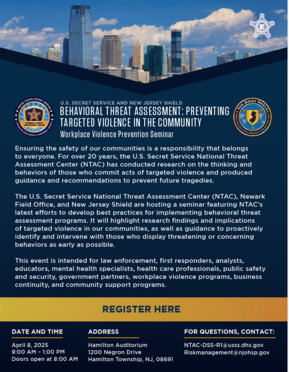
NJOHSP, through its New Jersey Shield program, and the U.S. Secret Service National Threat Assessment Center's (NTAC) Newark Field Office, are hosting a workplace violence prevention seminar on April 8, 2025, featuring NTAC's latest efforts to develop best practices for implementing behavioral threat assessment programs. Participants may attend either in person (if space permits) in Hamilton, NJ, or virtually, which is highly encouraged. Registration is required.
The seminar will highlight research findings and explore the implications of targeted violence in our communities, while also providing guidance on proactively identifying and intervening with individuals who display threatening or concerning behaviors as early as possible.
The event is designed for:
- Law enforcement
- First responders
- Analysts
- Educators
- Mental health specialists
- Healthcare professionals
- Public safety and security personnel
- Government partners
- Workplace violence program coordinators
- Business continuity planners
- Community support program members
- All partners of the New Jersey Shield and Global Shield Network
|
New Jersey Shield, a collaborative effort between NJOHSP and the New Jersey Regional Operations and Intelligence Center, serves as a centralized location for members to receive counterterrorism, cybersecurity, and emergency preparedness information and resources. The initiative partners with similar programs worldwide. Members report suspicious activity, share subject matter expertise and best practices, aid in identifying preparedness and resiliency gaps, and assist in developing solutions.
NTAC conducts research on the thinking and behaviors of individuals who commit acts of targeted violence and produce guidance and recommendations to prevent future tragedies.
The Global SHIELD Network is a collaborative law enforcement and intelligence initiative that partners with public and private sectors to prevent crime and terrorism and enhance public safety. It connects agencies worldwide, facilitating relationships, information sharing, and global distribution.
|
|
ISIS and al-Qa’ida use GenAI to Inspire Lone Offender Attacks Against US Jewish Community

A Washington, D.C.-based nonprofit organization, the Coalition for a Safer Web, released a report on February 3 revealing that foreign terrorist organizations (FTOs), such as ISIS and al-Qa'ida (AQ), use generative artificial intelligence (GenAI) on social media to inspire lone offender attacks against the Jewish community in the U.S. According to the report, FTOs frequent online platforms where Americans protest the conflict in the Middle East to incite attacks against Jewish communities.
FTOs employed manipulated GenAI videos, programs, and memes of Gaza's destruction and injured Palestinians to appeal to individual bad actors in the U.S. to incite acts of retaliation against Israel's supporters in the U.S. The videos used voice cloning software to create news programs in English to encourage a "younger, more persuadable" demographic to avenge civilian casualties in Gaza. The groups compiled "target identification packages," which showed geospatial photos of Jewish centers in New York City, Miami, Chicago, Detroit, and other cities abroad. The coalition also discovered multiple "how-to guides" and topics, including instructions on using cyber propaganda in publications, such as al-Qa'ida in the Arabian Peninsula's Wolves of Manhattan or ISIS's Voice of Khurasan.
"Unlike earlier Islamist online media used to incite violence and radicalize followers, this G[en]AI content often has no identifiable ISIS or AQ branding or digital fingerprints," according to the report. The content, therefore, can breach social media easier and evade content moderation attempts by social media platforms. The report also noted that ISIS and AQ often used GenAI to produce content similar to "help wanted" ads to recruit AI software developers, video producers, and open-source AI experts.
Analyst Comment: GenAI presents opportunities for extremists to push targeted messaging to specific individuals online and reach new audiences in a quicker and more efficient manner than passively sharing content to broad audiences. NJOHSP has examined extremist and FTO use of AI in previously written products, such as Foreign Terrorist Organization Propaganda Evolving Amidst Global Conflicts and Threat Actors Leverage Generative Artificial Intelligence. NJOHSP also discusses GenAI in the 2025 Threat Assessment.
|
|
|
NJCCIC: Beware of Quishing Campaigns with HR or IT Lures
Threat actors continue to exploit the growing reliance on QR codes through "quishing" campaigns, which trick users into scanning malicious codes without considering the risks. They impersonate trusted organizations, embedding tampered QR codes in emails, PDFs, Word documents, and other attachments. These codes direct users to phishing sites or fraudulent portals designed to steal credentials, sensitive data, or financial information when scanned. Some campaigns also deploy malware, ransomware, or trojans that compromise devices and facilitate further attacks.
The NJCCIC has detected and blocked multiple quishing attempts targeting New Jersey State employees, with threat actors using tactics such as Microsoft-branded emails and human resources-related themes to lure victims. In one case, a malicious QR code embedded in a PDF led to a phishing site disguised as an artificial intelligence-related verification page.
The NJCCIC recommends organizations verify QR codes before scanning, avoid interacting with suspicious or altered codes, manually enter trusted URLs, and implement strong security measures such as multifactor authentication and regular software updates. For more information, review the NJCCIC's latest alerts and advisories.
|
|
|
NJOHSP-Coordinated Training Courses
All NJOHSP-coordinated training courses are posted on the NJOHSP State Training Calendar. The calendar provides a course description, training location, target audience, and point of contact.
Contact Information
For more information or to share feedback, please contact the Communications Bureau at communications@njohsp.gov.
The NJ Security Spotlight is a biweekly newsletter of the New Jersey Office of Homeland Security and Preparedness and is intended to provide constituents with important agency updates, publications, and announcements. Please visit njohsp.gov/connect/nj-security-spotlight to read previous newsletters.
Report Suspicious Activity: Call 1-866-4-SAFE-NJ or email tips@njohsp.gov.
|
|
|
|
|