|
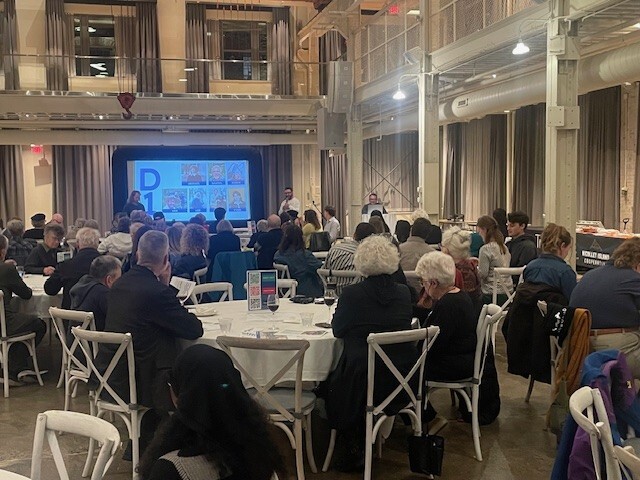
My office attended the Annual Meeting of the East Bank Neighborhoods Partnership (EBNP). EBNP was created a few years ago when five neighborhoods along the East Bank decided to merge into one neighborhood organization. The positive outcomes of that merger were on full display at this year’s annual meeting, which had around 100 people in attendance. Dozens of strong candidates are running for board seats with exciting priorities and diverse skill sets they want to bring to the neighborhood organization. The EBNP requires a proportion of seats to be filled by renters, which is an important step forward for equity in neighborhood association representation. Thank you to everyone who has brought EBNP forward!
At the East Bank Neighborhoods Partnership Annual Meeting
Neighbors of Seward, clear out your closets and refresh your style completely for free! Come to our community clothing swap. Get a new look while connecting with your neighbors—what better way to spend the time?!
Browse a fresh-to-you collection of clothes, shoes, and accessories. It is a fun, sustainable way to give your wardrobe new life, and also connect with neighbors as we all get ready for Winter activities and events. Think: layering.
Please bring your clean, gently-used garments, hats, shoes, and the like to share with others. All sizes of clothing are welcome. Fall and Winter clothing preferred. Anything left will be donated.
Bring clothing to Matthews Center large multipurpose room with the flags at 12 noon on Saturday, November 28th. Then come back for the clothing treasure hunt: 1pm – 4pm. Bring a bag!
Volunteers will set out clothing on tables, sorting by age, size, and category. This event is ground-level and accessible. Sponsored by Seward Neighborhood Group (SNG).
Seward Clothing Swap
November 28th 12-4pm
Matthews Park Rec Center (2318 29th Ave S)
Flyer for Seward Neighborhood Clothing Swap
During Winter Weather Awareness Week, we remind residents to be prepared before winter weather arrives. Taking steps ahead of time can make a significant difference during an emergency.
Be aware of winter weather
Minnesota winters can bring dangerously cold temperatures, heavy snowfall, strong winds and icy conditions. Staying informed is an important part of winter weather preparedness, so one of the best ways to prepare is to be aware.
Minneapolis residents can sign up for the City’s emergency alert systems, which provide important information about emergencies and public safety incidents. Follow official City of Minneapolis social media and other communication channels for timely information.
Residents should also enable Wireless Emergency Alerts (WEA) on their mobile phones and monitor trusted sources such as the National Weather Service for severe weather watches, warnings and advisories.
Take alerts seriously, follow the instructions and share important safety information with family members and neighbors.
Be safe at home
Winter weather requires you to properly prepare your home too. Home heating is the second leading cause of home fires, and many of them happen in winter.
Prepare your home for the impact of severe winter weather by:
- Keeping space heaters away from items that can catch fire.
- Checking heating systems, fireplaces and furnaces to ensure they are working properly.
- Protecting exposed pipes from freezing and knowing how to shut off your home's water supply.
- Keeping extra blankets, warm clothing, flashlights, batteries and a battery-powered or hand-crank radio available.
- Maintaining an emergency supply of food, bottled water and necessary medications.
- Making arrangements to check on older adults, neighbors and individuals who may need additional assistance during extreme cold.
Know before you go: Be safe on the road
Travel during the winter, even within Minneapolis, can be risky, especially if you’re driving. You can “expect the unexpected” by preparing yourself and your vehicles so a trip isn’t ruined by common problems travelers face in the winter. Be aware of the winter risks in places you visit. Check the local weather forecasts and warnings before heading out.
- Make sure your vehicle is in good working condition before you travel.
- Keep your gas tank as full as you can. A full tank will also keep the fuel line from freezing.
- Install good winter tires and make sure they have enough tread, or any chains or studs required in your local area.
- Every vehicle should have an emergency supply kit in the trunk. Kits should be checked every six months and expired items should be replaced regularly.
- Consider keeping a power bank for your phone in your car in case your car loses power.
- If stranded, run the engine for about 10 minutes per hour to run the heater and charge your cellphone. Open a window slightly to let fresh air in and avoid carbon monoxide (CO) poisoning.
A few minutes of preparation today can help prevent emergencies tomorrow.
Learn more about emergency preparedness on the City website.
Summary: I’m authoring 21 amendments totalling more than $11 million to restore programs that restore programs residents rely on without raising property taxes and lower property taxes by more than $3 million.
Background: This week, City Council Members submitted our proposed amendments to the 2027 Budget. I am proud to have worked with my colleagues to bring forward 21 amendments. Collectively the amendments I’m authoring would restore over $11 million for programs and services that residents rely on without raising taxes, and lower the property tax levy by over $3 million without impacting city services.
Here are the budget amendments I submitted:
-
Climate Equity Fund: Weatherization. Restoring $2.6 million towards residential weatherization programs that the mayor proposed cutting. This program helps lower utility bills for working class families and make progress towards a more energy-efficient city.
-
Preparing for HERC Closure: Allocating $1 million to the City’s Zero Waste programming. Zero Waste is how we reduce the amount of trash coming from residential and commercial users. The City adopted a resolution supporting the closure of the Hennepin Energy Recovery Center (HERC) trash incinerator by 2028, and will need to massively reduce our waste to make that a reality. Without this funding, significant waste reduction will not happen and we will not be prepared for HERC closure.
-
Sidewalk Plowing: Sidewalks should be safe and accessible to everyone in our city, even in the winter. This earmark protects $600,000 within the Public Works Department for sidewalk snow and ice plowing programs, both city-led and grants to neighborhood associations.
-
Homegrown Minneapolis: Restoring the Homegrown Minneapolis community gardens program. This funding supports dozens of community gardens that activate vacant lots, feed thousands of people, and build a healthier city. The Homegrown program also brings in significant grants, which the City will lose without providing base funding. This critical restoration was less than $500,000.
-
Green Careers: Restoring Climate Legacy Initiative funding for $298,000 for a partnership with Minneapolis Public Schools helping expose young people to green careers.
-
Safe and Thriving Communities: Allocating $1 million to protect a team of 5 staff who design and implement new public safety beyond policing programs, like embedded social workers in 911 and non-police response to non-injury car crashes. 47% of 911 calls are candidates for an alternative response other than police, and this team will be responsible for advancing and expanding comprehensive safety services and programs. This team also brings in millions in federal grants to support innovative public safety work.
-
Taxpayer Refunds for MPD Off-Duty in 2026 and 2027: The Frey administration has refused to collect fees from off-duty work performed by MPD officers. This inaction has forced taxpayers to subsidize these officers' side gigs at a tune of about $1.5 million per year, which goes directly to officers’ pockets. MPD not only failed to enact these fees in 2026, but has stated they are not likely to collect the fees in 2027 as well. These two budget amendments provide a Taxpayer Refund resulting in a $3 million property tax levy reduction. One additional budget earmarks resources within MPD for the administration of the fees, so that there are guaranteed staff resources for implementation in 2027 should the Frey administration choose to act.
-
MPD Staffing Study: Decisions about police staffing should be based on data, not feelings or ideology. A study of MPD staffing in 2022 provided significant insights into actual workforce needs. MPD declined to utilize the framework and recommendations claiming that the data was no longer relevant. Five years later, and millions of dollars in overtime costs, it’s time for updated data to evaluate how to best use taxpayer resources to keep residents safe. This budget amendment allocates $200,000 in MPD’s budget for a staffing study contracted through the Legislative Research Office.
-
MPD Overtime Oversight: MPD overspent their budget by $20 million two years in a row, and top leadership in the administration claimed to have no idea this was happening until it was too late. I authored a budget amendment to place MPD overtime into a reserve fund. This does not prevent the mayor from accessing the fund to make MPD payroll, which he is legally entitled to, but it does increase oversight and public awareness of MPD spending. Transparency and accountability will be crucial for solving MPD’s reckless overspending.
-
Municipal Grocery Store Development: Food insecurity is a serious problem in areas of our city, including in Dinkytown/Marcy Holmes where nearly 1 in 4 students lack access to fresh, affordable groceries. Last year I led the City Council to allocate $200,000 to leverage in support of community initiatives for grocery stores including municipal grocery stores. The funding was not made available this year, so I’m proposing extending it into 2027.
-
Office of Risk Management to prevent fraud, waste and abuse: The City currently lacks a centralized Office of Enterprise Risk Management to mitigate financial, reputational and operational risks to the city. It’s a best practice for large organizations to have offices like this to prevent fraud, waste and abuse. It has also been recommended by the City Auditor as a critical need for the City administration. I am proposing to reallocate about $500,000 to create an executive office early next year.
-
Partnership Engagement Fund: This amendment would restore $500,000 to the Partnership Engagement Fund, which is dispersed to organizations in grants of $15,000-$25,000 for community-led projects that improve community safety, youth mental health, arts and culture, and more. Many Partnership Engagement Fund partners led crucial programs that kept our communities safe and connected during Operation Metro Surge.
-
Childcare Workforce: Protecting $102,000 for investment in workforce development programs for childcare workers and early childhood educators. Addressing the childcare workforce shortage is a key way to expand access to childcare for working families.
-
Racial Equity: Protecting $285,000 in staff dedicated to advancing racial equity projects and ensuring City programs and services meet Strategic Racial Equity Action Plan goals.
-
✅Housing First: Restoring $1.8 million towards the Emergency Housing Voucher program. This partnership with Hennepin County and the Minneapolis Public Housing Authority will put 50 families and 50 individuals experiencing homelessness into housing with wraparound social services. Mayor Frey promised to maintain funding for this program for 2027 and 2028, but did not. This restoration provides funding stability so our partners can move forward with housing families. The City Council adopted this restoration last week ahead of the budget markup.
I am co-authoring the following amendments:
-
Public Safety Beyond Policing with lead author Council Member Osman: Restoring $3 million in proposed cuts to Violence Interrupters, Violence Prevention, hospital-based intervention, and other crucial programs to keep our city safe.
-
Housing inspectors and Stop Slumlords with lead authors Council Member Chavez and Osman: Restoring cuts to housing inspectors that enforce rental housing standards, and hiring new inspectors specifically focused on the highest-risk rental licenses and the lowest-quality rental housing. These inspectors are supported by higher fees on landlords and slumlords.
-
Fully Fund Elections with Council President Payne. Restoring about $1 million in staffing and technology needs for Elections and Voter Services.
-
Renters Rights with lead author Council Member Stevenson. This expands funding for a tenant advocacy organization that provides free legal help for renters.
The full packet of amendments from all Council offices will be published the week of December 7th, and the City Council will vote on the amendments through the markup process on December 10th and 11th. On December 15th at 6pm, the City Council will hold the final public hearing on the budget and vote on final adoption.
Key votes: No votes taken.
Summary: Mayor Frey and allies reject compromise, roll out red carpet for unregulated AI data centers.
Background: Last week, I shared that Mayor Frey vetoed the City Council’s regulations on data centers. Today, despite over 1,600 public comments urging the City to ban all data centers, Mayor Frey’s allies on the council voted to sustain the veto. Mayor Frey and his allies’ loyalty to Big Tech and unwillingness to respond to overwhelming public opinion resulted in a lapsed data center moratorium.
The sustained veto leaves the city completely unprotected from data center development, including hyperscale AI data centers. There are no regulations on size, noise, energy or water usage, among other factors.
The progressive majority of the Minneapolis City Council is now fast tracking a policy to ensure areas outside of downtown are off-limits from data center development. The progressive majority attempted to pass a stopgap measure immediately after the veto was sustained, but the city attorneys presented new information that the soonest opportunity to adopt a new policy is December 17th. Council Members who voted to override the veto are committed to passing regulations on the fastest possible timeline.
I know many community members are feeling disappointed and frightened to see their local government turn over our land, water, and energy grid to Big Tech to develop AI data centers. You are right to feel this way. It’s frankly astonishing to me that anyone would be advocating for data centers in our city, just weeks after historic midterm elections that were seen as a national referendum against data centers. Please continue to organize and make your voice heard. Big Tech oligarchs think they’re above the law and have successfully bought and paid for many of the government leaders who are supposed to be regulating them. During the debate around data centers, City Hall supporters of data centers have refused to answer why they do not want to protect Minneapolis from hyperscale energy use. We must stand up against Big Tech and protect our land, water, air, energy grid, and communities from AI data centers.
During the City’s Council discussion, Council Member Rainville implied that residents urging him to vote against data centers creates a threat to his safety. Actual threats of violence against elected leaders, or anyone, is never ok. But I refuse to equate participating in the democratic process and organizing to urge your representative to vote to protect you as “chaos.” That is insulting to working class people who have taken time to organize for a better city. It also distracts from what happened today: instead of compromising, elected officials doubled down on rolling the red carpet for data centers and removing all opportunities for residents to have a say in the future.
Please continue to organize and advocate for bans and regulations on data centers in Minneapolis. Even if the City Council approves the barebones protections on December 17th, neighborhoods like the Mill District, North Loop, and Hennepin Ave theater district will be completely vulnerable to data center development and the City will have surrendered our authority to stop it. These areas include the riverfront, the Mill City neighborhood, the Minneapolis Farmer’s Market, the nightlife areas of the warehouse district, and some of the most valuable residential and commercial real estate in the city. Data centers are dead zones that will kill economic development in these areas. Several council members have also continued to argue that taxpayers will see massive tax breaks due to data center development, despite the city’s own report casting significant doubts on that happening. Residents across the city are vulnerable to impacts like higher utility bills, polluted water, noise pollution, and loss of culture and economic vibrancy in our shared downtown.
Key votes: Council Members Rainville, Vetaw, Warren, Osman, Shaffer, and Palmisano sustained the Mayor’s veto and allowed unregulated AI data centers across the city.
Summary: Mayor Frey issued a performative veto of the City Council’s denial of Bill Peterson for Chief of Police, which does not result in Peterson being appointed chief.
Background: Last week, the City Council voted 8-5 against the appointment of Bill Peterson for Chief of Police after a public hearing in which he stated he had never personally witnessed one incident of racism in over 30 years in MPD. Many Council Members as well as the public found these statements implausible, since MPD has a documented pattern and practice of racism in the precincts where Peterson worked during the years he worked there.
After the City Council denied the appointment, Mayor Frey vetoed the denial. This has no impact, since an appointment requires affirmative support by the City Council. The City Council voted 7-5-1 to override the veto, but a veto override requires 9 votes so the veto was sustained.
Earlier this year, Mayor Frey vetoed the City Council’s denial of the appointment of Todd Barnette to Commissioner of Public Safety. The choice to veto a denial is unproductive and does not move our city forward on public safety.
Key votes: City Council voted 7-5-1 to override the Mayor’s performative veto of the City Council’s denial of Bill Peterson. Council Members Rainville, Vetaw, Osman, Shaffer and Palmisano voted against the override and Council Member Whiting was absent.
Curious about a service request in your neighborhood? The new Minneapolis 311 system includes an interactive map that lets you see open service requests across Minneapolis.
You can explore the map to see where requests have been submitted and get a better picture of the issues residents are reporting around the city.
The map is one of several new features designed to make it easier to connect with City services and see information about service requests.
Explore the new Minneapolis 311 system.
Download the new Minneapolis 311 app:
Contact Ward 2
Visit: minneapolismn.gov/ward2
Email: robin.wonsley@minneapolismn.gov
Phone: 612-673-2202
City Hall
350 S. Fifth St., Room 370
Minneapolis, MN 55415
For reasonable accommodations or alternative format please contact 311. People who are deaf or hard of hearing can use a relay service to call 311 at 612-673-3000. Para ayuda, llame al 311. Rau kev pab, hu 311. Hadii aad caawimaad u baahantahay, wac 311. |