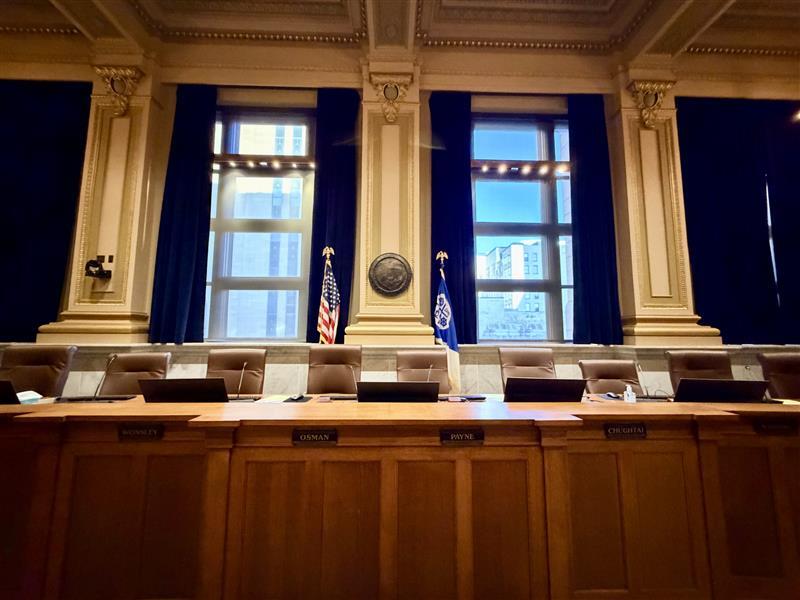
 This week, the council took a baby step toward working together on the budget. I brought forward a resolution stating the council’s intention to apply any savings from the restructuring of city government toward reducing the levy. Colleagues who wanted to use those savings to restore certain cuts told me they’d support a resolution committing half the savings to levy reduction and half to restoring cuts. In the spirit of collaboration, I supported this friendly amendment, and it passed unanimously.
This is the beginning of what I hope will be a more constructive relationship between those on the council – like me – who are more focused on lowering the levy and those who are more focused on restoring cuts. I believe there is a way for us to significantly lower the levy and restore some cuts, but it will require this same spirit of cooperation. I’ve heard that some of my colleagues are looking at a range of $5-10 million to restore cuts in the mayor’s proposed budget. That’s potentially almost two levy points, and money we’ll need to find elsewhere before we can even begin to lower people’s taxes.
I hope to float some ideas with my colleagues next week about how we can do both, with the goal of passing a budget 13-0 on December 15th and heading into the new year furthering our burgeoning spirit of collegiality.
The End of OCS?
Relatedly, city government is on the brink of a major restructuring as we voted 9-4 this week to eliminate the Office of Community Safety (OCS).
In the wake of the murder of George Floyd, Minneapolis established OCS to oversee and coordinate the various departments that make up the city’s public safety ecosystem: the police department, the fire department, emergency management, neighborhood safety and 911. The vision for OCS was to increase the overall safety and well-being of all residents while leading the process of police reform and expanding alternatives to policing.
As with any new structure in government, there were growing pains. The first Commissioner lasted only a year, and the council failed to approve the reappointment of its second leader, Commissioner Todd Barnette, earlier this year. Much of the criticism centered on the fact that, per the City Charter, the Police Chief reports directly to the mayor. Critics argued this undercut the Commissioner’s authority over the police and rendered the entire department ineffectual.
OCS department heads spoke about the importance of the Commissioner in coordinating responses to critical incidents like the Annunciation tragedy and Operation Metro Surge. In addition, the department has brought several alternative public safety responses online.
As I said from the dais, I’m largely agnostic on the question of eliminating OCS, but if it goes away, our city will need something like it to carry on its work: coordinating emergency response, fostering cooperation among public safety departments, and implementing the settlement agreement. Ultimately, I voted against its elimination.
This measure now heads to the mayor for his decision.
Car Encampments
As we’ve previously covered in our “Looking Ahead” section, we took up an ordinance this week allowing nonprofits or government agencies to establish temporary encampments for people living out of their cars in parking lots across the city, if they meet certain requirements. The ordinance passed 9-4 and now heads to the mayor’s desk.
I couldn’t support this measure. Living in a vehicle is not safe or dignified housing, and I don’t think the city should support it as an option, regardless of how stringent the regulations might be. Additionally, I don’t think the city should encourage the formation of encampments of any type, given the public safety and health challenges they’ve created in the communities where they’ve formed.
I support working with our partners at Hennepin County to connect people living out of their vehicles with the resources they need to secure safe and stable housing, so that their cars can remain what they should be: a means of transportation and not a place to live.

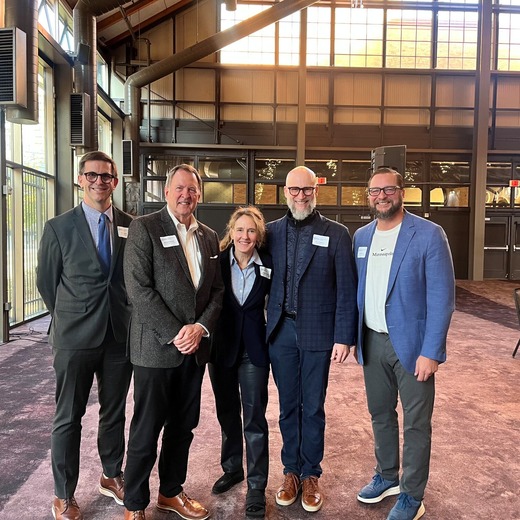 Today I had the honor of joining a panel at the Downtown Minneapolis Summit, hosted by the Minnesota Real Estate Journal.
One sobering number: downtown has 10 million square feet of vacant office space, the equivalent of eight IDS Towers. Commercial valuations in the downtown core have dropped 50% over the last few years, and that's a major reason residents are feeling the squeeze on their tax bills. I'm not convinced we've hit bottom yet.
Everyone on the panel agreed that Minneapolis is looking to cities across the country for what's working to cut red tape and spur development. But CPED Director Erik Hansen named the issue hanging over the whole conversation: when it comes to being business-friendly, Minneapolis has a bad reputation. Panel after panel, political dysfunction came up as one of the biggest hurdles for anyone looking to invest here.
Unlike Joan Jett, I do give a damn about our reputation. A council that runs on drama and conflict isn't just a bad look. It's bad for business. Minneapolis should aim to be the easiest city in the nation to do business in: one that welcomes investment, embraces growth, and keeps its rules predictable.
 Nov. 3 is Election Day in Minneapolis. After the City’s Early Vote Center closes at 5 p.m. Nov. 2, any voters who still haven’t voted can only do so at their assigned polling place or by dropping off a completed mail ballot at the City’s election office. All polling places are open Nov. 3 from 7 a.m. until 8 p.m. Anyone in line to vote by 8 p.m. Nov. 3 will still have the opportunity to vote.
Find the right polling place
Voters who plan to vote on Election Day should find out the location of their polling place. They can look for their polling place on the Secretary of State website.
Confirm a mail ballot was received
Voters who completed and mailed back their early ballots should check the online ballot tracking tool the morning of Nov. 3. If the tracking tool indicates that their ballot has not yet been accepted, they should look up their polling place and go vote in person.
Voters can vote in person as long as election officials have not yet received and counted their mail ballots. Elections staff at polling places check to see if they’ve received and counted mail ballots from voters who want to vote in person. Voters are given ballots as long as the City has not received and counted mail ballots from them. Any uncounted mail ballots from people who have voted in person will be cancelled and not counted (even if election officials receive it later).
Any Minneapolis voter who has a completed mail ballot should not mail it in at this point. Instead, mail ballots can be dropped off during voting hours at any Minneapolis Early Voting location. Or, on Election Day Nov. 3, ballots can be dropped off from 8 a.m.-5 p.m. at Minneapolis Elections & Voter Services, 980 E. Hennepin Ave., or the Hennepin County Government Center, 300 Sixth St. S. Mail ballots cannot be accepted at polling places on Election Day.
Voters can bring materials into the polls to help complete their ballots, and the sample ballot is the single best tool for this. Find sample ballots for all Minneapolis precincts on the City website.
Video
Voting in Minneapolis is safe, and there are security measures in place. You can vote at your polling place, or you can still vote early in person through Nov. 2. Watch the video on YouTube.
Find information about registering and voting in Minneapolis on the City website.
How to help
Every election year, Minneapolis sees strong voter turnout and residents who step up. From offering a ride to the polls, to sharing information across languages, you can use our guide for simple, nonpartisan ways to support voters. Download the guide in multiple languages.
Remember, polling places — and within 100 feet — are reserved for voters and people helping them vote.
How to identify an election judge
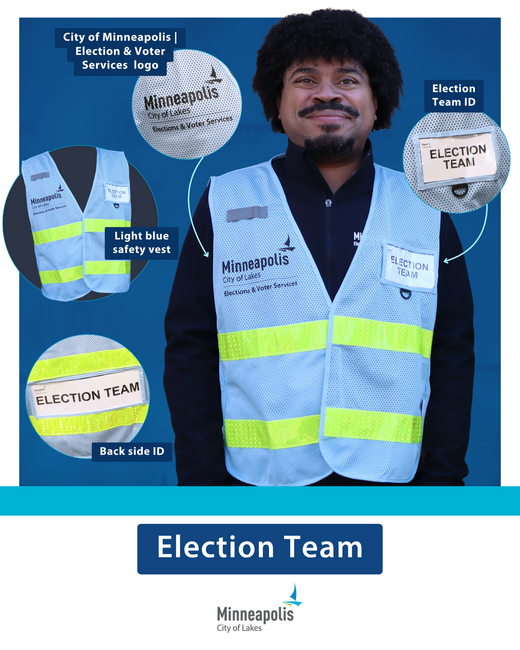 If you need any help while you’re out voting, just ask an election judge. They’ll be inside and outside polling places to make sure voters have access to their ballot. Minneapolis election judges outside of the polling place will be wearing a light blue safety vest with a City of Minneapolis logo. Election judges inside the polling place will have clearly visible identifying lanyards.
We’re fully staffed and ready to help you vote. Let’s work together to help ensure a smooth and accessible election for all.
Way to go Minneapolis! With less than a week to go until Election Day, a record-setting number of Minneapolis voters have made their voices heard by casting their ballots. Minneapolis Elections & Voters Services has accepted 52,661 ballots as of Wednesday, Oct. 28. The previous record was set in 2018 when 52,313 early/absentee ballots were cast.
This year’s numbers represent a 79.8% increase in early vote turnout so far compared to 2022.
By the numbers
- At this point during the 2022 Gubernatorial Election, 29,290 ballots had been accepted.
- At this point during the 2018 Gubernatorial Election, 28,896 ballots had been accepted.
You can track the number of ballots cast in the general election using the 2026 General Election Absentee/Early Voting Dashboard on the City website.
The Minneapolis Elections & Voter Services Division is responsible for administering elections in the City of Minneapolis. Find information about registering and voting in Minneapolis on the City website.
 This section is intended to flag issues coming up in the next council cycle (and beyond) that we believe may be of interest to Ward 7 constituents. Here are some upcoming items you might find interesting:
Data centers:
As most readers will know, I’ve been working for months with city staff and my fellow councilmembers to craft forward-looking, responsible regulations for data centers in Minneapolis. What has emerged strikes a healthy balance between environmental and urban planning concerns and creating space for much-needed development and investment in downtown Minneapolis.
Despite the proposed regulations being arguably the most restrictive in the country (and a potential national model), the City Planning Commission (CPC) suggested some material changes that, if adopted, would upset that balance and create a back-door ban. That’s not OK with me. While I’m sensitive to resident concerns about data centers, I also care about investment in our city, economic growth, shifting our growing property tax burden off of residents, and creating the necessary infrastructure for new businesses of the future.
The proposed regulations now come before the Business, Housing, and Zoning (BHZ) committee on Tuesday, where both the staff recommendations and CPC suggestions will be presented to the committee, with a final council vote expected the following week. Lots of moving parts on this one, so stay tuned.
Delinquent utility charges:
Monday’s meeting of the Enterprise & Labor Relations (ELR) committee features an item approving property tax special assessments for delinquent utility charges. Sound boring? It’s not. Turns out, property owners throughout the city have been ignoring their city utility bills to the tune of roughly $12 million. That’s a lot of money, and while the delinquencies include plenty of individual residences, some of the worst offenders are apartment owners. Just in the Loring Park area, we have one company that owes over $500,000, another owes over $360,000, and another “billpayer” who owes over $80,000 across several nearby buildings. This is an eye-popping report, but not news to my office. We’ve been following this issue for some time now, and will continue to work with renters, advocates, and city staff to find a solution.
Police chief and health commissioner confirmation:
Wednesday’s meeting of the Public Health, Safety, and Equity (PHSE) committee features public hearings on the mayor’s nominees for both police chief and health commissioner. In both instances, the mayor and the nominee will make opening comments, the public hearing begins, then the council members have an opportunity to ask questions of their own. These are important positions in our city government, and it will be interesting to get to know the nominees better and hear more about where they’d like to take their respective departments if confirmed.
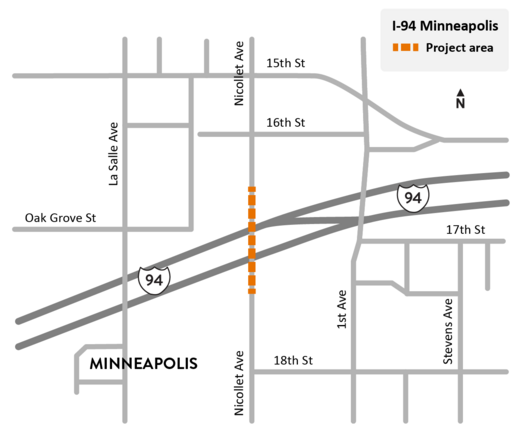 Mark your construction calendars — road work for the Nicollet Ave. bridge over I-94 in Minneapolis will begin in spring 2027. MnDOT will be replacing the Nicollet Ave. bridge to bring to life a modern bridge with pedestrian safety and accessibility improvements. Work on this project is scheduled to be completed in the summer.
Learn more about this project at a MnDOT public meeting, 6-8 p.m. Thursday, Nov. 19 at the Plymouth Congregational Church (1919 LaSalle Ave., Minneapolis). Stop by any time during the meeting to chat with the project team about the project work, traffic impacts and construction schedule.
For more information, visit the Nicollet Ave. bridge project homepage and sign up for email updates — the best way to stay informed.
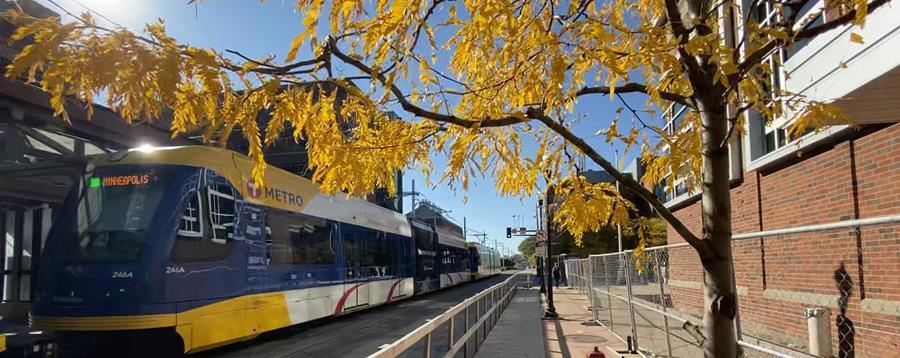 This week also featured a multi-jurisdictional rail safety meeting related to Southwest Light Rail (SWLRT). Held by law on an annual basis, this year’s meeting had additional significance because the new line is expected to open for service in June of next year, with actual rail car testing happening between now and then. The primary speakers were Jim Alexander, Project Director from Metro Transit, and Dr. Reginald Freeman, the city’s new fire chief. Jim provided a helpful overview of where the project stands now, what to expect in terms of testing, and what safety measures are in place as the line gears up for actual service. Neighbors living along the line will be pleased to hear that they will be conducting actual sound measurement and testing as the rail cars start running to measure the real world impact of all the added horns and bells. After some brief introduction, Chief Freeman followed with an outline of MFD’s HazMat readiness, coordination with Met Transit and rail carriers, and then provided some specifics about MFD’s response in the event of an actual rail incident. For those of you who are interested but couldn’t make the meeting, you can watch the recording here.
Monday, November 2: Kenwood Neighborhood Organization monthly meeting, 6:30 – 8:00 p.m., at the Kenwood Rec Center, 2101 W. Franklin Ave.
Monday, November 9: Downtown Minneapolis Neighborhood Association annual meeting, 6:00 – 8:00 p.m., Mill District Event Spaces, 233 Park Ave.
Monday, November 9: Citizens for a Loring Park Community board of directors meeting, 6:30 – 8:00 p.m., via Zoom. Click here for directions.
Tuesday, November 10: West Maka Ska Neighborhood Council monthly meeting, 6 – 8 p.m., Bakken Museum Great Hall, 3527 Zenith Ave. S.
Tuesday, November 10: East Isles Neighborhood Association monthly meeting, 7:00 – 9:00 p.m., at Grace Trinity Church, 1430 W. 28th Street. Click here for more information.
Tuesday, November 10: Stevens Square Community Organization Board of Directors Meeting, 6:00 – 8:00 p.m., 1900 Nicollet Avenue. Hybrid meeting with Zoom option.
Wednesday, November 11: Bryn Mawr Neighborhood Association monthly meeting, 6:30-7:30pm at Bryn Mawr Presbyterian Church, 420 Cedar Lake Road.
Thursday, November 12: Cedar-Isles-Dean Neighborhood Association monthly meeting, 6:00 – 7:30 p.m., Jones Harrison Senior Living, 3700 Cedar Lake Avenue. Click here for full details.
As highlighted last week, the Minneapolis City Council has added another way for community members to make their voices heard during the budget process. In addition to yesterday’s informal listening session, there will be one more this coming week where residents can provide feedback on the Mayor’s 2027 recommended budget:
Thursday, Nov. 5 Doors open at 5:30 p.m. Listening session from 6-7:30 p.m. Whittier Elementary School Cafeteria, 315 W. 26th St.
Listening session format
Each listening session begins with a brief budget overview. Residents will then have an opportunity to ask questions or give their opinions to City Council Members. Community members wishing to address the City Council are asked to arrive 30 minutes before the session begins to sign up to speak, similar to public hearings held in City Hall. Space is limited. All City Council members are invited to attend these listening sessions; however, since these are not official City Council meetings, quorum is not required. There will be audio recordings of these sessions for the public record.
Other ways to participate
Residents who can’t make it to one of these listening sessions can participate in other ways, including:
Small things matter – that’s one of the things that keeps me going. Case in point: Renaming the half-block, dead-end, awkwardly named “West 34th ½ Street” in West Maka Ska. It’s an isolated oddity, and neighbors report that, with West 34th Street being nowhere nearby, packages and mail (including checks) have regularly been misdelivered or not delivered at all. The solution? Rename it as a continuation of Rose Lane, just a few short feet away. With guidance from the city, neighbors organized a petition to rename the street “Rose Lane,” and a public hearing on that proposal is now scheduled for Monday, November 9, 4:30 p.m., before the City Planning Commission, 250 S. 4th St., Room 350. Absent the unforeseen, I expect this will sail through the commission and on to final approval. “Small things” can be big things to people directly impacted, and it’s been great watching this particular “small thing” move from problem to solution, and my hat is off to these organized neighbors!
 Help shape Minneapolis’ future through informed, community-focused investment decisions.
The Capital Long-Range Improvement Committee (CLIC) is recruiting members Nov. 1-30. This is your opportunity to influence long-term City investments in parks, streets, and public facilities, guide how the City funds major projects, and collaborate with fellow community members.
What you’ll do
- Review and evaluate capital project proposals.
- Participate in public listening sessions.
- Develop recommendations.
- Serve for two years.
- Meet weekly from late March-June (noon-2 p.m. Wednesdays).
Ready to help shape our city? Learn more on the City website, then apply Nov. 1-30.
The National Fire Protection Association reports that 71% of non‑working smoke alarms had battery issues. When you “turn back” your clocks on Sunday, Nov. 1, take a few minutes to replace the batteries in your smoke alarms and carbon monoxide alarms, too.
Smoke alarms are important because smoke spreads quickly and fire doubles in size every minute. Smoke alarms give you the critical seconds you need to escape and call 911 if a fire starts in your home.
Carbon monoxide (CO) alarms detect the invisible, odorless gas that can be fatal, especially during the winter season when using heat.
How to act when you “turn back”
- Set your clocks back one hour.
- Change your smoke alarm batteries at least once a year. Make a habit of replacing batteries each fall and spring during daylight saving time.
- Replace the whole smoke alarm if it is more than ten years old. See the manufacturer’s date on the back of the smoke alarm.
- Test all smoke and carbon monoxide alarms.
- Review your home fire safety plan including the escape routes and meeting location.
Smoke and carbon monoxide alarm tips from the Minnesota State Fire Marshal
- Install smoke alarms in every bedroom, outside each sleeping area and on every level of the home, including the basement.
- Interconnect your home’s smoke alarms. This way, when one sounds, they all sound.
- Teach children the sound of the smoke alarm and to exit the home or building when it sounds.
- Place alarms on the ceiling. If alarms are placed on the wall, they must be no more than 12 inches below the ceiling.
- Always follow the manufacturer's recommendations that are included in your alarm's instructions.
- Make sure you test your smoke alarms every month by pressing the test button.
- Even hard-wired alarms need fresh batteries.
 Congratulations to Minneapolis firefighter Andi Barrickz, who earned an impressive third-place finish at the Firefighter Challenge League World Championships in Las Vegas last week. She showcased the skill, strength and determination of Minneapolis firefighters on the world stage. Called “the toughest two minutes in sports” by ESPN, the Firefighter Challenge tests competitors’ speed, endurance and strength as they complete demanding firefighting tasks while wearing full protective gear and breathing apparatus.
Barrickz and fellow Minneapolis firefighters Greta Boogren and Penelope Onsrud competed against 368 firefighters from more than 20 nations around the world, demonstrating the athleticism and dedication needed to excel in one of the fire service’s most physically demanding competitions. Their team was also one of the fastest in the event.
The skills required to compete at this level — physical endurance, quick decision-making, teamwork and the ability to perform under pressure — are the same skills Minneapolis firefighters rely on every day to respond to emergencies and keep our communities safe.
Congratulations to Barrickz, Boogren and Onsrud for their outstanding efforts and for their commitment to protecting our community. |