|
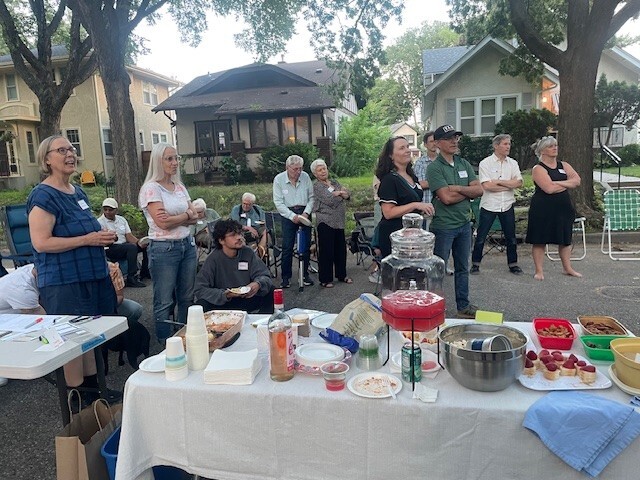
National Night Out was beautiful in Ward 2! Thank you to all the neighbors who took time to organize or attend a block party.
Neighbors in Seward do a round of introductions during a National Night Out block party in Ward 2.
Get ready for an afternoon of free live music across Minneapolis. The Minneapolis Mile of Music will bring local artists and performers to more than 25 cafés, restaurants, patios and public spaces on Wednesday, Aug. 19.
From jazz and folk to rock, Latin, pop, soul and hip hop, the event will showcase a wide range of music across three areas of the city: Saint Anthony Main, Nicollet Mall and Eat Street.
Save the date:
Minneapolis Mile of Music
4-8 p.m. Wednesday, Aug. 19
More than 25 venues
All performances are free
The Minneapolis Mile of Music is part of Minneapolis Forward and is funded through the City's Small Business Resiliency Fund, which supports efforts to bring people back to local businesses and strengthen Minneapolis' arts, culture and entertainment economy.
A full artist lineup, venue map and event schedule will be available soon. Visit the Facebook event for the latest event details.
Homegrown Minneapolis’ Food Forward program helps restaurants reduce wasted food, save money and make a lasting impact. The program is kicking off its August cohort with six local restaurants. Meet the August 2026 Food Forward Cohort:
These businesses are partnering with Food Forward coaches over the next six weeks to implement smarter, more efficient kitchen strategies and become leaders in saving food, one plate at a time.
Learn more about the Food Forward program.
Food Forward is currently accepting restaurants for its Fall 2026 cohorts. Fill out an interest form on our website and our coaches will reach out to you.
Summary: Next week, Mayor Frey will share his proposed 2027 budget. I am deeply concerned that he will propose cutting public sector jobs and important equity programs, continue giving MPD a blank check with no accountability, and raise property taxes significantly.
Background: Under the City Charter, the Mayor proposes a budget by August 15th, then the City Council amends the budget and adopts it. Mayor Frey will present his proposed budget for 2027 next week, and his proposal is likely to include significant cuts to programs, firing City employees, and double-digit increases to property taxes.
The City is facing extreme financial pressures. One of the largest drains is MPD, which is responsible for about a third of the entire general fund, and routinely goes over budget by tens of millions of dollars for overtime, which has no measurable outcomes and does not improve public safety. The City continues to face multi-million dollar liabilities each year created by MPD’s pattern and practice of racial bias and excessive force, as well as PTSD claims that are widely understood to be vulnerable to fraud. The police union is also in the process of negotiating a new contract with the City. The police contract can be one of the City’s strongest tools to implement reforms, but historically the Mayor and City Council have instead used it to give massive pay increases to officers without securing any meaningful reforms. The 2027 budget may also factor in proposed raises for MPD officers in the new contract– a sad indication of how the Frey administration is approaching negotiations.
In response to massive outcry from residents about MPD’s overspending, the Mayor held a press conference to discuss the police’s overspending and was joined by MPD leadership and the leadership of the City’s Finance Department. It was very concerning to hear the Mayor gloss over the fact that his administration failed to properly budget for MPD despite being aware that their current use of vacancy savings was unsustainable. There also seems to be shifting of goalposts of what a well-resourced police department looks like. Mayor Frey highlighted 2020, a year where there were nearly over 900 officers on the police force as a norm around which to budget. Yet MPD’s most recent quarterly update showed that MPD clearance rates for homicides are 32% higher than they were in 2020, despite having 200 fewer officers. 911 response times for MPD in 2026 are also better than they were a decade ago in 2016, a year where MPD also had nearly 900 officers. Mayor Frey arbitrarily talking about staffing numbers without accompanying metrics of success is poor governance and demonstrates a lack of understanding of the relationship between budgets and performance management.
Taxpayers will continue to see increased property taxes every year until the City stops rubber stamping blank checks for MPD regardless of public safety outcomes or reform implementation.
I believe that all programs should have measurable outcomes and will continue to lead investment in strategies that produce results, and cutting programs that do not deliver for residents.
Earlier this year in response to the City Council rejecting the reappointment of Toddrick Barnette as the Commissioner of Public Safety, several Council Members, including myself, questioned the effectiveness of the Office of Community Safety under the Frey administration. While I have been a champion for a comprehensive public safety system that goes beyond policing, the last four years have demonstrated that real progress on this work will be led by the residents of Minneapolis and the City Council. The Office of Community Safety has repeatedly failed to deliver systemic improvement of coordination of public safety services, and during a difficult financial year, we cannot afford to continue to fund initiatives that provide no measurable results. I am hopeful that Mayor Frey will reduce the funding for this office for the time being, and invest it into programs that have proven to be successful and our residents rely on.
Another reason for the City’s bleak budget outlook is the Frey administration’s failure to use fees as a tool to recoup costs. Under state law, cities can charge fees that cover the costs of services that they provide. For example, the City can charge fees to businesses that cover the cost of processing their license applications or fees on polluters that cover the cost of providing them with air or water filters. There are numerous areas in which the Frey administration is undercharging fees, meaning the City is not recouping the full cost of their services and taxpayers are subsidizing the difference. The City is only recouping 64% for rental licenses, meaning they could significantly increase fees on landlords, especially bad landlords who require more services from the City. Instead, taxpayers are subsidizing landlords by over $3 million every year.
In light of this, Council President Payne, Budget Chair Chughtai and I led the Council to request that the Frey administration do a comprehensive review of all fees to ensure that taxpayers are not being unfairly burdened. I was deeply troubled to learn that the Frey administration is over a year behind on this, and is proposing no fee adjustments in 2027. This means that the Frey administration is asking taxpayers to continue subsidizing bad landlords, polluters, and potentially other bad actors instead of following Council’s direction to make sure everyone is paying their fair share. I will continue pushing the Frey administration to do better and to use the tools that the City Council has provided them to reduce the burden on taxpayers. I will also be asking the Frey administration to release what information they have related to the fee study so that the City Council is able to make an informed decision about the 2027 Fee Schedule.
My other priorities for the 2027 budget are protecting programs and services that vulnerable residents rely on, limiting wasteful spending on upper-level management positions that are not improving City services, and generating new revenue from equitable sources other than property taxes.
Key votes: No votes taken.
Summary: The Minneapolis Tourism Improvement board presented their first year of activities to the Business, Zoning, and Housing Committee.
Background: Last year, I joined former Council Member Cashman and Council Member Rainville in establishing a Tourism Improvement District (TID), a public-private partnership created for the purpose of providing supplemental funding for specific tourism activities in Minneapolis.
This week, the Tourism Improvement District board presented to the Business Housing and Zoning Committee. The presentation was by City staff and Ward 2’s own local business owner, Jeff Barnhart. The funding for this district comes from hotel sales taxes for hotels in the city that have 50 rooms or more. In the first year of collecting this new revenue, the TID spent nearly $7 million dollars to support activities and investments in the city to support tourism. Some of those activities included sales programs and marketing campaigns to attract national events to host events in Minneapolis. Other investments included special projects such as funding for the city to participate in the Michelin guide, and supporting underrepresented communities into hospitality workforces through apprenticeships.
I am pleased that this protected fund has provided benefits and opportunities to the city to expand our revenue. I look forward to next year’s investments supporting and expanding investments into other critical tourism opportunities like our incredibly vibrant local artists and musicians who also have a key role in expanding our tourism base here in Minneapolis.
Key votes: No votes taken.
Summary: Last year, the City Council passed a policy to hold slumlords accountable. This week, the Frey administration presented updates on their plans to implement the policy, which demonstrated how much the administration is failing to use the tools available to them to protect renters.
Background: Minneapolis is a majority renter city. All rental units are required to have a license from the City of Minneapolis. The license ensures the property meets basic health, safety, and livability standards. The City classifies rental licenses based on how well they meet City standards. There are currently about 24,000 rental licenses in Minneapolis.
As of September 2025, about 1,000 were far below the city standard for health, safety, and livability. These licenses covered over 8,000 rental units. Some of these licenses have been renewed year after year without improvement. We have also learned that many units are not licensed or have delinquent licenses.
In light of this, Council Member Osman, Cashman, Chowdhury and I passed an ordinance last year called Slumlord Tier Oversight and Protection, or STOP Slumlords. STOP Slumlords set a new standard for licenses to be renewed if the property is below City standards. Previously, all rental licenses were renewed by the Mayor's administration without a City Council vote. STOP Slumlords requires that properties that are below City standards have a more rigorous process to renew their license, including a public vote by the City Council. STOP Slumlords creates a new level of transparency that will motivate property owners to bring their rental property up to standards. The policy is also intended to help the Mayor's administration be more successful in enforcing City standards on property owners.
Although we know that many renters need help now, the City Council approved the policy to go into effect on January 1, 2027. We chose this delayed timeline because the Frey administration stated that they needed the entire year of 2026 to revamp elements of the rental licensing system.
This week, the Frey administration presented their plans for implementation of the ordinance. They requested delaying implementation by another 15 months, to March of 2028. They also acknowledged that their system for rental licensing is essentially broken, with rental license tiers not reflecting unit quality and that a rental license does not represent a stamp of approval on a property. The presentation reflected how poorly the Frey administration has done protecting renters from slumlords and further affirms the need for the City Council to take on more oversight and accountability. This reality has been demonstrated recently at Heritage Park, where residents were completely neglected by the City and forced to suffer inhumane rental conditions. We know that there are similar situations occurring across the city. I am working with my colleagues to hold the Frey administration accountable to protecting renters.
Key votes: No votes taken.
The Minneapolis City Trees program offers low-cost, $30 trees for residents. Trees offer many benefits, including:
- Lower utility bills
- Shade for your property
- Habitat for wildlife
- Increased property values
Visit the City Trees Sale ordering page to order up to three $30 trees.
Following a recent incident in which a teenager fell 20 stories from a restricted mill building, the Minneapolis Police Department and Minneapolis Fire Department are reminding the public to avoid abandoned structures, underground tunnels, sewer systems, caves and all restricted areas in and around Minnehaha Falls.
Urban exploring and trespassing continue to be serious concerns in Minneapolis. These locations often contain significant hazards, including unstable or collapsing floors, broken glass, exposed electrical wiring and dangerous substances. Entering these areas can result in individuals becoming trapped, injured or killed, and further endangers firefighters, police officers and rescue personnel who may be called to respond.
We ask the community to help prevent future tragedies:
- Talk with your children about the dangers of entering abandoned or restricted sites.
- Speak up if a friend or family member is considering exploring a dangerous location.
- Call 911 immediately if you see someone entering a hazardous area or live‑streaming from a restricted space.
Public safety is a shared responsibility. Please help us keep Minneapolis safe by staying out of these areas and encouraging others to do the same.
Contact Ward 2
Visit: minneapolismn.gov/ward2
Email: robin.wonsley@minneapolismn.gov
Phone: 612-673-2202
City Hall
350 S. Fifth St., Room 370
Minneapolis, MN 55415
For reasonable accommodations or alternative format please contact 311. People who are deaf or hard of hearing can use a relay service to call 311 at 612-673-3000. Para ayuda, llame al 311. Rau kev pab, hu 311. Hadii aad caawimaad u baahantahay, wac 311. |