|
Reviving the Islamic Sisterhood for Empowerment (RISE) hosted a panel discussion on Zero Waste Management. This important topic provided an opportunity to deep-dive into the intersections of a sustainable economy, environmental justice, and how local government can advance equity through public works and infrastructure. Thank you to RISE for hosting this wonderful panel!
Council Member Wonsley at the Zero Waste Panel hosted by Reviving the Islamic Sisterhood for Empowerment.
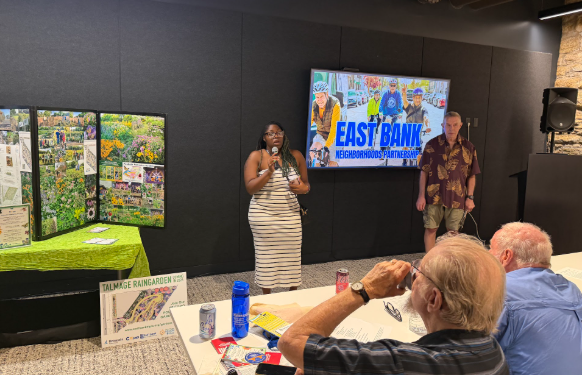
I attended the East Bank Neighborhoods Partnership meeting and shared updates on local priorities including pedestrian lighting, late night safety in Dinkytown, and local land use. Thank you to EBNP for consistently hosting meetings that focus on community needs and bring diverse residents to the table.
Council Member Wonsley presenting at the East Bank Neighborhoods Meeting.
My office attended a meeting hosted by Seward residents, businesses, and community organizations to look for solutions to the multiple sidewalk closures that have made the E Franklin Avenue/Cedar Avenue corridor completely inaccessible to many residents. The Minnesota Department of Transportation (MNDOT) in partnership with the City of Minneapolis have closed the sidewalks as part of an ongoing failed strategy to respond to unsheltered homelessness. These fences have not gotten people off the street, they have merely made sidewalks unusable for residents who rely on them to walk, push strollers, use mobility devices, and take public transit. It’s not abnormal for residents to have to walk in the street on Franklin or Cedar just to access basic services. The multiple closures have also meant that bikers and pedestrians have faced conflicting detours, where one detour re-routes them to another street that is also closed. Additionally, several residents shared how these closures have rerouted dangerous activity to residential streets, schools, and parks.
While the focus of the meeting was the fences, several people raised the lack of coordinated effort amongst government agencies regarding unsheltered homelessness as the clear underlying reasons for the fences.
Thank you to residents for raising these crucial concerns. The decisions to put up fences were made by the Frey administration and MNDOT, and unfortunately an individual City Council office does not have authority to override these decisions. That said, I will continue to stand with residents and amplify your demands for accessible sidewalks on E Franklin and Cedar Ave and continue to advance solutions to the root causes of what is driving these neighborhood safety issues.
The Minnesota Department of Transportation (MNDOT) is hosting a public meeting to learn more about the 2028 Hwy 280 and Broadway St. safety improvements.
From MNDOT:
We have identified safety concerns at the Hwy 280 and Broadway St. Northeast intersection after crash rates exceeded our agency’s critical crash threshold. To address these issues, we are proposing permanently closing the northbound left turn from Hwy 280 onto Broadway St. Northeast, removing the traffic signal and installing a concrete median barrier through the intersection in 2028. Right-turns to/from southbound Hwy 280 will remain open.
Before the closure, MnDOT and local partners will add bike facilities, rebuild sidewalks and improve the Hennepin/Industrial Ave. intersection to support safer, multimodal travel. These improvements are intended to reduce the risk of serious crashes and enhance safety and mobility throughout the area.
Learn more about the safety improvements online.
Thu, Aug. 6 4:30-6:30 p.m. (brief presentation at 5 p.m.)
Van Cleve Recreation Center Gym (901 15th Ave. Southeast, Minneapolis, MN 55414)
Attendees will have the opportunity to learn more about the project and ask questions to the project team. There will be a brief presentation at 5 p.m., but the public is invited to stop by at any time.
We encourage you to attend the public meeting if you live, work or travel in the area.
For more information, visit the Hwy 280 project webpage. If you have questions, please contact the project team.
Summary: MPD presented on the non-fatal shooting task force that I led the City Council to fund. The non-fatal shooting task force has doubled the City’s shooting closure rate– using less than 1% of MPD’s budget.
Background: Last year, my office worked in collaboration with local and national experts on a proposal for Minneapolis to implement a data-backed method to reduce gun violence, a non-fatal shooting task force.
Saint Paul implemented a non-fatal shooting task force in early 2024, and the impressive results have garnered nationwide attention. When police investigate non-fatal shootings with the same level of seriousness as homicides, gun violence citywide is reduced. I believe Minneapolis residents deserve the same level of public safety services as our neighbors in Saint Paul, so I led Council to allocate $1,700,000 within MPD for a non-fatal shooting task force.
This week, MPD presented their first and second quarter outcomes from the Non-Fatal Shooting Task Force. MPD had glowing reviews of the impacts that the program has had on improving public safety outcomes.
The Non-Fatal Shooting Task Force costs Minneapolis taxpayers only $1.7 million/year, under 1% of MPD’s total budget. This is a stark contract to some MPD programs, which use tens of millions of dollars and deliver no measurable impacts to residents. Prioritizing resources into evidence-based strategies like the Non-Fatal Shooting Task Force is how the City Council can avoid wasteful spending of tax dollars while creating a safer city for all. I look forward to continuing to champion this technique and prioritize funding programs that deliver instead of wasteful spending.
Key votes: No votes taken.
Summary: The Climate & Infrastructure Committee received updates on the Climate Equity Plan.
Background: In July 2023, the City Council approved a Climate Equity Plan that outlines our 10-year goals for sustainability and all the strategies and policies that can advance those goals. The headline goal is for the entire city to be carbon neutral by 2050. The Climate Equity Plan was approved after thousands of residents across the city organized to demand real commitments on sustainability instead of empty promises.
This week, the Climate and Infrastructure Committee received updates on the City’s progress on the CEP. I recommend everyone who is interested in the topic watch the full presentation and discussion. It’s clear that the City is making incremental progress at best, and needs to dramatically improve our climate work:
- The City is far off-track in meeting our goal of reducing emissions for commercial, multi-family, and industrial emissions and needs to significantly accelerate reducing use of fossil gas. Heating is the major use of fossil gas.
- The City has met 3% of our goal on insulating homes.
- The City is far off-track of meeting our goal for 3 out of every 5 trips to be taken without a car by 2030. We need to increase public transit ridership by nearly 500%, and significantly increase biking and walking to meet our goals. Street design is the key way to support mode shift from cars to non-car transportation.
Since the passage of the CEP, residents citywide have been organizing to hold the City accountable to using our full authority to advance the strategies in the CEP that advance climate resiliency and environmental justice. In response to community organizing, Mayor Frey created a Climate Legacy Initiative (CLI), which he stated was a $10 million fund for climate work. The funding for these initiatives came from electric and gas franchise fees. Since the inception of CLI, residents demanded that the City significantly increase funding if we were actually serious about making headway on our goals. The City Council approved an increase in electric and gas franchise fees at the end of last year to scale up programs to help working families weatherize their homes. These funds were intended to reduce working families' energy costs while simultaneously reducing the city’s greenhouse gas emissions. The increase in franchise fees was estimated to bring in an additional $4 million to CLI. However, the City Council has since learned that the funds in the Climate Legacy Initiative are not legally required to be committed to climate equity work, and there is significant concern in the community that the funds will be diverted to other areas of the budget, such as MPD overtime or reducing property taxes.
I remain committed to working in partnership with community leaders to ensure that we are bringing in significant funding that is exclusively dedicated to sustainability work, and holding the City accountable to the goals and commitments in the Climate Equity Plan.
Key votes: No votes taken.
Summary: The Office of Community Safety presented updates from Police, Fire, 911, Neighborhood Safety, and Emergency Management.
Background: The Office of Community Safety presented updates from the second quarter from Police, Fire, 911, Neighborhood Safety, and Emergency Management. Due to limited time, committee members were not able to ask questions about the information to the department leadership who presented. Here are the questions I sent to MPD leadership about the data that they presented.
-
In 2018, MPD’s clearance rate for homicides was 63%. In 2025, the clearance rate for homicides was 83%. There were nearly 900 officers on staff in 2018 and just a little over 600 in 2025. How does MPD and OCS interpret this 20% improvement, while simultaneously having 200 fewer officers and larger caseloads?
- Despite having nearly 200 fewer officers, response times are better than they were a decade ago. How do OCS and MPD interpret this data?
- Both Downtown and the Northside have their own dedicated Community Response Teams (CRT). The 3rd and 5th Precinct currently share a CRT, despite the rise of incidents in the 5th, is there any plan for the 5th Precinct to have its own CRT soon? If not, why?
- How does MPD reach out to other jurisdictions to help ensure coverage of high need areas as MPD staff levels fluctuate?
- During critical incidents, who determines whether other jurisdictions such as Hennepin County are called in to provide support?
- There are currently two existing contracts for the Neighborhood Safety Department to provide alternative support to the areas of Nicollet where we have seen an increase in gun violence. According to constituents and Council offices, absolutely no one has seen them.
- How is NSD utilizing contracts to cover Nicollet right now?
- What is the schedule of the groups who cover this area?
- Are precincts made aware of when police alternative resources are going to be coming to their beat? If no, why? If yes, what staff member holds that responsibility?
- If there is an existing contract in NSD and they never seem to be working, what are accountability mechanisms? Are they being used?
I look forward to receiving followup answers in the coming days.
Key votes: No votes taken.
Summary: I participated in a briefing on the Mayor’s plan to recruit and nominate a new chief of police.
Background: The City hosted briefings for Council Members to provide feedback on the Police Chief selection process.
I recently attended a briefing held in partnership with the firm that is helping coordinate the search process for the city’s Police Chief. We were invited to provide feedback on what skillsets, attributes, and qualifications we would like the finalist to exhibit.
I articulated that I do not believe candidates whose only professional law enforcement experience is with MPD should be considered. If an individual’s entire policing career has been within MPD, it raises serious concerns about whether they have been exposed to constitutional, effective, and accountable policing practices. For any internal candidate who advances, they should be prepared to explain the role they played during the years when MPD was widely documented as abusing residents particularly Black and Brown communities. Did they demonstrate leadership in challenging the department’s toxic culture, or were they complicit in maintaining it? More broadly, all candidates should be able to provide concrete examples of how they have challenged the status quo and driven meaningful reform within their previous agencies. A strong background in finance would also be a significant asset, as MPD has regularly overspent their budget and thus placed the entire city in financially precarious positions that taxpayers have to foot the bill for.
Additionally, I shared that the new Chief must have a strong understanding and demonstrated collaboration with police alternative programs and services. Minneapolis has embraced a comprehensive model of public safety and has built robust systems of safety services that include mental health professionals, social workers, and violence interrupters. Previous MPD leadership has not always supported these initiatives so it’s imperative that any new Chief must exhibit a respect and commitment to the city’s comprehensive safety ecosystem.
Lastly, I emphasized that the selection process must also include citywide community engagement such as town halls and forums with selected finalists; as was done with the previous Chief search.
Key votes: No votes taken.
Summary: The Board of Estimates and Taxation (BET) passed a resolution recommending that the City Council and Mayor's Office pursue equitable revenue sources to reduce the burden on property taxes, work I’ve been leading on the City Council.
Background: Minneapolis property taxes continue going up every year, putting a serious burden on working class homeowners and renters. At the same time, many residents aren’t seeing an increase in city services that their property taxes fund. I believe we need to balance the City budget by reining in wasteful spending on programs that don’t serve residents, and to find alternative sources of revenue so that everyone pays their fair share. I led the City Council to get expert recommendations on ways to generate more revenue without raising property taxes.
Two options for alternative revenues are to get authority from the State Legislature to implement new taxes that target empty homes and high-value real estate– commonsense ways to tax the rich. Another recommended strategy is to create a Payment In Lieu of Taxes program so that non-profits, hospitals, colleges, religious institutions, and other tax-exempt property could contribute to the public budget for the public services that they receive, like roads, police, fire, and water. I authored a staff direction to get more information on what a PILOT program could mean for revenues in Minneapolis.
This week, the Board of Estimates and Taxation passed a resolution encouraging the City Council and Mayor to continue pursuing both of these strategies. This demonstrates alignment between the City Council, which is the City’s budgetary authority, and the BET, which is the taxation authority. I look forward to continuing to partner with my colleagues on the BET, City Council, and state legislature on alternative revenue sources.
Key votes: The BET approved the resolution.
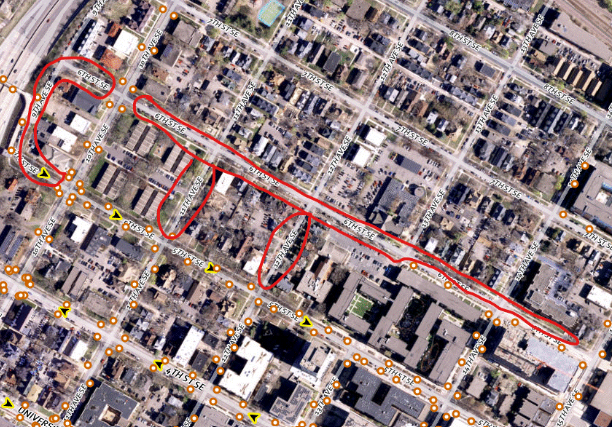
Summary: More improved pedestrian lighting is coming to Dinkytown soon as a result of the Dinky After Dark initiative.
Background: Dinkytown residents have consistently emphasized that they need improved pedestrian-level street lighting to create a safe and welcoming neighborhood for students and members of the University community. Dinkytown and Marcy Holmes have some of the highest rates of public transit usage and pedestrian transportation, yet many were left walking and waiting for the bus in the dark. I worked with the Undergraduate Student Government, University administration, East Bank Neighborhoods on a joint initiative called Dinky After Dark. I also led the City Council to allocate $500,000 to the first phase of the Dinky After Dark initiative, lighting up about six blocks where thousands of students walk.
This week, the Public Works Department shared that installation of street lighting for Dinky After Dark Phase 2 will begin this summer! The timeline was moved up by several months from the anticipated start date due to changes in other street lighting projects.
Public Works staff will coordinate with the other active pedestrian improvement projects in the neighborhood so that both projects do not interfere with each other. They will also minimize the temporary no parking areas as much as possible.
Thank you to everyone who partnered with my office to make Dinky After Dark possible!
Approximate lighting area of future lighting circled below:
Dinky After Dark Phase 2 map
Contact Ward 2
Visit: minneapolismn.gov/ward2
Email: robin.wonsley@minneapolismn.gov
Phone: 612-673-2202
City Hall
350 S. Fifth St., Room 370
Minneapolis, MN 55415
For reasonable accommodations or alternative format please contact 311. People who are deaf or hard of hearing can use a relay service to call 311 at 612-673-3000. Para ayuda, llame al 311. Rau kev pab, hu 311. Hadii aad caawimaad u baahantahay, wac 311. |