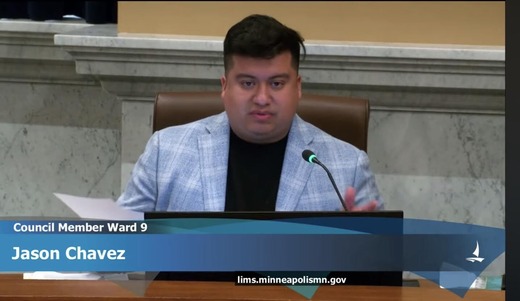
 The City of Minneapolis strives to be a welcoming City to all. More than half of the residents of the City live in rental housing, and all residents deserve to feel safe in their homes and have access to safe housing. That is why I brought forward an ordinance creating protections to ensure residents are not prevented from obtaining rental housing or made to feel unsafe in their rental housing due to their immigration status. At yesterday’s council meeting, we voted to approve this ordinance.
Under this ordinance, a landlord is prohibited from inquiring about a tenant’s immigration or citizenship status. Landlords are also prohibited from denying a rental application solely because the applicant provides an Individual Taxpayer Identification Number (ITIN) in lieu of a Social Security. Further, there are anti-retaliation protections, prohibiting landlords from taking any kind of retaliatory actions against tenants and applicants if they report violations, make requests for repairs, or attempt to join a tenant union among other actions.
Operation Metro Surge was a reminder that we still have so much work to do as a City when it comes to keeping our immigrant families safe and in secure housing. I am proud to have brought this ordinance forward with Council Member Chowdhury, Majority Leader Chughtai, and Council Vice-President Osman, and I appreciate all of the residents, community organizations, and my colleagues who helped to make this happen.
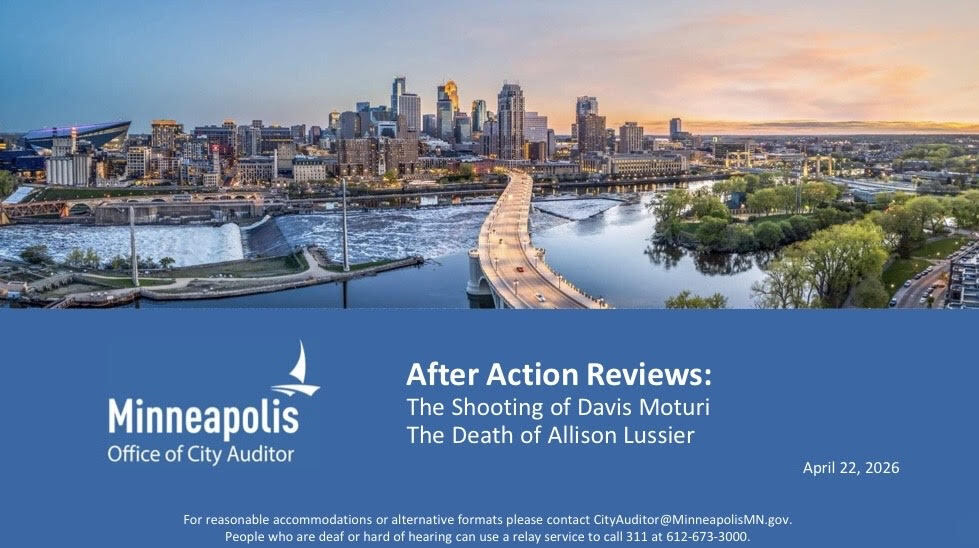 Earlier this week, there was a special joint meeting between the Audit Committee and the city council. There, the Minneapolis City Auditor published a new after-action review of the City’s actions in the cases of Davis Moturi and Allison Lussier.
Davis Moturi is a Black resident of Minneapolis who was facing specific threats of racist violence from his next-door neighbor. Mr. Moturi requested help and protection from the Minneapolis Police Department (MPD), with his household making 38 calls to 911 between October 2023 and October 2024. Nine days after Mr. Moturi called 911 to report that his neighbor leaned out of his window and aimed a firearm at him, Mr. Moturi was shot in the neck by his neighbor.
Allison Lussier was a 47-year-old Indigenous woman who requested MPD protection from her domestic abuser. Ms. Lussier made at least nine 911 calls accusing her partner of domestic abuse. She was found dead in her North Loop apartment in February 2024, one week after her final 911 call.
In response to demands for accountability by victims and community members, the City Council requested that the City Auditor conduct an independent after-action review of the City’s actions in both cases.
The after-action review was delayed due to resistance and opposition from MPD. Last year, the City was forced to add $115,000 to the contract for independent investigation due to police noncompliance with the audit timeline.
The review included 49,000 pages of documents, 75 hours of body-worn camera footage, and more than 30 interviews. The after-action review highlights shortcomings in MPD operations, including:
- Officers demonstrated inconsistent understanding of critical legal and procedural tools such as the distinction between Harassment Restraining Orders and Orders for Protection; warrant execution limits; and the “72 Hour Rule.”
- These differences influenced arrest decisions, case escalation, and, importantly, the accuracy of information provided to victims.
- In the Lussier case, differing views on Crime Lab involvement highlighted the need for more consistent protocols around scene processing and evidence preservation.
- Reporting practices varied widely, including incomplete witness statements, missing victim forms, inconsistent injury documentation, and inconsistent use of flags for bias, weapons, or repeat conduct.
- In the Moturi case, documentation of officer follow‑up was inconsistent, reducing situational awareness across shifts.
- In the Lussier case, incomplete early documentation weakened later investigations. Importantly, MPD did not obtain the Medical Examiner’s report for its homicide investigation until the audit team requested it.
- Information did not consistently reach officers or investigators across units or shifts, resulting in missed opportunities for escalation.
- In the Moturi case, a gun‑threat report was not escalated before the shooting.
- In the Lussier case, inconsistent communication with the Medical Examiner contributed to incorrect internal assumptions.
- These issues reflect a broader problem, where strained relationships at senior levels created ripple effects through the organization.
- Messaging from MPD leadership was at times premature, underinformed, and inaccurate. These statements caused additional harm to the families and heightened public concern.
- Misstatements also played into longstanding distrust among communities disproportionately affected by violence
These findings are horrific. They describe a department that failed at nearly every level. From how it applied the law, how it gathered evidence, how it communicated, and how it spoke to the public. These are failures.
The families of Davis Moturi and Allison Lussier deserve more than a report. They deserve accountability, and they deserve change.
That is why I am committed to bringing the Mayor’s administration before the Public Health, Safety, and Equity Committee to conduct regular, public reporting on the status of the recommendations that came out of today’s review. They must be tracked, implemented, and reported on so that this Council and this community can hold the administration accountable for follow-through. We owe that to these families. We owe that to every Minneapolis resident who deserves a public safety system that actually works.
In January, the City Council passed a resolution urging Governor Walz to enact an eviction moratorium to protect families impacted by Operation Metro Surge. For thousands of residents, leaving their home to go to work was a significant risk to face harassment, violence, or abduction by federal agents. No family should have to choose between keeping a roof over their head and risking a family member being kidnapped by ICE on the way to work. Many families have lost income because of the federal occupation of Minneapolis and need assistance paying their rent.
Last month, Council passed the Pause Evictions, Save Lives ordinance. Unfortunately, Mayor Frey sided with landlords and vetoed the ordinance. The lead author of that ordinance was Minority Leader Wonsley and I was proud to join as a co-author.
Pause Evictions, Save Lives is an ordinance that gives renters more time to pay their rent. Currently, if a landlord plans to file an eviction due to missed rent, they must give the renter 30-days notice prior to filing the eviction. The Pause Evictions, Save Lives ordinance that we passed last month would have temporarily increased the required notice from 30 days to 60 days. After it was vetoed, Council Member Chowdhury and Majority Leader Chughtai brought forward a new ordinance to extend the pre-eviction from 30 to 45 days. I was proud to join this ordinance as a co-author as well.
At yesterday’s council meeting, we voted 8-5 to approve Pause Evictions, Save Lives for a second time, which means that it’s now on the mayor’s desk waiting for his signature. If he sides with the most vulnerable tenants among us, a 45-day pre-eviction notice will be required through August 31, 2026. If he sides with landlords again, the current 30-day notice requirement will remain in place.
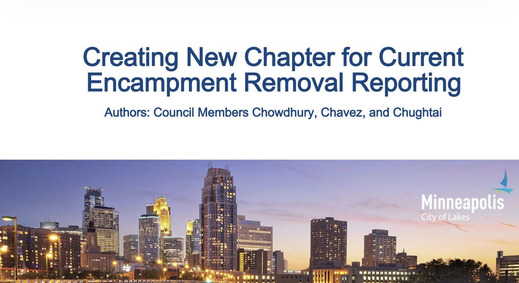 Along with Council Members Chowdhury and Chughtai, we have been working on a number of ordinances to address unhoused homelessness. This is complex work and the breadth of it covers a number of different areas within the City Code. That is why we brought forward an ordinance to create a new chapter to hold the current comprehensive encampment eviction reporting framework for all encampment evictions within the city. The content of this ordinance was first adopted in 2024, and it will allow us to move all future ordinances related to encampments here.
Key provisions of the current encampment eviction reporting ordinance that would be established under the new chapter are:
- Detailed reporting on the cost of and cost associated with encampment removals, inclusive of equipment, city department personnel time, and cost of service providers.
- Detailed reporting requirements for each removal event, including the involvement of city departments, non-government entities, and service providers.
- Data on the number of affected individuals, offers of housing and services, and outcomes related to each removal.
This ordinance promotes greater transparency and accountability in the management of encampments involving individuals experiencing homelessness. BIPOC communities are disproportionately represented among those experiencing homelessness and are often more vulnerable to negative interactions with law enforcement. Detailed reports will gather data on patterns of racial disparities in the deployment of public safety resources during encampment removals. This ordinance seeks to mitigate these risks by providing oversight and ensuring that public safety responses are conducted with respect for the rights and dignity of all individuals, particularly those from marginalized communities.
We are continuing the work on the Safe Parking and Safe Outdoor Spaces ordinances and policies meant to respond to encampments in a humane way.
On August 26, 2025, a mass shooting occurred near Cristo Rey Jesuit High School while students were inside. An individual fired 29 rounds within eight seconds from a rifle at a group of people. The perpetrator killed Gregory Sweeten and six others were injured.
On August 27, 2025, a mass shooting occurred at the Church of the Annunciation. The perpetrator killed Fletcher Merkel and Harper Moyski, and injured twenty-eight other people. The shooter fired 116 rounds from an assault rifle in less than four minutes.
These acts of violence devastated our community. Minneapolis residents and families made it clear that we cannot wait for action. They said that our city and state have the responsibility to act.
On September 11, 2025, Council Member Chowdhury gave notice to begin drafting the ordinance. She has been working closely with the city attorney’s office and community members. Earlier this year, she re-introduced that notice, and I am proud to join as a co-author.
This ordinance would, among other things, ban:
- Assault weapons
- Large-capacity magazines
- Binary triggers
- Ghost guns
Under current state law, the City cannot ban these weapons. This ordinance, if passed by the Council, would only go into effect if the state legislature passes a law permitting cities to take such action.
At this week’s Committee of the Whole meeting, we voted to set a public hearing for this ordinance at the May 5 Committee of the Whole meeting. That meeting will be held in Council Chambers at City Hall on Tuesday, May 5 at 1:30 p.m.
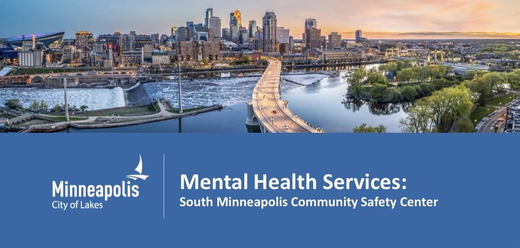 At yesterday’s council meeting, we approved $500,000 for direct service delivery, enabling the city to provide coordinated, trauma-informed, culturally specific, nontraditional community mental health and wellbeing services in a single, accessible location. This funding will support expanded access to community-based mental health and wellbeing services that reflect the cultural needs and lived experiences of Minneapolis residents. I was excited to author this alongside Minority Leader Wonsley.
Locating these services within the South Minneapolis Community Safety Center supports an integrated public safety and public health approach by providing accessible, community-based support in a neighborhood setting. This investment strengthens prevention and early intervention efforts while advancing the City’s goals related to community safety, health, and racial equity.
Earlier this month, Mayor Frey nominated three members of his cabinet: Kristyn Anderson for City Attorney; Margaret Anderson Kelliher for City Operations Officer (COO), and; Toddrick Barnette as Commissioner of Community Safety. Under the City Charter, the city council are tasked with voting to approve or deny the appointment of these staff (among others, which will occur in the near future). Council voted to approve the city attorney and CO, and we voted to deny the appointment of commissioner of community safety.
The mayor vetoed our vote to deny the appointment of the community safety commissioner. A public memo from the City Attorney clearly states that “the availability of a veto does not mean that a veto results in an affirmative permanent appointment to a new term.” Further, it states that “the only action that would result in a permanent appointment to a new term would be an affirmative vote of the Council consenting to the nomination coupled with approval by the mayor.” In other words, it’s now on the mayor to reach out to council members so that we can engage in meaningful discussions about our visions for community safety.
I voted against re-confirming Commissioner Barnette. As chair of the Public Health, Safety, and Equity Committee, I strongly believe we need someone who is present, responsive, effective, and visionary in this role. Unfortunately, Commissioner Barnett’s time in office has been riddled with mismanagement and concerns from a variety of our partners in safety work. That his office asked the council to approve contracts with someone with a history of making homophobic and threatening statements is disqualifying.
There are a number of reasons why a majority of the council voted against this appointment. For more information, please read this memo. This was posted in response to the accusations made by Mayor Frey and in support of the majority of the council who rejected this appointment.
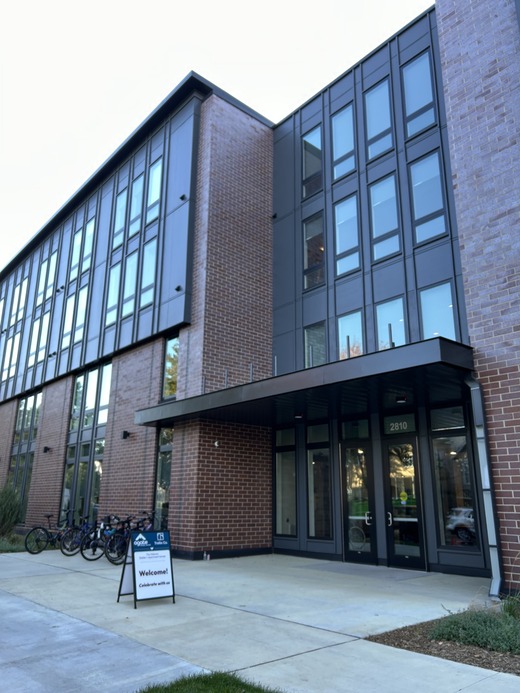 Minneapolis residents are now able to apply for rental assistance funded by the City of Minneapolis. The city council led the efforts to support renter households after the devastating and continued impact of Operation Metro Surge.
Minneapolis residents having difficulty paying rent may be eligible for this assistance if:
- Their household earns no more than 30 percent of area median income
- They have received a 30-day pre-eviction filing notice from their landlord
The City is partnering with Hennepin County to distribute the money through Rent Help Hennepin and their network of community-based partners. Minneapolis households seeking this emergency rental assistance can reach out to one of these organizations to get help starting an application.
More information can be found in English, Arabic, French, Hmong, Spanish, Pashto, Dari, and Somali here.
 The City’s animal shelter has plenty of four-legged friends available for adoption, and there are no adoption fees April 30-May 1. Normally Minneapolis residents pay no adoption fees for cats or adult dogs but $250 for dogs 6 months and younger. Non-residents normally pay an adoption fee up to $250 plus tax for any of the pets.
The City provides daily care, shelter and adoption services for animals in Minneapolis. We have about 65 animals in our care right now. Every adoption creates space for another animal in need. We’re open six days a week for adoptions and have a constantly changing selection of pets rescued in your community, cared for by your City. Adoptable cats and dogs are already spayed or neutered, vaccinated and microchipped. Licensing fees may still apply.
- No adoption fee event
- Take the time to meet and fall in love with the pet that’s right for you.
- 1:00 -5:00 p.m. on Thursday, April 30, and Friday, May 1
Find adoptable pets on the City website.
Curious what happens inside Minneapolis City Hall? During Doors Open Minneapolis, you’re invited to take a look. From 10:00 a.m. to 5:00 p.m. May 9-10, this free event offers behind-the-scenes access to spaces that shape our city and the people who keep it running.
At City Hall and Hennepin County Courthouse, don’t miss your first chance to see the newly updated City Council Chambers and other renovated spaces. Staff will be on hand to share how their work serves the community.
Doors Open is about more than buildings. It’s about helping people feel connected to their city. By opening these spaces, we make civic life more approachable and invite everyone to better understand, and care for, the place they call home.
You can also explore City sites like Fire Station 1, the Minneapolis Traffic Management Center and other spaces that shape our city.
Plan your visit on the Doors Open Minneapolis website. No tickets are required — just bring your curiosity.
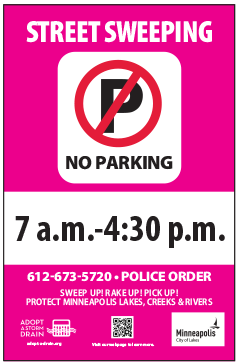
Public Works crews started the City’s comprehensive street sweeping program April 21 to clear away what accumulated in the streets over the winter. Drivers should watch for hot pink temporary “No Parking” signs to avoid a ticket and tow.
For approximately four weeks, sweeping crews will take care of more than 1,100 miles of city streets and nearly 400 miles of alleys. To make sure the crews can do the most complete job possible, temporary “No Parking” signs will be posted at least 24 hours in advance to make sure streets are clear of parked vehicles. Drivers need to follow street sweeping parking rules or they may have their cars ticketed and towed to the Minneapolis Impound Lot.
Find your street on the schedule: You can see when your street is scheduled to be swept by visiting the interactive street sweeping map. Learn more about street sweeping.
 Celebrate with your neighbors at Neighborhood Day Saturday, May 2. Neighborhood Day is an annual day set across the city to increase resident participation in local civic engagement through one of the city’s 67 recognized neighborhood organizations. It’s a chance to come together in community, find the neighborhood organization that represents you and get to know your neighbors.
Neighborhood organizations host their own events, ranging from board elections to family-friendly activities. This year, select neighborhood events will include a bike tour, bean bag tournament and duck race. No matter your neighborhood, there’s something for everyone.
Use this map to find information about your nearest Neighborhood Day events.
Your voice is important: Neighborhood organizations are the most local, smallest form of government. It’s an easy way for residents to be involved at the most grassroots level in their own neighborhood, on their own street. Find information about your neighborhood organization.
Through the Neighborhood Traffic Calming program, Minneapolis Public Works is finding ways to make your neighborhood streets safer and reduce risky driving. We have identified several areas for traffic calming projects in 2026. The City wants to hear your concerns about traffic safety near the projects. You can provide feedback in several ways.
Tell the City about traffic safety concerns in your neighborhood. Use the project feedback map to tell us about safety concerns you experience near the projects.
Complete a short survey by May 1 to share more of your thoughts
Yard waste season began the week of April 6. During yard waste season, we pick up yard waste every week on your garbage pickup day. There is no extra charge for us to collect properly prepared yard waste.
The City accepts leaves, brush and other yard trimmings. You should prepare yard waste and set it at your alley or curb next to your garbage cart by 6 a.m. on your garbage pickup day.
You can set yard waste out in reusable containers, compostable bags (paper or BPI certified compostable plastic) or bundles secured with string or twine. Learn how to prepare your yard waste for pickup.
Attend the Minneapolis Health Department annual resource fair for a free light lunch and connect with the City’s health, wellness and sustainability programs. Stick around for the Local Public Health Heroes award ceremony at noon and see who is helping make Minneapolis healthier. This year’s Local Public Health Heroes theme is “Supporting Community Resilience.”
When Wednesday, April 29
What Public health resource fair: 11 a.m.- noon Award ceremony: Noon-1 p.m.
Where Public Service Building 505 Fourth Ave. S., Room 100
Learn more about the public health resource fair and award ceremony.
 Operation Metro Surge has had a devastating impact on our economy and small businesses. I was proud to author funding with my colleagues to create the Minneapolis Small Business Resiliency Fund. This was meant to help our city recover from losses, promote community gatherings and drive customers to our vital commercial districts.
The Minneapolis Small Business Resiliency Fund provides $7 million for license fee relief, financial support for public events in commercial areas, cultural market grants and additional resources.
Immediate relief
License fee relief: We are excited to share that over 2,000 food and hospitality businesses are already receiving license fee relief. Eligible businesses have been contacted. Business Licensing staff is processing refunds for businesses that paid for their eligible 2026 license before the fund was announced.
Fee-Free Events: This year, you can look forward to events throughout the city that bring our community together in celebration — recognizing all we’ve been through and helping to uplift and energize our small businesses. This is supported by the City covering common event permit fees for 2026 public events. Read more about which permits are covered.
If you have questions about Fee-Free Events, email the Small Business Team or call them at 612-673-2499.
Funding opportunities
Existing business support programs are getting a boost this year thanks to monies from the Resiliency Fund. These programs will provide direct and indirect support for small businesses across the city in 2026.
Cultural business weeks: Organizations can apply now to host events during Black Business Week, scheduled for July 27-Aug. 2. Applications are due by 4 p.m. April 27. A separate request for proposals will be issued later this year for Latino Business Week events.
Business Technical Assistance Program (BTAP): Funding is available for organizations that can provide consulting services and training for entrepreneurs and small businesses. Both nonprofit organizations and for-profit businesses may apply. Proposals from service providers are due by 4 p.m. April 27.
Cultural market grants: The Cultural Market Small Business Support program is currently accepting applications for grants to cultural mall operators for activities that benefit all tenants and customers, such as security, marketing and physical improvements to common spaces. Applications are due by 4 p.m. May 13.
Great Streets Business District Support (BDS): BDS awards money to not-for-profit organizations to enhance the vitality of existing commercial districts in Minneapolis. The application period has closed and funded applicants will be notified in the next few weeks.
Learn more about these and other funding opportunities.
More to come
And — there is more to come. Additional information for venue and music activation, as well as the creative marketing activation, will be available later this spring as the City’s Arts and Cultural Affairs department solidifies details with partners.
To receive future updates about funding opportunities, sign up for Plan. Launch. Grow., the monthly newsletter from our Small Business Team.
Learn more about the Small Business Resiliency Fund.
Contact the Ward 9 Office
Email: jason.chavez@minneapolismn.gov
Phone: 612-673-2209
City Hall
350 S. Fifth St., Room 370
Minneapolis, MN 55415
For reasonable accommodations or alternative format please contact 311. People who are deaf or hard of hearing can use a relay service to call 311 at 612-673-3000. Para ayuda, llame al 311. Rau kev pab, hu 311. Hadii aad caawimaad u baahantahay, wac 311. |