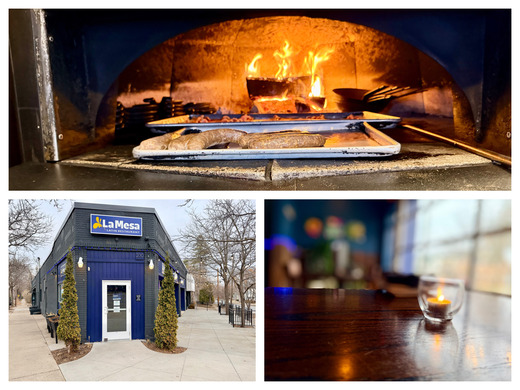
Photos of La Mesa Restaurant in Bryn Mawr, featuring the wood-fired oven, the blue-trimmed corner exterior, and a candlelit table inside the dining room.
Two weeks ago, the council unanimously passed a resolution allocating $7 million for small business aid. We’re now waiting for planning and economic development staff to come back to council with recommendations for high-impact deployment within our small business community, and we’re hoping to receive those recommendations later this month. While this won’t come close to meeting the full needs of our struggling business community, it’s a start, and we’re hoping this commitment can help leverage additional state aid.
When the recommendations from staff come back, we’ll make sure that information reaches the community at large. In the meantime, I thought it would be helpful to interview one of our local Ward 7 small business owners to hear about her experiences firsthand about the joys and challenges of operating a small business in our community.
Ann, who along with her husband Juan, owns and operates La Mesa graciously agreed to an interview.
Tell us who you are and how La Mesa came to be:
Juan grew up in Ecuador, where cooking together was part of daily life. He started cooking professionally when he moved to Minnesota almost 30 years ago. We opened La Mesa in 2018 in our own neighborhood as a place that reflects that heritage and the fine dining cooking Juan has done in Minneapolis.
What is La Mesa, and what are you trying to create?
We like to say that La Mesa is a neighborhood bistro with Latin roots. Our goal is simple: a warm, welcoming place that serves great food and drink.
What does a typical week look like?
Running a small restaurant means doing a little bit of everything — cooking, serving, ordering, scheduling, and solving whatever issue pops up that day. It’s a lot of moving parts, but we love the rhythm of it.
What have been the hardest things to navigate?
Like many small businesses, the last few years have meant adapting to higher costs, labor shortages, and new state and local regulations. Every shift requires careful adjustments.
How has Operation Metro Surge or public safety affected your business?
Public safety matters for everyone — our guests and our staff. When people feel comfortable coming into a neighborhood and spending the evening, local businesses benefit.
What role does La Mesa play in the community?
We see the restaurant as a gathering place — somewhere neighbors can meet for dinner, celebrate something special, or just stop in for a drink. Small businesses help give a neighborhood its rhythm and personality.
What do you wish more people knew about running an independent restaurant?
Most independent restaurants are very small operations behind the scenes. It takes a lot of hard work and dedication to keep things running smoothly.
When someone walks out happy, what do you hope they’re saying?
Ideally something like, “That was great— we should come back soon.” Seeing people really enjoy their evening is one of the most satisfying parts of the job.
How can the community support you?
The best support is simple: come in, bring friends, and tell people about places you enjoy. Neighborhood restaurants really depend on repeat visits and word of mouth.
Anything else you’d like to add?
We’re grateful to be part of Bryn Mawr and to have such lovely neighbors and guests. We really appreciate being a part of this community.
____________________________________________________
Stop in and see La Mesa for yourself at 230 Cedar Lake Road South. They’re open Tuesday to Saturday from 5:00-10:00pm | www.lamesampls.com | 612-259-8943

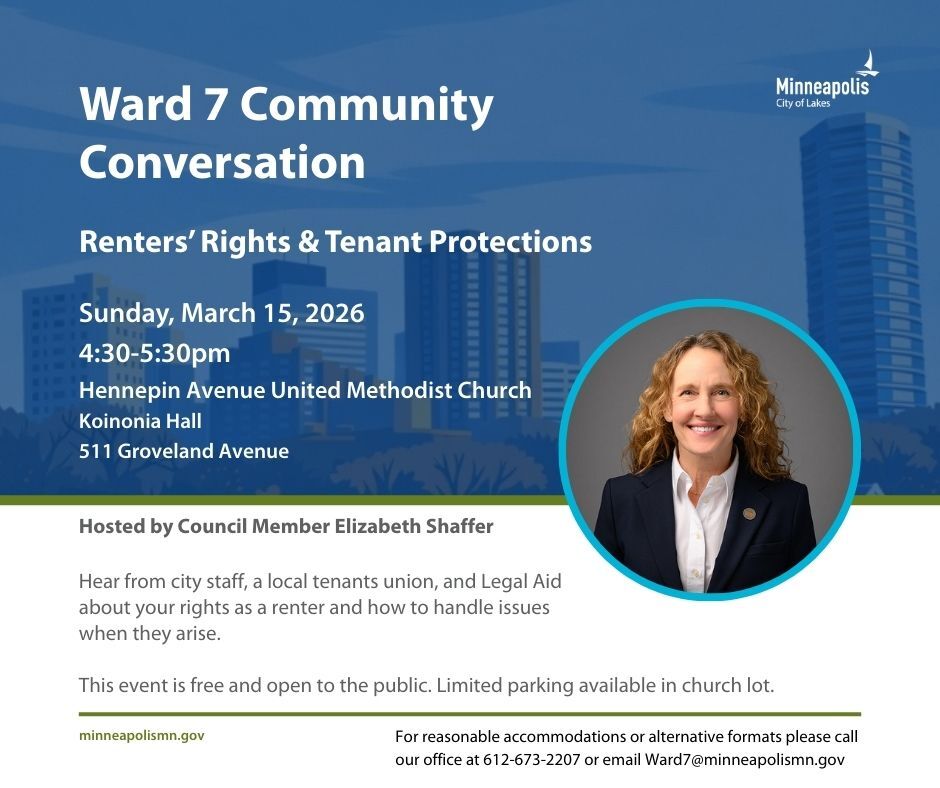
On Sunday, March 15, from 4:30 to 5:30 p.m., I’ll be hosting our second Ward 7 Community Conversations event at Hennepin Avenue United Methodist Church. Our first event focused on the impact of Operation Metro Surge on our Ward 7 school communities, and the upcoming event will focus on renter’s rights and tenant protection, which I’ve been hearing a lot about from community members, particularly in the Loring Park area. We’ll hear from city enforcement staff, the president of a local tenant’s union, and a Legal Aid attorney with expertise in tenant’s rights and eviction prevention. The event is free and open to the public, and I hope you can join us!
This was a busy week for City Council with our Committee of the Whole meeting on Tuesday lasting all day and needing to be adjourned to the next day to finish our business. Then there was the council meeting on Thursday. The most substantive issue we took up was whether to temporarily extend the pre-eviction notice period from 30 to 60 days.
After hearing nearly six hours of public comments and a lengthy debate amongst the council, this measure passed 7-5 and now it’s up to the mayor to decide whether he will sign or veto it.
Ultimately, I was not able to support this measure.
I want to begin by acknowledging what I heard during public commentary and in many other venues: the extraordinary outpouring of mutual aid we have seen across Minneapolis. Neighbors are raising money and sharing food to support families living with uncertainty. That solidarity is something our city should be proud of.
I take the argument from our residents seriously: that if ordinary people are stepping up, then government should at least do the “bare minimum” to help. But our responsibility as policymakers isn’t just to pass a policy that feels like the bare minimum—it is to pass policies that actually work.
When we heard from the people who provide affordable housing whether this proposal would stabilize tenants, their answer was a warning: this proposal is counterproductive.
This past Tuesday, we heard from a coalition of nonprofit housing providers—including Aeon, Agate, CommonBond, Catholic Charities, and Project for Pride in Living—who collectively house thousands of our neighbors. These are the partners we fund through our Affordable Housing Trust Fund. What they told us is that extending the notice period from 30 to 60 days will produce worse outcomes through larger balances and higher rates of eviction.
When they speak with a united voice, we have a responsibility to listen.
Consider the math they shared:
- Under the current 30-day timeline, residents typically reach court two to three months behind on rent.
- A 60-day notice period will result in an accrual of three to four months of rent.
- At that level, the debt becomes insurmountable for most households, even with rental assistance.
This is where what looks like “mercy” can actually become a trap. Giving someone more time sounds like compassion, but time without money is just a longer runway toward a deeper crisis. If we allow rent balances to keep rising while help is delayed, we aren’t providing “breathing room”—we are creating a debt trap that residents cannot escape.
Furthermore, these providers explained that the eviction notice is actually when outreach begins. That is the moment staff connect tenants with rental assistance and negotiate payment plans. By delaying that notice, we are delaying the help. We are letting a manageable crisis grow while balances are still surmountable.
Finally, we must consider the long-term damage. A massive outstanding balance on a housing record makes it nearly impossible to qualify for a new home in the future. What looks like “mercy” today becomes a permanent barrier to housing stability tomorrow.
The experts were clear: the most effective tool for preventing eviction is rental assistance, not longer timelines. That is why this Council has already approved:
-
$1 million in rental assistance
-
$500,000 for immigrant legal services
-
$7 million for small business support
We are continuing to lobby the state through our Intergovernmental Relations staff for the substantial funding our housing providers say actually keeps people housed.
This vote is not about whether we care—it is about whether this policy achieves the outcome we all want. When the organizations that house our most vulnerable residents warn us that a proposal will increase housing instability, we have a responsibility to trust the experts.
Another important presentation we received on Wednesday was an update from Chief Brian O’Hara about the effects of Operation Metro Surge on the Minneapolis Police Department. This presentation takes you through the major events and difficulties beginning in December 2025, including budget and personnel impacts. If you are interested in how MPD handled this crisis, please watch here.
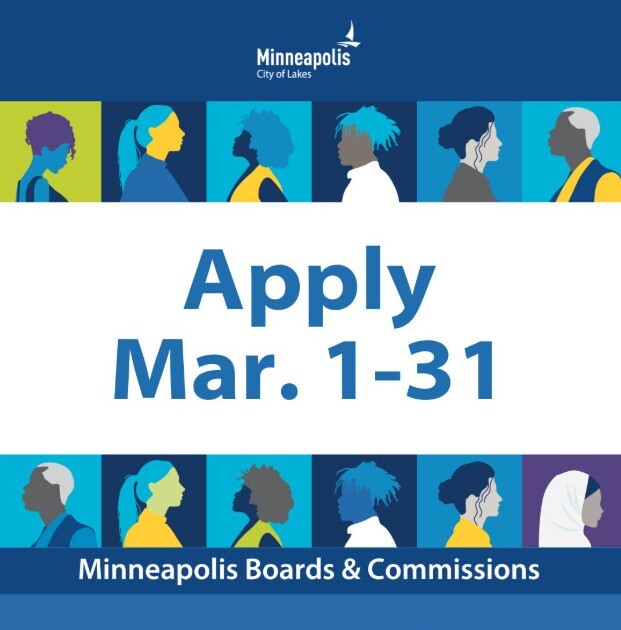
Minneapolis is seeking passionate community members to serve on its boards and commissions, helping shape the policies and programs that affect every neighborhood. Applications are open March 1-31.
While we encourage people to apply for any of the boards that interest them, there are four boards that are currently seeking representation specifically from Ward 7: the Minneapolis Arts Commission, the Minneapolis Advisory Committee on Aging, the Minneapolis Advisory Committee on Housing, and the Public Health Advisory Committee.
One of the City’s most visible boards is the Minneapolis Arts Commission. Members of the Arts Commission play a critical role in guiding public art across the city. Members advise on public art works funded by public dollars, serve on artist selection panels, and review recommendations from the Public Art Advisory Panel. By joining, you can help ensure Minneapolis continues to be a vibrant, creative and inspiring city for everyone.
Other recruiting boards and commissions include:
- Homegrown Minneapolis Food Council to grow and strengthen the local food system.
- Minneapolis Workforce Development Board to connect people to jobs and strengthen the local workforce.
- Safe and Thriving Work Group to advise on community safety and support restorative, non-police solutions.
- Community Commission on Police Oversight (seat open in Ward 9) to ensure accountability, transparency and trust in policing.
- Advisory committees on aging, bicycling, housing, people with disabilities, public health and walking. Help shape City policies that improve daily life.
Serving on a board or commission is a unique opportunity to make a difference in your community, bring your expertise and ideas to City leadership, and collaborate with fellow residents who care about the future of Minneapolis.
Video: You can watch a short video about serving on a City board or commission.
Learn more and apply on the City website March 1-31.
Click here for the Applicant Quick Guide which walks you through the process of applying.

Traffic safety camera.
Our traffic safety cameras are already showing results; speeding went down by more than 50% in the first two months.
A pilot of traffic safety cameras for speeding is part of the City’s Vision Zero effort to get to zero traffic deaths and serious injuries.
The Minneapolis traffic safety camera pilot launched Oct. 1 with five cameras focused on speeding, and the report for 2025 is out. It shows more than 13,000 fewer people speeding at all the camera locations over December compared to October. Speeding at more than 20 mph over the limit was down 58%. We saw large reductions in speeding at every camera location.
The City expects to add more speed cameras and add red light cameras as early as this spring. Those locations will be decided from 11 locations identified as high priorities in the City’s 2025 camera location analysis. There will be public notice, including signs at the sites of the future cameras, before any new cameras are added.
Read the full traffic safety camera pilot report on the City website.
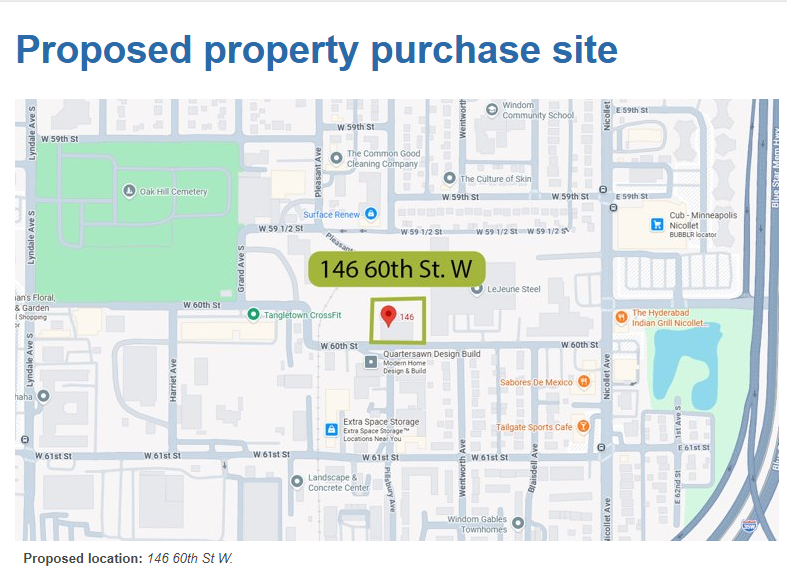
Last week council members were invited to attend a Community Safety briefing on the need for an updated, consolidated law enforcement training and wellness center. Current facilities are scattered and outdated, with one training facility currently operating in a former Minneapolis Public School. While the department has needed a new facility for some time, the matter took on new urgency when a site at 146 West 60th Street, in a light industrial area of south Minneapolis, became available.
In recent years, Minneapolis has recognized the importance of modernizing law enforcement and emergency response training facilities to prepare for large-scale events. These events underscore the importance of supporting first responders’ physical and mental health, and many of the functions of this center are required by the consent decree with the State of Minnesota.
The proposed facility would serve 911, Behavioral Crisis Response (BCR), Emergency Management, Fire, Neighborhood Safety and Police. The total estimated project cost is $38 million, and would be covered by the City’s capital budget as well as a request for State funding.
Anticipated features include:
- State-of-the-art classrooms: Modern classrooms of varying size that are designed and equipped for adult learning
- Wellness and mental health support: Space and resources, like family support rooms, offices for employee support teams, among others
- Fitness
- Advanced training spaces: large-scale areas for exercises and incident management, which the City currently lacks
- Indoor shooting range: The MPD shooting range would be relocated from the 4th Precinct
Approval for funding to match a state funding request will come before the council the end of March. Learn more about this proposal and how it supports a safer Minneapolis on the City’s website.
During major emergencies such as Operation Metro Surge in Minneapolis, the City activates an Emergency Operations Center (EOC). Staff from various departments and community partners collaborate to respond to the crisis and offer resources to community members.
Staff pause their regular duties and gather in one room, focused entirely on the emergency at hand as a single, unified operation. They streamline decision-making, deploy resources quickly, and meet the most urgent needs of residents and community members.
The Emergency Operations Center also brings together county and state resources, as well as other critical partners and experts from outside City government. Having everyone at the same table ensures a timely and coordinated response.
Effective February 27th, the city deactivated the EOC for Operation Metro Surge (OMS) impacts. For three months over the course of the last six months, the EOC has been up and running, responding to the mass shootings at Annunciation, Lake Street and then Operation Metro Surge. With 132 staff from City departments contributing their time, these team members worked extremely long hours, including overnight and through weekends, and deserve our deep appreciation.

The Minneapolis City Trees program offers free and low-cost trees for residents and businesses
Tree ordering is now open to all residents and businesses in Minneapolis. We offer low cost, $30 trees for both residents and businesses. If you live in a low canopy area of Minneapolis, you may be eligible for free trees.*
Trees offer many benefits, including:
- Lower utility bills
- Shade for your property
- Habitat for wildlife
- Increased property values
Learn how to order trees on our website
|