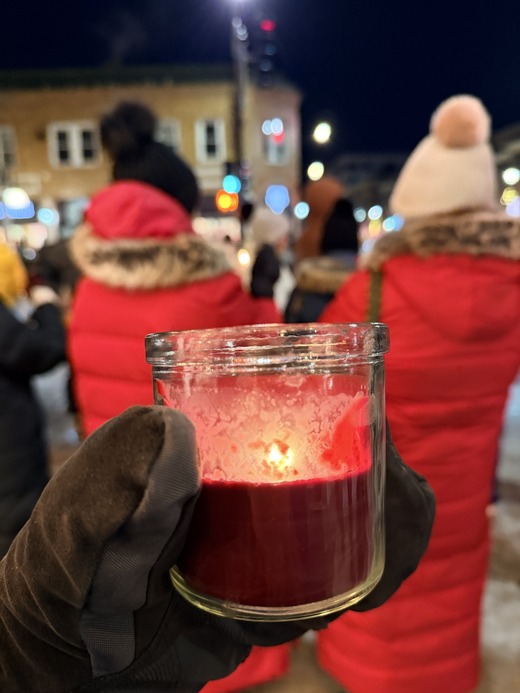
 It’s been just under a week since Alex Pretti was killed by federal agents at the intersection of 26th and Nicollet, and we all continue to feel a range of emotions – anger, sadness, and uncertainty about the future, to name a few. But we also continue to resist, and that unflagging resolve has finally caught the attention of the country at large – Bruce Springsteen has written a song, Anderson Cooper hosted a town hall, Congress is starting to discuss DHS reform. Earlier this week, Greg Bovino was replaced by Tom Homan, and while Mr. Homan has offered some more conciliatory words and talked yesterday of a “drawdown,” ICE continues to operate freely in Minneapolis, and with relative impunity. I hope the talk of a drawdown is real – we’re all exhausted – but I won’t believe it until we see these masked men out of our neighborhoods and away from our schools, and that hasn’t happened yet.
Legal Update
The hearing on the city’s motion for a temporary restraining order against ICE in our federal lawsuit had a hearing on Monday. It lasted two and a half hours, and featured tough questions from the judge, and a request for more briefing on specific questions the judge had for the federal government. Although we’re hoping for a ruling any day, the timing is entirely up to the judge, although intervening events on the ground could have an impact as well.
In the meantime, Patrick Schiltz, the chief judge of our federal court here in Minnesota, has plainly had it with ICE, issuing a series of letters and orders this week, one of which noted that ICE has violated at least 96 orders in 74 cases, meaning that “ICE has likely violated more court orders in January 2026 than some federal agencies have violated in their entire existence.” Judge Schiltz continued: “This list should give pause to anyone—no matter his or her political beliefs—who cares about the rule of law.” The bottom line? Regardless of what happens with the city lawsuit, we’re expecting our federal courts will start taking action on their own initiative unless ICE dramatically shapes up its act.
Last but not least, on Wednesday a different federal judge, John Tunheim, issued an order directing that lawful refugees detained by ICE be returned to Minnesota and released immediately. Judge Tunheim emphasized the legal right of refugees to be in the United States, and decried the fear and chaos caused by the government’s actions:
“Refugees have a legal right to be in the United States, a right to work, a right to live peacefully—and importantly, a right not to be subjected to the terror of being arrested and detained without warrants or cause in their homes or on their way to religious services or to buy groceries. At its best, America serves as a haven of individual liberties in a world too often full of tyranny and cruelty. We abandon that ideal when we subject our neighbors to fear and chaos.”
 Community Action
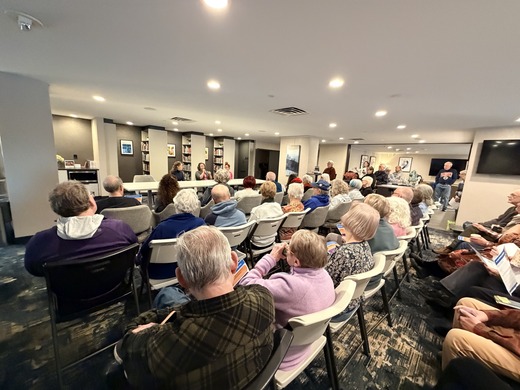
Within Ward 7, neighbors continue to work tirelessly to support neighbors, and that work is an inspiration to us all, including the larger world. Last Sunday my office helped coordinate a meeting at the Loring Green East condominium building for residents who wanted to find ways to get directly involved in helping those who cannot help themselves. We heard presentations from school-based organizations who are offering food aid, rental assistance, and educational support to families with school-age kids who are currently forced to shelter in place. The event was packed, and it was heartening to see so many residents lining up to offer help after the formal presentations wrapped up.
 MPD Graduation at the Basilica
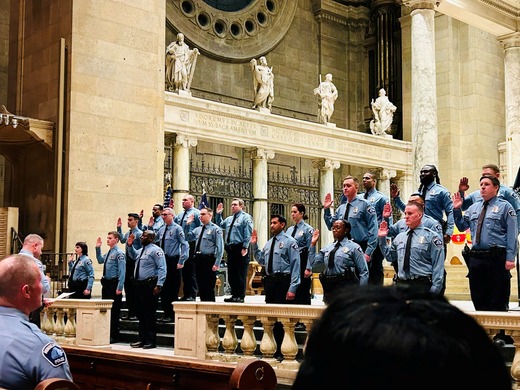
With all the fear and uncertainty swirling around our city, it was a joy to be able to attend the graduation of the latest class of Minneapolis Police Department officers – 24 in total! After years in which recruitment was barely enough to offset attrition, the ranks of MPD recruits has swelled recently, and if it continues at this pace (which is expected), Chief O’Hara says he believes the MPD will reach its charter minimum number of officers (731) in the next two years. While that certainly doesn’t mean all our work will be done, the department’s anticipated growth will provide much-needed relief to exhausted officers who have been stretched thin by the unending demands of their jobs.
It was also inspiring to see and hear about the diversity of this latest class. MPD is building a department that reflects the diversity of our community, and the diverse skill sets needed for effective policing in a new era. As badges were being handed out to the new officers, I particularly appreciated the class speaker, who marched up to the chief to receive her badge with her three year-old son in her arms!
 Spotlight on Schools
By Dave Berge, Council Aide
Before coming to work in the Ward 7 office, I was a Special Education teacher in the Minneapolis Public Schools. Over the years, I came to know scores of incredible educators – many of whom now find themselves, once again, on the front lines of a crisis.
The last crisis was COVID, a pandemic largely beyond our control. This time, the crisis has been created by our own federal government, throwing our schools into emergency mode.
For this article, I interviewed a former colleague and friend who works at a Minneapolis high school serving a significant immigrant population, with students from every corner of the world. Because of the sensitive nature of providing aid to immigrant families in the era of Trump 2.0 and Operation Metro Surge, I have withheld the name and identifying details about the school.
That decision alone underscores one of the realities my colleague wants people to understand: students and families are living in constant fear. “The fear is very real,” she told me. “People are living in fear 24 hours a day.”
Students and families are afraid to go to work. Afraid to shop. Afraid to see a doctor. Afraid because so many have already had family members taken. One 17-year-old student’s father – her family’s primary breadwinner – was detained. She is now caring for herself and her siblings, with no idea where her father is or when, or if, he will return.
Numerous students at the school have been detained themselves. One student had ICE break into his home in the middle of the night and drag him outside in only his pajamas. Though he was later released, he continues to live with the trauma of masked men forcing their way into his home.
At least once a week, staff receive texts from students saying: “ICE is outside my house. What should I do?”
Are these students amongst the “worst of the worst,” federal officials claim to be protecting us from? On the contrary, my former colleague said they are “the most kind-hearted, hardest-working students I’ve ever met.”
Many are preparing for careers in nursing and health care. Others dream of starting businesses or becoming entrepreneurs. They believe deeply in the American promise of working hard, following the rules, and contributing to their communities. As my friend put it, “Everything these students hoped for and dreamed of has been completely stolen from them.”
Today, she estimates that 98% of students at her school are learning remotely. As we learned during the pandemic, online learning is no substitute for in-person education – especially for multilingual learners.
Students face irreparable harm to their academic and economic futures. Many may never return to school or graduate. They are missing opportunities for post-secondary programs that save money, accelerate careers, and help them continue building critical English reading, writing, and speaking skills.
One of the hardest moments for educators comes daily, when students ask: “Why did this happen? And when will it end?” Teachers don’t have satisfying answers, only the promise: “We don’t know, but no matter how long this lasts, we will be here for you.”
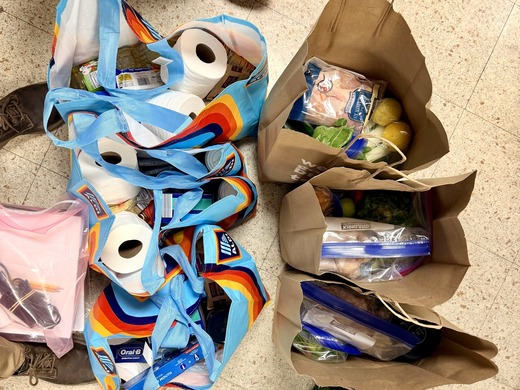
Still, there are bright spots. On a dime, educators have become social workers, logistical coordinators, and fundraisers. At her school, they are delivering food to more than 90 families across the metro. They’ve raised money to help with rent, groceries, car repairs, and other basic needs.
The outpouring of support from the people of Minneapolis, she says, has been extraordinary. “If we keep doing that,” she told me, “we will win.”
So how can we help?
Her answer was clear: rental support is the single greatest need right now. Food donations – especially culturally relevant food – are also deeply appreciated.
She encourages residents to find a school they’re connected to, reach out, and ask how they can support a family. Buy donuts or lunch for school staff. Show up in small but meaningful ways.
Her closing message is simple and powerful: “Don’t give up hope. Don’t give in to despair. When we fight hatred with love, we win.” |