|
My office participated in the monthly University Strategic Safety Meeting that brings together stakeholders from across campus and the University community on shared priorities around public safety and community safety.
This month, we celebrated a July 4th without major safety incidents and reflected on how a strong preventative plan helped ensure a successful holiday weekend.
Overall, safety has been improving significantly in the University area. Crime rates are down and the last robbery in Dinkytown was at the end of March. University admin reported that as orientation season kicks off, they are noticing much fewer family concerns and questions about campus safety. Investments like the off-campus safety center, improved lighting, and UMPD’s expanded off-campus jurisdiction appear to be a key parts of this success.
In 1935, Seward was home to a deadly battle over labor rights. Now, local labor activists have organized a series of activities to commemorate these major events in local labor history. The exhibit includes display panels, vintage photographs, and images and stories of the Ivy Arts/Flour City building from 1902 to 2025. Events will include lectures on local labor history, Seward History Q&A, concerts, and opening and closing parties.
The labor struggles that took place 90 years ago are more relevant than ever in our current political moment. Thank you to residents for organizing this important and well-rounded event series.
MASSACRE AT FLOUR CITY!
The Deadly Battle over Labor Rights
In the Streets of Seward, in the Summer of 1935
Vine Arts Center: 2637 27th Avenue South
Saturdays July 12th, 19th, and 26th
Exhibit and event details at the Ivy Building website.
Free and open to all.
Sponsored by the History Committee of the Seward Neighborhood Group and Smart Set Community Printing, with local labor union support.
Event poster for Massacre at Flour City art and history event at the Ivy Building.
Summary: Council Members want the City to enter into a legally binding agreement to implement the police reforms from the federal consent decree, and tried to direct the City Attorneys to do so The City Attorney’s Office claimed this was not a viable pathway. I remain committed to finding a viable pathway.
Background: In May, the Trump administration dismissed the federal consent decree. This removed one of the strongest mechanisms for ensuring that the City actually implemented systemic changes to help end racist and unconstitutional policing. The provisions that were included in the federal consent decree included many police reforms that numerous City leaders had promised for years, but never actually implemented.
I started raising concerns that the Trump administration would dismiss the federal consent decree as early as January. That apprehension led me to reach out to the City Attorney to discuss a potential “Plan B” to ensure that even if the consent decree didn’t move forward, the City would still be legally committed to implementing the hundreds of reforms that both and Mayor and the City Council had formally signed off on. One pathway that my colleagues and I were interested in advancing was amending the City’s ongoing police reform agreement with the Minnesota Department of Human Rights (MDHR) to include the provisions from the consent decree.
Between January and June, the City Attorney's Office told Council that this was a goal shared by all city leaders, that the pathway was viable, and that the City Attorneys were jointly pursuing it with MDHR. I brought forward a staff direction to formalize what I believed was the shared legal strategy.
In response, the City Attorney produced a new legal opinion with information that had not been shared with me or my colleagues during several months of closed session conversation. The new opinion is that neither Council nor the Mayor has the authority to direct the City Attorneys to renegotiate the MDHR agreement. While I understand the City Attorney’s opinion that the Mayor, rather than Council, has authority over contract negotiations, I was very surprised that the City Attorney declared that she would not seek to amend the MDHR agreement due to her inability to make a legal argument to preserve the federal provisions. I was not the only one that was unconvinced by her opinion. Legal experts including a previous City Attorney have publicly stated their disagreement with the current City Attorney’s analysis that there is no legal pathway forward at all. In addition, the MDHR, which is represented by Attorney General Keith Ellison’s office, has publicly stated they are willing to come to the table to support this effort. Here is a portion of MDHR’s most recent statement regarding this issue:
“To bring about the transformational changes needed in the City and MPD, modifying the terms of the state consent decree may be helpful at times, including in this moment when a federal court has dismissed the proposed federal consent decree.”
It deeply concerns me that the City Attorney maintains the opinion that there is no viable pathway forward, despite agreement amongst many attorneys and strong support from residents.
I remain committed to finding a way for the City to enter a legally binding agreement to rein in MPD as outlined in the consent decree. Minneapolis has a long history of broken promises on police reform, which has caused years of trauma and cost taxpayers millions in legal settlements. Residents deserve not only a verbal commitment to reform, but a legally binding one.
Key votes: Council voted unanimously to delete the item directing the City Attorneys to renegotiate the settlement agreement with the Minneapolis Department of Human Rights. I and several of my colleagues remain committed to finding a pathway to a legally binding agreement that includes the consent decree provisions.
Summary: Dinkytown is getting new pedestrian lighting thanks to Council advocacy and funding.
Background: For decades, students and university community members have emphasized the need for increased pedestrian-level lighting in the Dinkytown Marcy Holmes area. My office worked with students and stakeholders to allocate $500,000 to install new pedestrian-level lights to address this important safety and livability issue. We call this project Dinky After Dark.
Dinky After Dark lighting installation has now begun! Most of this work is planned for June and July so that we can be done before the school year starts.
This work will cause intermittent short term no parking restrictions using only as much space as needed for work immediately adjacent to the lighting construction. There will not be any full road closures or detours with the work.
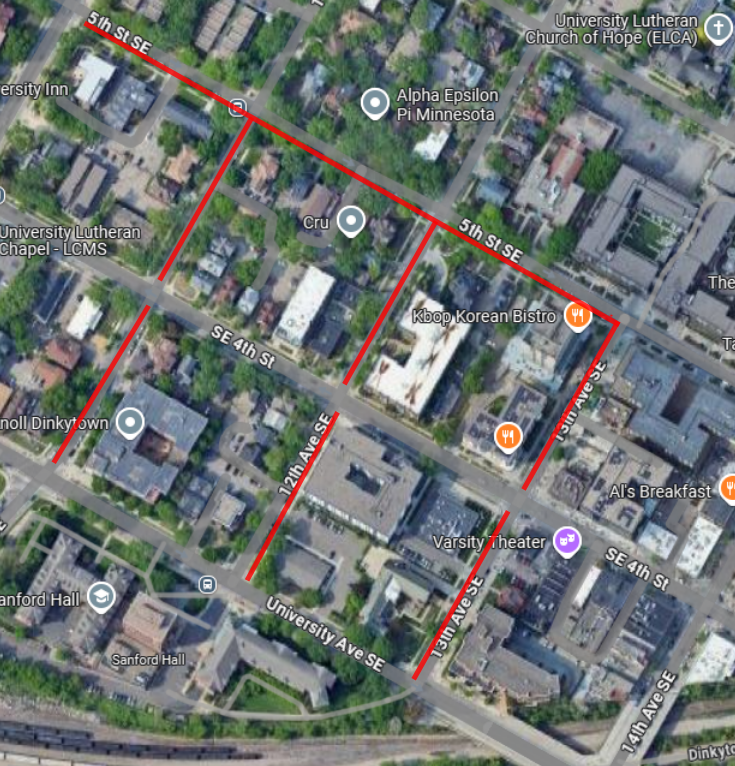
The approximate project area for Dinky After Dark Phase 1 is shown below. It includes installation of 29 lights that will illuminate the sidewalk and bike lanes.
Dinky After Dark Phase I lighting map.
Summary: Council unanimously approved a directive from myself and Council President Payne to explore options to diversify and increase municipal revenue, including through progressive taxation of the richest individuals and businesses.
Background: In November of 2024, I authored a direction for staff to research potential strategies to help increase City revenue without relying on property taxes. At that time, Council was grappling with the City’s bleak budget outlook for the next several years, and newly elected President Trump was already discussing major cuts that would impact state and local government. My colleagues approved this direction unanimously and requested a report by July 1, 2025.
Since then, the impacts of federal cuts are more clear and likely are going to increase. The so-called “Big Beautiful Bill” is a massive transfer of wealth away from the working class into the pockets of the 1% that will hurt our communities so much in the coming years. The Tax Policy Center estimates that 60% of the tax benefits will go to those at the top 20% of annual incomes. It’s more important than ever that cities like Minneapolis begin the pathway to equitable taxation, which looks like income taxes on the wealthy and innovating new ways to generate revenue without taxing working class residents.
The City’s Board of Estimates and Taxation expressed a shared interest in partnering with the Council on these conversations. In light of that, Council President Payne brought forward an amended staff direction. That direction passed Council unanimously and will be publicly presented on August 18, 2025.
During Council’s discussion of the item, Council Member Rainville motioned to strike the following research requests: “Policy changes that would be required at the state and local level to implement a tax on the wealthiest individuals in Minneapolis. Through consultation with the City Attorney, excluding property taxes, identify any potential revenue sources that are currently available to cities under state law,” and “Policy changes that would be required at the state and local level to implement a tax on the wealthiest businesses in Minneapolis.” I strongly opposed removing these elements, as did many of my colleagues. Decades of research has debunked “trickle-down” economics. The reality is that if local governments do not figure out a plan to respond to these federal cuts and fill the gaps with taxes at the local level, there will be significant disruption in critical services that working people in our city depend on. Redistributing wealth from the ultra rich is not only crucially necessary for achieving equity, it is also something that many Minneapolis residents support. After discussion by Council, Council Member Rainville withdrew this proposal.
While the City does not have the authority to tax individuals or businesses, I look forward to collaborating with our partners at the Board of Estimates and Taxation, the State of Minnesota, and beyond to help shift the burden of municipal revenue away from property taxes paid by working class people.
Key votes: Council voted unanimously in support of the directive. Staff will present a response on August 18th.
Summary: Council has prioritized funding to repair street lights that were damaged by copper wire theft. Repairs are now well underway.
Background: Copper wire theft has damaged many of the city’s light poles, leaving some of streets and parkways dark. Council offices heard from many constituents that these lights are crucial for public safety and livability, and prioritized funding to accelerate repairs. The Public Works Department is also switching from copper to aluminum wiring, which has a lower resale value.
Here are updates on repairs and new damage since June:
- There was tampering at Franklin and West River Parkway but we believe the aluminum wire deterred theft of material. There has been limited new reported thefts since early May.
- Completed repairs:
- East River Road and surrounding neighborhood
- Bancroft
- Nokomis
- East Minnehaha Parkway from Cedar to Hiawatha
- Repairs currently in progress
- St. Anthony Parkway and Columbia Parkway
- Harriet
- Mid/Late Summer (August/Sept)
- Bde Maka Ska
- Harriet
- Lake of the Isles
- Fall (Oct/Nov)
- Cedar Lake
- Minnehaha Parkway
- Remaining areas (including Greenway and Franklin/Hiawatha trail)
You can still request traffic calming in your area for 2026. Requests are due Aug. 1.
Make your request online by Aug. 1. If you’re not able to use the online form, you can print the application and either email it or mail it (postmarked by Aug. 1) to: Traffic Calming, 300 Border Avenue, Minneapolis MN 55405. If you need help filling out the form, you can contact Minneapolis 311.
Find more information about traffic calming projects on the City website.
Summary: 65 creative projects across seven cultural districts will get vital support from the Cultural District Arts Fund.
Background: The City of Minneapolis announced the recipients of the $700,000 that Council allocated to in funding to empower local artists, creative entrepreneurs, community place makers, and cultural organizations working to enhance community and quality of life through culture and creativity. In total, the 2025 Cultural District Arts Fund will grant 65 awards across the city’s seven cultural districts.
A dynamic portfolio of art projects is supported by this fund, including funding for new/existing festivals, cultural venues/spaces, supporting pop-up projects and creative activations. The 65 selected projects will showcase a vibrant tapestry of community engagement, artistic expression, and cultural celebration across the seven Minneapolis Cultural Districts: Lowry Avenue North, 38th Street, Cedar Avenue South, Central Avenue, East Lake Street, Franklin Avenue East, and West Broadway. A full list of award recipients can be found on the fund's website.
The Arts & Cultural Affairs Department exists to advance, support, stimulate, and promote a diverse and active arts and cultural environment that recognizes and draws on the full potential of Minneapolis’ artists and arts organizations, reflects, and responds to civic concerns and aspirations, and enriches the lives of all people who live in, work in and visit Minneapolis. More information about the department’s work can be found on the Arts & Cultural affairs website.
Register now for the City of Minneapolis’ Trans Equity Summit Aug. 11. This year’s theme is Trans Equity and Intergenerational Power: Strengthening the Future by Honoring Our Past.
The Trans Equity Summit is a free event designed for trans and gender nonconforming community members. The day is meant to:
- Connect to resources.
- Connect with each other.
- Learn more about important issues.
2025 Trans Equity Summit 9:30 a.m.-4:30 p.m. Monday, Aug. 11 McNamara Alumni Center, 200 Oak Street SE
Check back for more specific information about keynotes, workshops and more. The planning committee will also share up-to-date information about the schedule, speakers, workshops and accessibility on the Facebook event page.
Register now.
Contact Ward 2
Visit: minneapolismn.gov/ward2
Email: ward2@minneapolismn.gov
Phone: 612-673-2202
We've moved while work is being done in City Hall. Our office is in:
Room 100, Public Service Center
250 South 4th St.
Get directions
For reasonable accommodations or alternative format please contact 311. People who are deaf or hard of hearing can use a relay service to call 311 at 612-673-3000. TTY users call 612-263-6850. Para ayuda, llame al 311. Rau kev pab, hu 311. Hadii aad caawimaad u baahantahay, wac 311. |