|
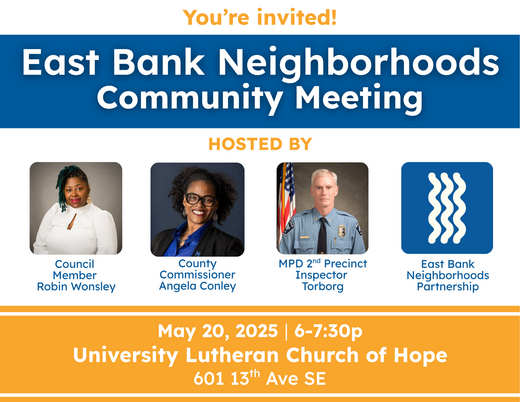
Hear updates from Council Member Robin Wonsley, County Commissioner Angela Conley, 2nd Precinct Inspector Nick Torborg, and the East Bank Neighborhoods Partnership.
This meeting is open to all residents and community members in the East Bank area (Como, Dinkytown, Marcy-Holmes, University, Stadium Village, and East Bank)
May 20th, 2025 from 6-7:30pm
University Lutheran Church of Hope
601 13th Ave SE
Flyer for the East Bank Neighborhoods Community Meeting.
This week, I attended two events commemorating the history of the Jackson Family. The Jacksons moved to Prospect Park in 1908 and were the first African American family in the neighborhood. The Jackson’s three daughters were the first African American children to attend Pratt Community School.
Soon after they moved in, the Jackson family was subject to discrimination, harassment, and daily threats trying to get them to leave the neighborhood. Mr. Jackson was told that his daughters would have no other children to play with. In response, he built a playground in his yard that was open to all, and many neighborhood children came to play with the Jackson children on the new playground. The Jacksons lived in the neighborhood for over 20 years and became important members of the community.
In the last several years, the modern Prospect Park community has invested into uplifting the story of the Jackson Family and launched the Jackson Family Project, a partnership of Jackson family members, Prospect Park Association, Pratt PTO, and Pratt school faculty that is funded by the University of Minnesota Good Neighbor Fund, City of Minneapolis Neighborhood Community Relations, Prospect Park Association, Prospect Park Co-op Legacy Fund, and Pratt PTO. The Jackson Family Project is intended to serve the students of Pratt Community School and within the Prospect Park neighborhood by providing a safe, engaging, and innovative play space in addition to educational opportunities to learn about the rich racial history of the community.
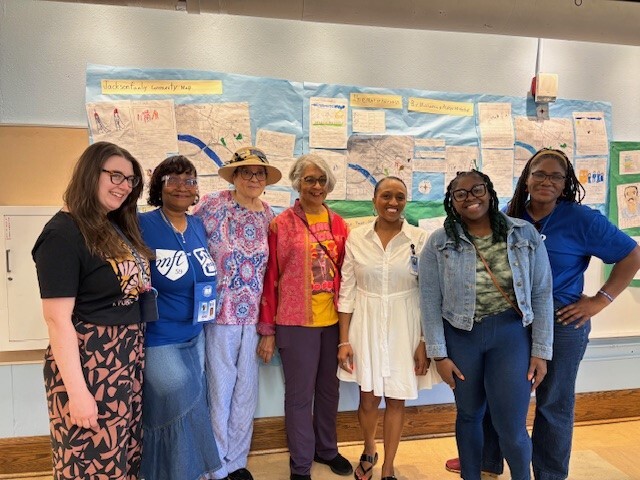
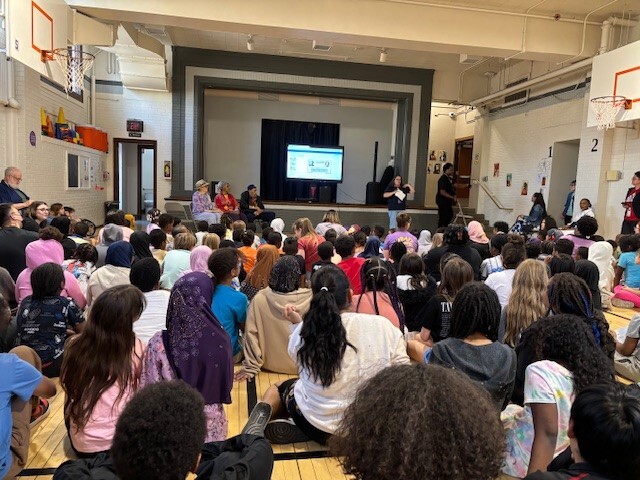
This week, the Jackson Family Project organized a series of events with the descendants of the Jackson Family. I attended a powerful community conversation at the Pillars of Prospect Park senior community, and a fantastic school assembly at Pratt Community School. From our oldest to our youngest residents, it was very meaningful to see Prospect Park neighbors engaging with the neighborhood’s history, including the history of racism and discrimination. Thank you to everyone who continues to uplift the Jackson Family history.
CM Wonsley with leaders from Pratt Elementary, Minneapolis Public Schools, Minneapolis Federation of Teachers and descendants of the Jackson Family.
Jackson Family History assembly at Pratt Elementary.
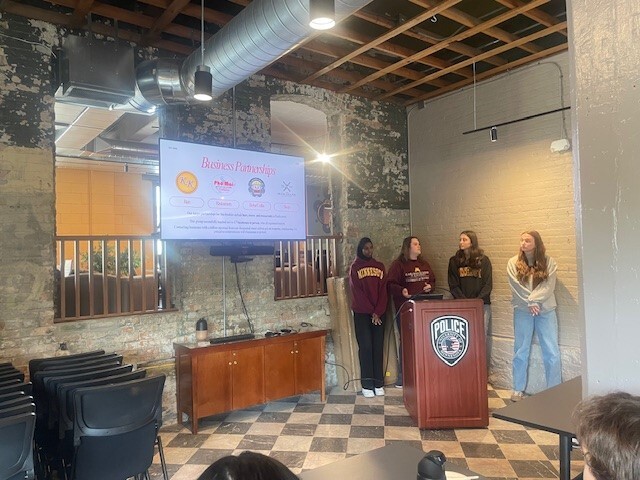
My office works with students at the Carlson School of Management on projects that relate to solving problems in their community. This semester, in partnership with the University administration, we supported several student groups working on rebranding and revitalizing Dinkytown. This week, students presented at the University’s Bringing U to the Community event to preview their proposal to refresh Dinkytown’s brand, website, and placemaking strategies. The University administration is going to use these student presentations as the guide for investment into Dinkytown. I love getting to see students bring their unique and brilliant perspectives to life!
Students from the Carlson School present their Dinkytown branding and placemaking proposal to stakeholders at Bringing U to the Community.
Glendale Townhomes is the oldest public housing in Minneapolis. I have worked in partnership with Glendale residents to nominate Glendale for local historic designation. Historic designation has been a decade-long initiative that was first brought by my predecessor, Council Member Cam Gordon. Thanks to persistent community organizing, historic designation for Glendale has now been recommended by the Heritage Preservation Commission (HPC).
This week, the Council’s Business Housing and Zoning Committee discussed the recommendation, and then forwarded the item to the full Council for a final vote on designation. In light of the committee’s discussion and questions that I’ve gotten from my colleagues and members of the public, my office created a Glendale Historic Designation FAQ. This document is intended to answer common questions my office has received related to the impacts of historic designation on property maintenance, demolition, redevelopment, funding streams, density, and more.
Read the Glendale Historic Designation FAQ here.
The Council will vote on historic designation at the Council meeting on May 15th at 9:30am.
Key votes: The Business Housing and Zoning Committee voted 5-1 to forward without recommendation for the Glendale Historic Designation. Council Member Jenkins was the only vote opposed. Council Members Cashman and Rainville stated that they currently do not support historic designation of Glendale. Council will vote on historic designation at the Council meeting on May 15th at 9:30am.
Summary: In partnership with Meet Minneapolis, I’m co-authoring an ordinance with Council Members Cashman and Rainville to create a Tourism Improvement District to help support the city’s hospitality sector.
Background: I am co-authoring an ordinance with Council Members Cashman and Rainville to create a Minneapolis Tourism Improvement District (MTID) to support the Minneapolis hospitality industry. The MTID would allow for the collection of a service charge of 2% on hotel room rates for all hotels with 50 or more rooms in the city of Minneapolis. The collected funds would be managed by a nine person committee of hoteliers, who could use it on projects that support hotels in initiatives that support the industry. The MTID would be established for five years with an annual report and public hearing at the Minneapolis City Council. You can read the proposed ordinance language here.
This ordinance was proposed by Meet Minneapolis, the city’s tourism and promotion agency. I’m glad to be working with Meet Minneapolis as well as my colleagues to find ways to equitably support and invest in our hospitality industry.
University-area hospitality leaders encouraged me to bring forward language that explicitly includes investment in hospitality in a geographic range outside downtown. Ward 2 is home to the largest concentration of hospitality outside of downtown, and ensuring that the efforts of the MTID extend into the University area is important for our city’s economic growth. I was glad that Meet Minneapolis and my co-authors agreed with this sentiment and the ordinance includes language around geographic equity in the MTID’s programs and services.
I was also contacted by Unite Here Local 17, the state’s hospitality union, to see how we could ensure the ordinance created the opportunity for increased investment in our hospitality workforce. I strongly supported this idea and appreciate our city’s labor leadership for identifying ways to ensure that growth in the hospitality industry starts with the workers who make the industry run. With this in mind, I worked with Meet Minneapolis and my co-authors to include workforce development and training as one of the type of programming that MTID can resource with their funds.
The Business Housing and Zoning (BHZ) Committee will hold a Public Hearing to discuss the Minneapolis Tourism Improvement District (MTID) on May 20, at 1:30pm.
Public hearing on the Minneapolis Tourism Improvement District
Tuesday, May 20 at 1:30pmCouncil Temporary Chambers: Public Service Center, Room 3500, 250 4th St S.
Written comments
Written comments may also be submitted for the record of this public hearing. Written comments may be submitted by email to CouncilComment@minneapolismn.gov.
Key votes: The Business Housing and Zoning Committee will vote on the Tourism Improvement District on May 20th.
Background: Following the lead of resident advocacy, in 2022 I began legislative work to advance policies that support the People’s Climate Equity Plan. Last year, I led Council to put fees on carbon emissions from the largest polluters. Although carbon fees were identified as a strategy in the city’s Climate and Equity Plan and were slated to reduce hundreds of tons of emissions, Mayor Frey vetoed the fees. In doing so, he also vetoed the city’s entire fee program, which would have created a multi-million dollar gap in the city budget. Thanks to much persistence by Council, we were able to override the veto, save the city budget, and implement carbon fees.
This week, staff in the Mayor’s administration presented their plan for 2025 carbon fees. Fees must reflect the cost of the services being provided. Staff presented that rather than actually implementing carbon reduction measures, this year they will be bringing on another consultant to help them create a carbon reduction plan for qualifying polluters to be implemented in 2026. The 2025 fee will therefore only recoup the costs of this contract and some staff time, rather than the cost of implementing carbon reduction technologies on polluters.
While I appreciate that staff are moving forward with contracting an external consultant to support the creation of a carbon reduction program—one that ensures polluters help fund the solutions—it’s deeply concerning that avoidable, duplicative actions have once again delayed progress.
Back in early 2023, Mayor Frey’s administration announced they were contracting with a consultant to do this very work, with the goal of implementing carbon fees in 2024. Council also received a joint report last year, co-authored by the Mayor’s staff, which included recommended fees to reduce carbon emissions from major polluters. My office advanced those recommendations, and Council adopted them. Yet shortly afterward, we were told by the same staff that the fees they had proposed were potentially inaccurate and would need to be reevaluated.
These missteps have now led to a two-year delay—not only a failure in governance, but also an unacceptable pace given the urgency of the climate crisis. Carbon fees are just one of many tools we must rapidly deploy to meet our climate goals.
Residents have been clear that emissions reduction is a high priority, and the Climate Equity Plan sets clear and robust goals around reducing the amount of carbon emissions in the city. I take this work extremely seriously and look forward to continuing to work hand-in-hand with residents to meet our climate goals and continue to utilize the council’s oversight ability to provide accountability to residents and community members.
Key votes: No votes taken.
Following 2024’s Minneapolis Music Census, join the City of Minneapolis Arts & Cultural Affairs Department, in partnership with the Minnesota Independent Venue Alliance for a day of community-building, celebrating and imagining the future of Minneapolis music. Whether you are a musician or a promoter, working in management, recording, venues, studios, or policy, and whatever your genre, you are invited.
Get connected to resources, give feedback on policy ideas, and be a part of the conversation. Learn more here.
When: 11 a.m.-5 p.m., Saturday, May 10, 2025
Where: Green Room, 2923 Girard Ave S, Minneapolis, MN 55408
RSVP for free: https://tinyurl.com/MPLSMusicSummit2025
Flyer for the Minneapolis Music Summit.
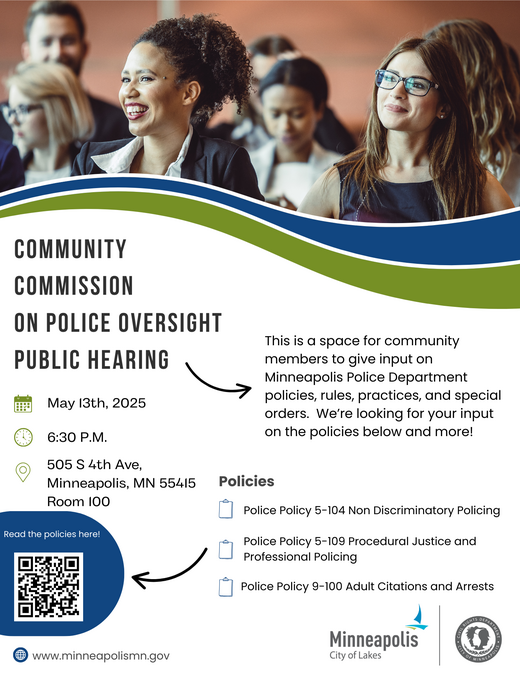
The Community Commission on Police Oversight is hosting a public hearing at 6:30 p.m. on May 13, 2025, and you're invited to share your thoughts.
This is a space for community members to give input on Minneapolis Police Department policies, rules, practices, and special orders. We hold these hearings to make sure community voices are part of shaping how public safety works in our city.
Everyone is welcome- come speak up, listen in, or just learn more about the process.
The CPPO will be soliciting feedback for the three policies below. Please review the policies ahead of May 13 and provide your feedback at the public hearing or submit a written comment!
- Police Policy 5-104 – Non-Discriminatory Policing
- Police Policy 5-109 - Procedural Justice and Professional Policing
- Police Policy 9-100 – Adult Citations and Arrests
Written comments
Written comments may also be submitted for the record of this public hearing. Written comments may be submitted three different ways:
Public hearing
Those who are interested may register to speak in the public hearing starting at 5:30 p.m. Speakers will be taken in the order they have registered.
Community Commission on Police Oversight public hearing
6:30 p.m. Tuesday, May 13
Public Service Building, Room 100, 505 Fourth Ave. S.
Learn how to participate in a public hearing.
Flyer for the CCPO Public Hearing
At a public listening session coming up May 15, the Capital Long-Range Improvement Committee and the Planning Commission will discuss the projects currently under review for the Minneapolis 2026-2031 Capital Improvement Plan. The committee invites public participation for a deeper understanding of community perspectives, to incorporate public input into their discussions with City departments, and to share information about the committee’s role in shaping the City’s long-range capital planning.
Capital Long-Range Improvement Committee and City Planning Commission Special meeting, public listening session 6 p.m. Thursday, May 15 Public Service Building, Room 100AB 505 Fourth Ave. S.
The Capital Long-Range Improvement Committee
The Capital Long-Range Improvement Committee is a group of residents and business leaders who advise the City of Minneapolis on its six-year Capital Improvement Plan. They share recommendations through an annual report. It will meet until the end of June.
See what’s happening on the upcoming calendar or previous agendas and minutes.
The City of Minneapolis will celebrate Bike To Work Day Friday, May 16. There’s no better time than the present to make your daily commute healthier, greener and more fun.
Group rides
Four group rides to downtown will meet up at 7:30 a.m. across the city. Meet at:
- Farview Park (intersection of Lyndale Avenue and 26th Avenue North)
- Great Northern Greenway (intersection of Fifth Street and 18th Avenue Northeast)
- 38th Street Station (intersection of Hiawatha Avenue and East 38th Street)
- Lyndale Farmstead Park (intersection of Bryant Avenue South and West 40th Street)
Government Center Plaza
Join elected officials, public works leaders and fellow bike commuters for free coffee, donuts and more.
7-9 a.m. Friday, May 16 Hennepin County Government Center Plaza
Read more about bicycling in Minneapolis on the City website.
East River Parkway is scheduled to close between Harvard Street and SE Delaware Street on Sunday, May 18 and Saturday, May 24, 2025.
The closures are necessary for a contractor hired by the University of Minnesota to unload medical machinery at M Health Fairview University of Minnesota Medical Center. The closures may be delayed by a day if there's bad weather.
Stay away from areas where work is being performed and follow signed detours. The Minneapolis Park and Recreation Board appreciates the public's patience during this parkway closure.
Contact Ward 2
Visit: minneapolismn.gov/ward2
Email: ward2@minneapolismn.gov
Phone: 612-673-2202
We've moved while work is being done in City Hall. Our office is in:
Room 100, Public Service Center
250 South 4th St.
Get directions
For reasonable accommodations or alternative format please contact 311. People who are deaf or hard of hearing can use a relay service to call 311 at 612-673-3000. TTY users call 612-263-6850. Para ayuda, llame al 311. Rau kev pab, hu 311. Hadii aad caawimaad u baahantahay, wac 311. |