|
The City of Minneapolis broke ground on the first city-owned and operated biochar facility in North America. The Minneapolis facility will have the capacity to remove nearly 3,700 tons of carbon dioxide from the air annually, the equivalent of taking more than 789 cars off the road! I’m so proud that we get to host this historic facility in Ward 2.
Biochar is a specialized charcoal that pulls carbon out of the air and stores it in the soil. It also holds nutrients and water, helping plants grow. Learn more about biochar and what it’s doing to help our city.
The City has set specific goals around emissions reduction and sustainability. The federal government is not going to be an ally in climate justice initiatives for the next few years, which means that on the local level we must double down on our commitments, our investments, and our political will to create a sustainable, equitable, and healthy city. This biochar facility is a publicly-owned piece of infrastructure that was developed in partnership with our indigenous community. It’s exactly the right direction for our City to be going.
The biochar facility is the product of a lot of community organizing, advocacy, staff time, and collaboration both within Minneapolis and beyond our city limits. That’s what it takes to make transformative change. That’s what it’s going to take to move forward the other sustainability initiatives that we need if we want to meet our climate goals, like rethinking highway I-94 into a multimodal boulevard, expanding geothermal energy and municipal control of our power grid, and massively expanding public transportation. These things aren’t going to be easy, just like this biochar facility wasn’t easy.
But as we broke ground on our new biochar facility this week, I felt deeply inspired that we can meet our climate goals together. I look forward to working in partnership with residents and stakeholders to continue building for an equitable and sustainable Minneapolis.
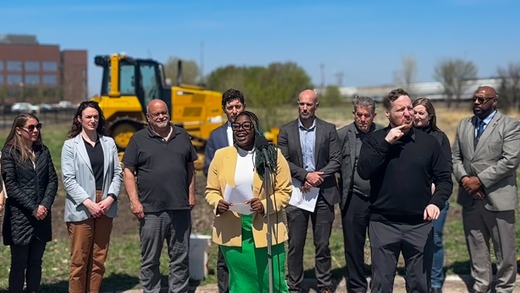
Council Member Wonsley with Mayor Frey and Health Department leadership at the biochar groundbreaking.
I had the honor of speaking at the Women’s Foundation of Minnesota’s Feminist Future Festival. The festival is an immersive exploration of movements for social change in our communities. It was a beautiful opportunity to connect with diverse thought leaders and entrepreneurs who are working to create impact around racial and gender justice. In this critical moment, it’s more important than ever for us to have shared spaces to dream, imagine, and feel inspired together!
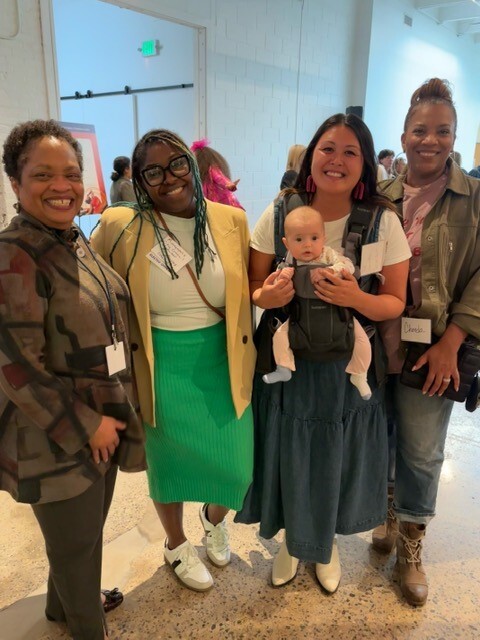
Council Member Wonsley with State Representative Samantha Sencer-Mura, Chanda Smith Baker, and Marquita Stephens at the Feminist Future Festival.
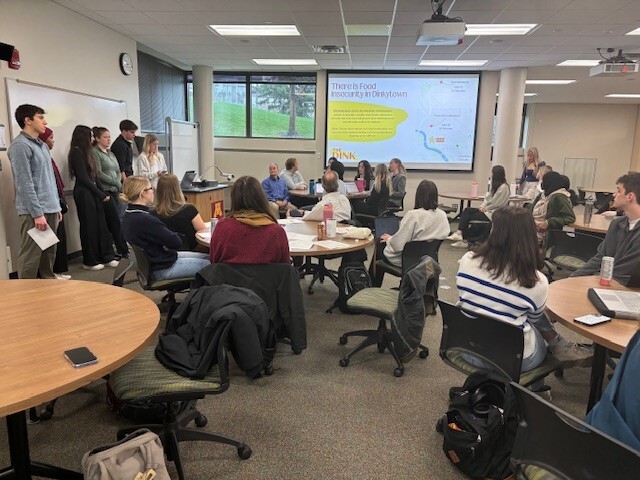
For the last three semesters, my office has worked with the Carlson School of Management Impact Lab to involve students and Ward 2 residents in real-world problem solving. I love this opportunity to help empower young leaders to use their perspectives and skills. It’s also a great way to introduce students to local government and the public sector. Through this partnership, Carlson students have meaningfully advanced priorities and projects that are improving Ward 2! This semester, students focused on:
- A draft business plan and feasibility study for a student grocery co-op in Dinkytown to help address student food access.
- Proposals for the City to diversify revenue through municipally owned retail.
- Proposals for the City to expand private parking fees and traffic enforcement to improve the budget forecast and reach transportation goals.
- Resource guides for residents to implement traffic calming through art installations, street improvements, and temporary solutions.
- Rebranding packages for Dinkytown to help improve neighborhood placemaking and public image, with impacts on public safety and economic vibrancy.
- A summer coupon booklet to help drive business to small businesses in Dinkytown during the summer lull.
I am so grateful to the students and faculty for this semester’s collaboration. I hope students will be able to see parts of their work reflected in improvements to their own neighborhood and communities in the coming months.
Carlson students present a business plan and feasibility study for "The Dink," a student food co-op.
Residents may have seen that there were multiple fatal shootings in the Midtown Phillips neighborhood earlier this week. I want to extend heartfelt condolences to the Native community and all the residents who were impacted by this tragedy.
Council Member Chavez, who represents Ward 9 where these this tragic violence occurred, shared this important context about gun violence and violence prevention in Midtown Phillips:
In February and March 2025, the Minneapolis City Council approved contracts for our Violence Interrupter, Group Violence Intervention, and Youth Group Violence Intervention programs with the expectation they would begin on April 1, 2025. These programs are meant to reduce violence, address community safety issues and they are a part of us taking community safety issues seriously.
Unfortunately, since April 1, 2025, we have been without violence interrupters in our neighborhoods, including some locations where these incidents of gun violence are occurring, and we do not have these gun violence intervention programs in place meant to reduce gun violence. The lack of contract execution is now impacting our communities tremendously. I hope the Commissioner of Public Safety works to resolve these issues immediately to prevent this gap in services.
My office also made a request for patrols in the area, community violence prevention, and consistent beats to support our residents during these difficult times yesterday. I have not heard back yet on this request but MPD has added extra patrols and technical resources in the Phillips area, and the Office of Community Safety is working to identify potential community needs for trauma response that the City could support.
Additionally, the City and MPD are working closely with local and federal partners in response to this violence. The Neighborhood Community Relations department is working with the Office of Community Safety and our Native community.
As I mentioned in a previous newsletter, data demonstrates that safety incidents in the City of Minneapolis typically rise during the summer months each year. In advance of this expected rise, I co-authored a legislative directive seeking information to better understand safety plans for 2025. As a result, the Mayor’s Administration presented their plan to the Public Health and Safety Committee last week. You can find it here. I believe that a more robust and comprehensive summer safety plan will be needed as we approach summer and my office is committed to working on shared solutions.
An execution of contracts council approved in February and March would be a good start in addressing these issues.
I also want to note that public safety initiatives that include hate crime prevention and gun violence prevention have been funded by the Council since 2023 but have yet to be implemented by the administration, and that is unacceptable. Like Council Member Chavez, I remain committed to using the Council’s oversight authority to ensure that the programs that we fund are actually implemented.
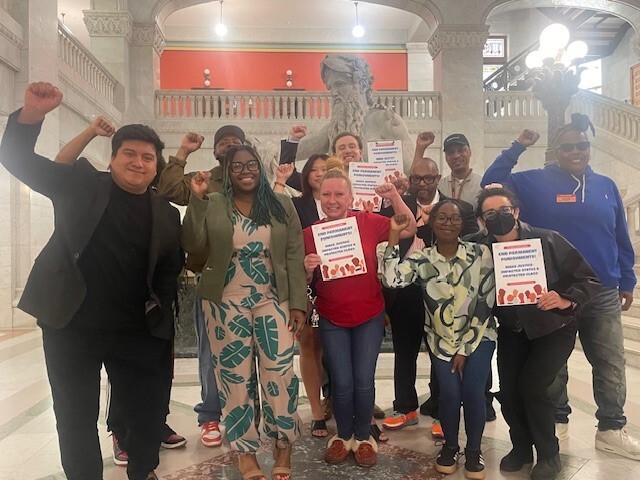
Summary: Council voted unanimously in support of the Civil Rights ordinance authored by Council Member Chavez and I that adds new protected classes, strengthens enforcement, and streamlines administrative procedures to help residents who have been victims of discrimination receive justice.
Background: The Minneapolis City Council voted unanimously for Council Member Chavez and my legislation to expand the City’s Civil Rights Ordinances. The new language:
-
Adds three new protected classes: justice-impacted status, housing status, and height and weight. Protected class refers to elements of a person’s identity they cannot or should not be asked to change. The current ordinance includes protected classes including race, religion, national origin, sex, sexual orientation, gender identity, disability, age, and more. Discrimination based on protected class in covered areas is a violation of City law unless one of the exemptions applies.
-
Added a definition of race to help prevent discrimination. The improved definition includes skin color, certain physical features, and hair texture and style, mirroring the state-level Crown Act.
-
Incorporates the Pregnant Workers Fairness Act. This allows the City to take enforcement action to receive justice for pregnant workers who do not receive appropriate accommodation.
-
Expanded provisions to investigate pay inequity. A longer timeframe will make it possible to investigate discrimination in pay, which may happen over multiple years.
-
Streamlined administrative provisions to help complainants get closure. A more streamlined investigations process means faster results for those impacted by discrimination.
-
Added language explicitly allowing for the investigation of intersectional discrimination, which is discrimination based upon multiple protected classes
-
Expanded the definition of familial status to include those residing with and caring for adults who are unable to care for themselves.
-
Requires accommodation for religious observance. This expands the existing protection against discrimination based on religion to ensure everyone has accomodate to observe their religion.
- A variety of other improvements that will help protect the civil rights of residents.
Last week, dozens of residents spoke at a public hearing testifying to the importance of creating these new protected classes and why it is meaningful for them to see the City formally codify their right to equal treatment. There’s nothing like these personal stories to really drive home why this work matters.
The Trump administration is advancing attacks on our most vulnerable residents and attempting to strip away our hard-earned civil rights. Minneapolis gets to be a beacon of light and show other cities around the nation that not only must we defend the rights we have, we can be responsive and expand protections against other forms of discrimination. I am so proud that Minneapolis is one of the first cities in the country to ensure protected class status for justice impacted communities.
I’d like to thank Council Member Chavez, the Civil Rights Commissioners, the Civil Rights Department, and most of all the directly impacted community members who made this ordinance happen. I also look forward to further conversations with the Civil Rights Commission to learn how these changes have impacted their work as a body and how we as council can support their ability to be effective and meet the needs of our residents.
Key votes: Council unanimously approves the Civil Rights Ordinance. The new provisions go into effect on August 1st, 2025.
Council Member Chavez, Council Member Wonsley, and community advocates for justice-impacted residents celebrate the passage of the Civil Rights Ordinance.
Summary: Council approved a legislative directive I authored with Council Member Chavez to gain more clarity on the Frey administration and MPD leadership’s plans in case of possible direction by the Trump administration that conflicts with local policy on immigration enforcement.
Background: Minneapolis aims to be a welcoming city for all, regardless of immigration status. The City has a separation ordinance that affirms that the City’s law enforcement function is separate from the federal government’s immigration enforcement operations, and that the City will not operate programs for the purpose of enforcing federal immigration laws.
Since the start of the second Trump administration, I have received questions from residents who are concerned about how MPD leadership will educate officers on this policy and establish clear disciplinary consequences for officers who violate the policy.
Due to local and national media coverage, residents are aware that President Trump has a close relationship with former Minneapolis Police Officer Federation president Bob Kroll and that the current police union president endorsed Kroll for US Marshall. Understandably, residents have demonstrated concern to see that at least some rank-and-file leadership within MPD is aligned with Trump’s agenda and are worried about the implications of that locally as we are all witnessing daily disregard of the rule of law at the federal level.
In response to these questions from residents, I reached out to MPD leadership to advance these concerns. My goal was to gain information to assure the public that the Frey administration has clear and specific plans for response to potential actions that the Trump administration is openly discussing, such as directing local law enforcement to facilitate mass deportation. I also hoped MPD would share their plan for policies to deal with officers who disobey direction from leadership in situations where there may be conflicting federal and local direction. Those informal questions did not result in a lot of clarity, so Council Member Chavez and I authored a legislative directive to ensure both Council and the public understand how the separation ordinance is being implemented by the administration.
At a time where the federal government is demonstrating disregard for the safety of our immigrant communities, I believe this is an opportunity to demonstrate that our local government is being proactive about educating law enforcement about our separation ordinance and enforcing it. The information we receive from this legislative directive will instill confidence in the City’s ability to provide public safety services for all residents and show that our commitment to stand against Trump’s attack are not just lip service.
Key votes: Council unanimously approved the legislative directive. The Frey administration is expected to present a response at the Administration and Enterprise Oversight Meeting on May 19th at 1:30pm.
Summary: I gave notice of intent to introduce an ordinance to strengthen transparency around law enforcement use of surveillance.
Background: I have notice of an intent to introduce an ordinance related to regulation of surveillance technology. While the Council does not have authority over the operations of MPD including which technology they use, I believe we need more transparency for the Council and the public to learn when and what type of surveillance equipment that law enforcement is utilizing. Therefore, I am authoring an ordinance that will require a public hearing when MPD wants to purchase or contract with an external party for surveillance related equipment or services. It's important that there is public awareness on the type of technology that the City and law enforcement has access to and utilizes, especially in the context of our federal government’s current actions. I will share more updates as policy development continues.
Key votes: No votes taken.
Summary: I gave notice of intent to introduce an ordinance to strengthen transparency in contracting by the Mayoral administration.
Background: Under current City policy, the Council is required to approve any contract that the City enters into that is over $175,000. Contracts under $175,000 can be signed by the Mayor’s administration without approval by Council. This policy is meant to strike a balance between financial oversight and logistical practicality, since having Council approve every contract would be very resource intensive and not efficient.
However, in the last few years there have been several contracts that have been awarded by the Frey administration that have raised serious concerns about public dollars being awarded to questionable contractors. Fortunately, in several of these instances members of the public or the media raised concerns about these contracts, and Council used our oversight to yield corrective actions by the administration. But it shouldn’t take public scrutiny for City leadership to institute greater transparency around our contracts. This loophole is not good governance, so I am authoring an ordinance that will require the Mayoral administration to publish quarterly reports of all contracts they enter into that did not obtain Council approval. After a recent situation involving a questionable contract, Council Member Koski led Council to approve a legislative directive to obtain a report of all City contracts from the last 10 years, which I applaud. This ordinance will build off that legislative directive to codify this practice going forward.
Key votes: No votes taken.
For the first time, all residents in Minneapolis are represented by a neighborhood organization. Come celebrate at Neighborhood Day Saturday, May 3.
Neighborhood Day is an annual day set across the city to increase resident participation in local civic engagement through one of the city’s 68 recognized neighborhood organizations. It’s a chance to come together in community, find the neighborhood organization that represents you and get to know your neighbors.
Participating neighborhood organizations host their own events from board officer elections, recycling and clothing drives to food trucks, potlucks and tool swaps. There’s something for everyone.
Your voice is important
Neighborhood organizations are the most local, smallest form of government. It’s an easy way for residents to be involved at the most grassroots level in their own neighborhood, on their own street.
Organizations act as their own nonprofit and have volunteer boards of directors. The organizations communicate to residents – share City news and awareness of topics such as housing and environmental concerns – and engage with one another.
Local neighborhood boards review, respond and participate in City projects at the local level and participate in conversations on everything from stop signs to development projects.
Learn more about Neighborhood Day and which organization represents you. There’s also a map of neighborhoods engaged with the day and details on their events.
The City of Minneapolis will celebrate Bike To Work Day Friday, May 16. There’s no better time than the present to make your daily commute healthier, greener and more fun.
Four group rides to downtown will meet up at 7:30 a.m. across the city. Meet at:
- Farview Park (intersection of Lyndale Avenue and 26th Avenue North)
- Great Northern Greenway (intersection of Fifth Street and 18th Avenue Northeast)
- 38th Street Station (intersection of Hiawatha Avenue and East 38th Street)
- Lyndale Farmstead Park (intersection of Bryant Avenue South and West 40th Street)
Join elected officials, public works leaders and fellow bike commuters for free coffee, donuts, and more on the Hennepin County Government Center Plaza from 7-9 a.m.
Minneapolis has been investing in infrastructure to make bicycling easier, safer and more comfortable for all trips. Through our Transportation Action Plan, the City has committed to a safe, modern and convenient transportation landscape. A key component of the plan is to encourage drivers to shift away from personal vehicle trips and have 60% of trips taken by walking, rolling, biking or transit by 2030.
Bike To Work Day and our campaign As You Go MPLS are helping travelers around the city make this switch by highlighting improved infrastructure and providing information and resources.
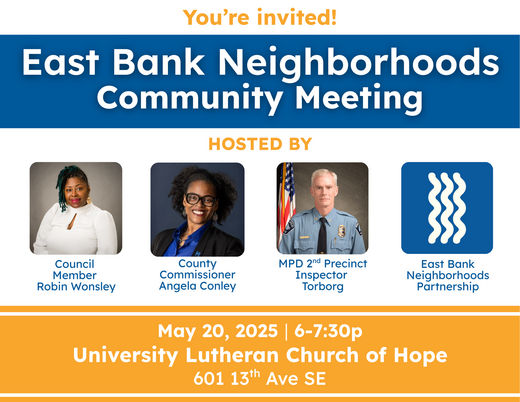
Hear updates from Council Member Robin Wonsley, County Commissioner Angela Conley, 2nd Precinct Inspector Nick Torborg, and the East Bank Neighborhoods Partnership.
This meeting is open to all residents and community members in the East Bank area (Como, Dinkytown, Marcy-Holmes, University, Stadium Village, and East Bank)
May 20th, 2025 from 6-7:30pm
University Lutheran Church of Hope
601 13th Ave SE
Flyer for the East Bank Neighborhoods Community Meeting
A new citywide student dance program is bringing dance education to students in all 13 wards. After the closure of the Cowles Center for Dance Education in 2024, the city’s dance community rallied for something new, something bold. This program is the response.
The program will include:
- Dance classes in every Minneapolis Public Schools elementary school
- Dance companies in residence at Minneapolis Public Schools secondary schools
- Dance programming at every Minneapolis Park and Recreation Board recreation center
Dance education improves physical health, builds confidence, sparks creativity, and helps students express themselves emotionally and artistically. When offered in schools and rec centers, these classes can be a lifeline for students seeking connection, belonging and a safe outlet for self-expression.
Read more on the City website.
Contact Ward 2
Visit: minneapolismn.gov/ward2
Email: ward2@minneapolismn.gov
Phone: 612-673-2202
We've moved while work is being done in City Hall. Our office is in:
Room 100, Public Service Center
250 South 4th St.
Get directions
For reasonable accommodations or alternative format please contact 311. People who are deaf or hard of hearing can use a relay service to call 311 at 612-673-3000. TTY users call 612-263-6850. Para ayuda, llame al 311. Rau kev pab, hu 311. Hadii aad caawimaad u baahantahay, wac 311. |