|
Summary: The Minneapolis City Council passes 30-day eviction pre-notification ordinance by a unanimous vote.
Background: Council Members Chavez and Chowdhury and Council President Payne authored an ordinance that increases the amount of time that a landlord must give a tenant before filing an eviction. The current policy is 14 days, and this ordinance would change it to 30 days. The ordinance only applies to residential tenants who are facing eviction from nonpayment of rent. It does not apply to commercial tenants or to residential tenants who are facing eviction due to non-financial matters such as safety or inappropriate use of the property.
Nationally, the Twin Cities is second only to Las Vegas for the increase in eviction cases compared to the pandemic era. There are so many families in our city who are one paycheck or one emergency away from getting behind on their rent. With 30 days of notice, families have a much better chance of identifying resources to help correct the situation and avoid the eviction completely. For example, rent help from Hennepin County is a great resource that typically takes about 28 days to access.
The best way to prevent homelessness is to keep people housed. Eviction prevention measures are exactly where this Council should be directing our legislative efforts. I am working with Council President Payne to expand eviction prevention policies through a Homes to Do Homework ordinance that would prevent evictions of families with school-aged children during the school year, and look forward to advancing that policy early next year.
Key votes: Council unanimously approves the 30-day eviction pre-notification ordinance. The ordinance goes into effect on March 1, 2025. The Mayor now has five days to veto the ordinance. Council can override a veto with nine votes.
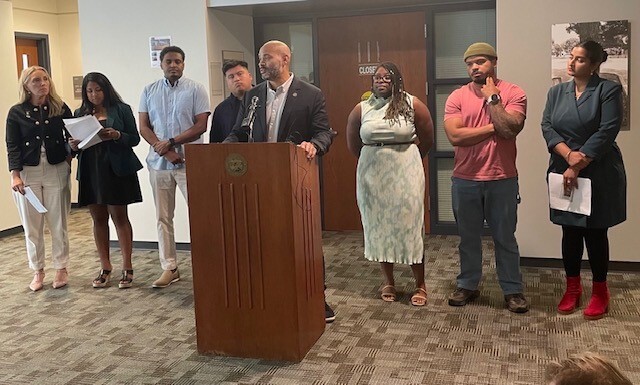
Press conference celebrating the three Housing First policies passed by a supermajority of Council.
Summary: Council passes an ordinance that requires standardized reporting on the costs and impacts of evicting encampments of unhoused residents.
Background: Residents of Minneapolis who are experiencing unsheltered homelessness have formed encampments. Often in or near residential neighborhoods, these encampments can be extremely challenging for housed residents living nearby. The Mayor, who is responsible for administering city services, has so far chosen to respond to encampments by repeatedly evicting them. After many years of this strategy, there has been no reduction in the number of encampments and no solution to unsheltered homelessness.
Council Members Chowdhury, Chavez and Vice President Chughtai authored an ordinance requiring the Mayor’s administration to provide regular reports on the cost and staff time of evicting an encampment, and the outcomes for each of the unhoused residents (ie, if the eviction caused them to find permanent housing, if they were connected to social services, etc).
At the Public Health and Safety (PHS) Committee meeting this week, the ordinance authors gave a presentation on the ordinance and presented an FAQ sheet to provide clarity on what the ordinance does. After the presentation, dozens of residents testified. The vast majority spoke in strong support, and the committee voted 4-2 to forward the ordinance, with Council Members Palmisano and Rainville in opposition. The testimony that was shared at PHS echoed the feedback I consistently receive from residents that they believe that the Mayor’s current strategy is not working, based on the evidence that encampments are growing despite the city spending untold millions of dollars evicting them. I also hear consistently that residents want real solutions for homelessness, like investment in low-barrier housing and support services.
The ordinance is an incredibly common sense policy that ensures that we have data about the costs and impacts of evicting encampments. This data will provide clarity on the overall efficacy of the strategy that Mayor Frey’s administration has been using for the last six years to try and address homelessness in Minneapolis. Thank you to the authors, as well as residents who organized for years around this demand.
Key votes: The City Council votes 9-4 to adopt the encampment removal reporting ordinance. Council Members Rainville, Vetaw, Osman, and Palmisano voted in opposition. The Mayor now has five days to veto the ordinance. Council can override a veto with nine votes.
Summary: Council Members allocated $1.5 million in funding for the rehabilitation of Agate’s Board & Lodge Transitional Housing Facility & Shelter – which services 137 residents – to prevent them from closing their doors permanently, in a 10-3 vote.
Background: Several of the city’s shelters are facing extreme financial hardship. One shelter, Agate Housing’s 137-bed transitional facility, was facing closure and needed capital support to repair and improve their building. Council Members Chavez, Osman, and Koski and President Payne and Vice President Chughtai stepped up to allocate $1.5 million from the city’s contingency fund to help fill the gap and prevent permanent closure.
The contingency fund is a fund of approximately $6 million that the city is required to set aside each year for unanticipated expenses. The city hasn’t spent any of the contingency fund so far in 2024. I and many of my colleagues believed this was an excellent example of an opportunity to use the contingency fund to cover an unanticipated need in our community, especially with just a few months left in the year. However, other Council Members requested that the authors find a different funding source. The authors rose to the challenge and identified a way to fund the allocation by researching the average budget surplus of each department and committing about 7.5% of that anticipated surplus. This in depth calculation led to an amended proposal that funded Agate’s need without touching contingency or sacrificing any city programs.
This allocation is exactly what our city should be doing to step up and help our city’s poorest and most vulnerable residents. The Frey administration’s failed whack-a-mole approach towards encampments has not only shown to be ineffective but also treats unhoused residents in the utmost cruel and disdainful way. This is such a clear and straightforward way to make good on the values we claim to uphold in this city.
It’s easy to say that we want to invest in the services that support people experiencing housing instability, but in situations like this, we see who is actually ready to show up with financial commitments and concrete solutions. I am deeply proud of my colleagues who demonstrated clear leadership by giving Council the opportunity to help save one of the city’s needed shelters.
Key votes: Council voted 10-3 to approve funding to Agate. Council Members Rainville, Vetaw and Palmisano voted in opposition.
Summary: Council approves a contract with ShotSpotter that includes a limited geographic expansion, and a directive for an independent evaluation of ShotSpotter’s efficacy. The Council will receive the results of the independent evaluation before voting on a long-term contract or more geographic expansion in March 2026.
Background: Five months after the original contract expired, the Mayor’s administration asked the Council to approve a three-year contract extension and significant geographic expansion to ShotSpotter. There is a national conversation in cities across the country about whether ShotSpotter is the most effective tool for reducing gun violence and improving responses to gun violence.
Right now, there is a lack of concrete data on the utility of ShotSpotter which has led to decision-making based primarily on anecdotes and perceptions. Good governance means making decisions based on data. I worked with Council Member Ellison to collaborate with staff in the Policy and Research Division and MPD for several months around the need for an independent evaluation. This resulted in Council voting unanimously to obtain an independent analysis of the utility of ShotSpotter, which will come before Council in early 2026.
The need for an independent evaluation is clear. During the discussion prior to the vote, some Council Members shared that they believed ShotSpotter could identify which type of gun was being fired while others shared they had seen it falsely activated by rain. This underscores that there is a broad range of perception of what the technology does and does not do.
Council Member Chavez also emphasized that ShotSpotter does nothing to prevent or reduce gun violence as his ward has numerous ShotSpotter sensors and is still experiencing upticks in gun violence. He drew attention to the fact that gun violence prevention and reduction programs are not being adequately supported by the Mayor’s administration, and that gun violence will continue to be an epidemic until the administration changes course, regardless of what actions the Council takes with ShotSpotter.
Council Members also spoke about how MPD has some of the lowest clearance rates in the state, making it unclear how this tool has improved MPD’s investigations process around gun violence. There were also concerns raised around ShotSpotter’s role in over-policing in majority BIPOC neighborhoods, as well as concerns about surveillance and civil liberties.
I want to thank the leadership of MPD and the Office of Community Safety (OCS) for working with my office and with SoundThinking, the company that makes ShotSpotter, to come up with a modified contract that gives Council the option to extend our use of ShotSpotter for about 18 months while we conduct that thorough analysis, so that we can revisit this topic when we can all refer to more context and data.
Key votes: Council votes unanimously on an 18-month contract with ShotSpotter, and will receive an independent evaluation of the utility of the technology before considering a future contract extension.
Summary: Council unanimously adopts a policy supporting highway removal of I-94 and other priorities for the Rethinking I-94 process.
Background: The Minnesota Department of Transportation (MNDOT) is reconstructing the I-94 corridor and running a community engagement process called Rethinking I-94.
I-94 runs through the heart of Ward 2. It separates Seward from Riverside, and Prospect Park from East River Road. It brings thousands of vehicles through Ward 2 every day, releasing tons of greenhouse gas and air pollution that give neighboring residents disproportionately high rates of asthma, heart disease, and cancer.
The City of Minneapolis has the chance to Rethink I-94, and Ward 2 residents have been clear that they want a city that repairs the racial justice and public health harms this highway has committed. Removing I-94 and replacing it with a multimodal boulevard will continue to support vehicle traffic, but while greatly expanding pedestrian, biking, and public transit infrastructure as well as public health, equitable development, and sustainability.
Rethinking I-94 is a once-in-a-lifetime opportunity to make these things happen. I am proud to have worked with Council Members Osman and Cashman who also represent the I-94 corridor to author a resolution that establishes a formal city policy position which states that the key decision-making factors in this reconstruction should be the impacts on adjacent neighborhoods, public health and the environment, equity, multimodal mobility, sense of place, and connectivity. Highway removal and conversion is the path that best aligns with city goals and Council unanimously affirmed that in today’s vote.
Key votes: Council unanimously approves Rethinking I-94 priorities resolution.
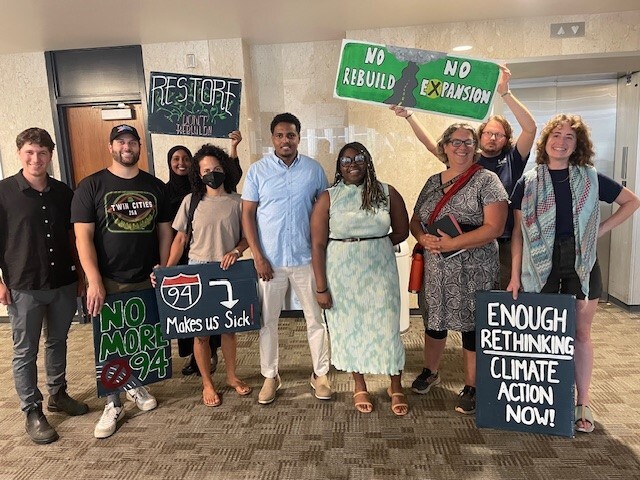
Community celebrates unanimous Council vote on Rethinking I-94 priorities resolution.
Summary: Council votes unanimously to fund violence prevention work on sections of Lake Street where homicide and second degree assault have occurred.
Background: The Neighborhood Safety Department (NSD) is tasked with deploying the city’s unarmed violence prevention and intervention teams to areas that need them. These methods are proven to help prevent crime and violence. Council has allocated funds to ensure that the city’s Cultural Districts receive services, but the Mayor’s administration has failed to actually dispatch these services.
Council Member Chavez took the additional step of allocating funds within the NSD explicitly for the purpose of prevention, intervention, and healing in areas of East Lake Street where there have been homicides or second degree assaults. Council Member Chughtai amended this to include an area of West Lake Street that is in need of services. The allocation passed unanimously.
Council Members should not have to take this additional step to push the administration to deliver the services they are responsible for providing, but I appreciate my colleagues for going the extra mile to compensate for the administration’s lack of action.
Key votes: Council votes unanimously to fund violence prevention, intervention and healing on areas of Lake Street that have had homicides and second degree assaults.
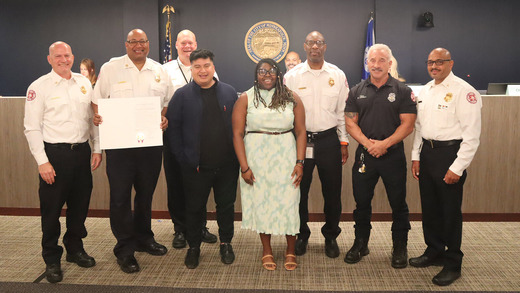
The City Council passed a Firefighter Remembrance Honorary Resolution brought forward by Council Member Chavez and myself to acknowledge the sacrifices that firefighters make in the line of duty, including those who have lost their lives. Thank you MFD for your service!
Leadership of the Public Health and Safety Committee with firefighters honoring MFD.
All Prospect Park residents are invited to a Community Meeting co-hosted by Prospect Park Association and BrittFit50 Indigenous Health. There will be updates from:
- MPD 2nd Precinct Inspector Nick Torborg
- 2nd Precinct Crime Prevention Specialist Teila Zoller
- Ward 2 Council Member Robin Wonsley
- Prospect Park Association leadership
- Park Board Commissioner Billy Menz
Prospect Park Community Meeting
Monday September 23rd 6:30-8pm
The Market at Malcolm Yards- 501 30th Ave SE
Prospect Park community meeting flyer
Voters can cast their ballots early by mail or in person at the Early Vote Center, 980 E. Hennepin Ave.
Voting by mail
All mail-in ballots need to be received by Election Day (Nov. 5) to count. If you choose to deliver your ballot in person to the Elections & Voter Services office, it must be returned by 8 p.m. on Election Day, Nov. 5. Mail ballots cannot be dropped off at polling places on Election Day.
Find more information on how to vote by mail on the City website.
Voting at the Early Vote Center
Save Oct. 23 for a free seniors fair. The fair is tailored for our senior community members and caregivers. The day will feature workshops, an elected officials panel, a resource fair, and a free breakfast and lunch. The workshops will cover yoga and meditation, City services, public safety and connecting with community.
Seniors fair 9 a.m.-2 p.m. Wednesday, Oct. 23 Diamond Lake Lutheran Church, 5760 Portland Ave. S.
Schedule
Raffle with prizes to be announced.
9 a.m. - Welcome and breakfast
10 a.m. - Morning workshops: yoga for all – mind and body, City services presented by Public Works and 311
11 a.m. - Resource fair and lunch Noon – Panel discussion with local elected officials including City Council Members Andrea Jenkins, Emily Koski and Aurin Chowdhury; and Hennepin County Commissioner Angela Conley. More to be announced.
1 p.m. - Afternoon workshops: the City’s holistic approach to community safety, a discussion about making community connections through art.
The seniors fair is sponsored by Wards 8, 11 and 12.
For more information about registering and voting in Minneapolis, go to the City website.
Join the Health Department’s School Based Clinics team for a health and wellness fair as we connect the community to services, resources and career opportunities.
The fair is for all ages. It will include:
- Resources around mental health and social services for young people.
- Career opportunities ranging from lifeguard and swim instructor to yoga instructor training.
- Engaging activities for all abilities.
Health and wellness career fair 4:30-6:30 p.m. Thursday, Sept. 26 Edison Senior High School, 2030 Monroe St. NE
Learn more about Minneapolis School Based Clinics.
Do you care about standing up for civil rights in our community? Now’s your chance to make a real difference! Apply to join the Minneapolis Civil Rights Commission and help protect the rights of everyone in our city.
The commission is made up of 21 passionate volunteers, including 6-8 lawyers, who work together to solve important civil rights issues, talk to local leaders, and teach people about their rights under the Minneapolis Civil Rights Ordinance.
Applications are open now until September 30th—don’t miss out on this amazing opportunity! Apply now: Boards & Commissions Current Openings (minneapolismn.gov)
Civil Rights Commission flyer
The City is now recruiting members for the Advisory Committee on People with Disabilities. This advisory committee is open to any Minneapolis resident regardless of ward and has been in existence since 1976.
Many amazing disability justice advocates have served on MACOPD over the years and influenced numerous City projects. Some of the projects include the city’s Americans with Disabilities Act (ADA) Action and Transition plans, the Minneapolis 2040 comprehensive plan, renovations to public parks and recreation facilities, and numerous pedestrian and transit-related projects.
City boards and commissions offer a direct way for residents to advise City leadership about topics important to them. Applications will be accepted Sept. 1 through Sept. 30. Translation and interpreting are available so all residents can participate. If interested in applying, fill out the online application.
For more information, potential applicants can email or call Guthrie Byard, Community Specialist – People with Disabilities, 612-554-3666.
Contact Ward 2
Visit: minneapolismn.gov/ward2
Email: ward2@minneapolismn.gov
Phone: 612-673-2202
We've moved while work is being done in City Hall. Our office is in:
Room 100, Public Service Center
250 South 4th St.
Get directions
For reasonable accommodations or alternative format please contact 311. People who are deaf or hard of hearing can use a relay service to call 311 at 612-673-3000. TTY users call 612-263-6850. Para ayuda, llame al 311. Rau kev pab, hu 311. Hadii aad caawimaad u baahantahay, wac 311. |