|
Summary: The Public Health and Safety (PHS) Committee received a presentation from five leading national violence prevention organizations.
Background: The city has committed to implementing a comprehensive public safety system that includes prevention, responsive, and restorative services. The Safe and Thriving Communities Report is a robust and clear 10-year plan on what the Mayor’s administration needs to do to make that vision a reality.
One key piece of that system is violence prevention and intervention through the nationally-recognized Group Violence Intervention model. Successful implementation of violence prevention strategies have abundant evidence to demonstrate they lower violence, lower crime, and have positive effects in the community.
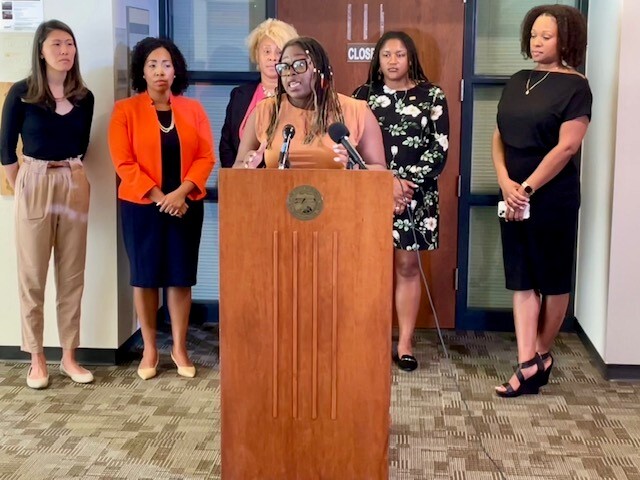
Given this, I organized a presentation by several of the national experts in violence prevention to overview their approaches and strategies. These organizations have a successful track record at lowering violence and creating safer neighborhoods in cities throughout the nation.
The presenters included Synethia White, Director of Strategic Initiatives at Cities United; Shantay Jackson, Director of National Offices of Violence Prevention Network; Sasha Cotton, Executive Director of National Network for Safe Communities at John Jay College; Dr. Monique Williams, Executive Director of Cure Violence Global; Josephine Pang, Senior Manager at The Health Alliance for Violence Intervention; and Juard Barnes, Senior Advisor for Communities of Practice at The Health Alliance for Violence Intervention
I encourage everyone to watch the full presentation by these experts, which starts here at 0:36:30. Below are a few examples of what was covered in the presentation:
“Baltimore is down 36% so far year-to-date on homicides and non-fatal shootings and was down 20% last year. We’re seeing year-over-year successes. Where we’re seeing those successes play out is where we’re seeing an integrated approach to public safety, ” said Shantay Jackson, Director of National Offices of Violence Prevention Network.
“Violence is a public health issue. It has risk factors and protective factors. There are things that make violence more likely and things that can protect against violence. Multiple independently funded, independently conducted, multi-site and multi-year scientific evaluations show that the Cure Violence model works, and you can see between a 30-70% reduction in shootings and killings where it is implemented,” said Dr. Monique Williams of Cure Violence Global.
“According to the data in most major cities, it is about 0.5% of the population that is driving the violence, and that is true in Minneapolis as well. So if we can identify those people who are most vulnerable and susceptible to committing violence and focus our attention on them, we can be finite with our resources instead of blanketing communities with law enforcement or resources. We can really deliver the services that make cities safer,” said Sasha Cotton, Executive Director of the National Network for Safe Communities at John Jay College.
I hope that this presentation is the beginning of a renewed commitment from the city to fully adhere to national best practices and prioritize violence prevention strategies as part of our public safety system. These partners have a successful track record and we have a responsibility to lean into these partnerships to create the strongest possible public safety system for Minneapolis residents.
Key votes: No votes taken.
CM Wonsley welcoming violence prevention partners
Summary: Staff has published a report outlining ways for the city to implement fees for off-duty police work.
Background: Minneapolis police officers can work off-duty. This off-duty work is completely unregulated and untracked. Officers wear city uniforms, drive city cars, and rely on city liability while working off-duty, but they set and collect their own compensation at any rate they want. Off-duty policing is counterproductive to an equitable public safety system and the Department of Justice has said that it undermines supervision and is poorly managed.
For nearly two years, my office has been engaged in trying to formalize and advance an off-duty administrative fee to cover the costs the city incurs when officers participate in off-duty work.
When I first brought a legislative directive to understand potential options of instituting fees, the administration sidestepped the question and failed to provide any examples or suggestions on how to do so.
I authored a staff directive to the City Council’s Policy and Research division which provided a thorough report with the Public Health and Safety committee this week. The report gives some clear examples of different ways cities have administered fees and my office is already in communication with the city attorney’s office on next steps. I look forward to using this report and finally addressing the issue of off-duty police work through common sense regulation.
Key votes: No votes taken.
Summary: The Renters Rights Mandatory Disclosure ordinance passed committee and goes to a final vote on August 15th.
Background: I am authoring an ordinance that requires landlords disclose basic information about the property to all prospective tenants, and that all new tenants receive basic information about their rights. This is a basic, commonsense regulation to ensure that tenants can make informed decisions about their housing options, advocate for themselves, and take action if needed. You can read more about the ordinance on this FAQ sheet.
This week, the ordinance went to the Business Housing and Zoning (BHZ) Committee for amendment and discussion. I worked with the community, staff, and my colleagues on several amendments to strengthen the policy. The following amendments were approved at BHZ:
- An implementation date of March 1st. This will ensure time for the Regulatory Services to reformat their dashboards to facilitate the disclosure process for landlords. It will also allow Regulatory Services ample time to communicate with each landlord about the new requirement and improved dashboard/resources to support compliance.
- Changing the requirement for a “list of violations” to “information about violations” to better accommodate various formats that Regulatory Services may choose to use.
- Adding a requirement for a form of contact information for the management company as well as the property owner.
- Adding a specification that the required disclosures made after the lease is signed must be done within 90 days of the signing.
- Adding an overview of how garbage, recycling, and organics recycling are managed at the property.
- Adding a provision that a tenant who terminates their lease under the terms of the ordinance cannot be charged punitive fees or penalties for doing so.
The amended ordinance will go to full Council for final approval on August 15th at 9:30am.
Key votes: The Business Housing and Zoning (BHZ) Committee amends and unanimously approves the ordinance. Council will take a final vote on August 15th.
Summary: Council is exploring options for an independent third party evaluation of the impacts of ShotSpotter technology. Council will consider a contract extension during the next cycle.
Background: Preventing and responding to gun violence effectively is a high priority for improving public safety. One of the tools the city currently uses is called ShotSpotter, a gunshot location detection system. In March, the Administration and Enterprise Oversight (AEO) Committee received a report from local and national experts about the limitations and unintended consequences of ShotSpotter that are causing cities around the country to reconsider their investment in this technology.
I believe it is important to evaluate all our city’s tools for preventing and responding to gun violence and use our resources as efficiently as possibly to protect residents. All multi-million dollar investments should be backed by data and based on evidence rather than perceptions. For this reason, I directed the city’s Policy and Research division to provide Council with some examples of independent evaluations of ShotSpotter that other cities around the country have used so that we can have a sense of what evaluation options we could use. This week staff presented an overview of their report on municipal evaluation of ShotSpotter.
The city’s current contract with ShotSpotter expired in March. With essentially no warning, MPD requested a vote on a three-year extension of the contract and to expand the technology to a wider area of the city. Council Vice President Chughtai motioned to delay consideration of this extension for a cycle to give Council time to work with the Frey administration to overview concerns and explore additional options prior to voting on such a large investment.
I do not support increasing the geographic area of ShotSpotter and signing a three-year contract without evidence that it is the best use of our public safety spending. I look forward to working with my colleagues on getting an independent objective evaluation to inform our investments.
Key votes: The Administration and Enterprise Oversight (AEO) Committee votes 3-2 to hold the ShotSpotter contract in committee for one cycle to allow adequate time for Council consideration. Council Members Palmisano and Vetaw voted in opposition. The contract will return to the AEO Committee on August 19th.
Summary: In response to increased oversight by Council, the Frey administration is now starting to implement elements of a comprehensive public safety system.
Background: In the summer of 2023, the city received a report called the Safe and Thriving Communities Report. Written by experts at Leadership for a Networked World at Harvard University, the Safe and Thriving Communities Report gives an in depth outline of how Minneapolis can implement a comprehensive public safety system that includes preventative, responsive, and restorative services. It also includes a detailed 10-year action plan.
Despite championing the plan in the media, the Frey administration did not move forward with a systematic implementation of the plan for a year. While some implementation may have been happening, it was not being transparently documented and communicated to Council and the public.
I continue to hear from residents that they want the city to finally implement a comprehensive public safety system that goes beyond policing. I have made it a priority to support the administration’s implementation and use the Council’s budgetary and oversight authority to urge the administration to work efficiently to take the steps that are outlined in the Safe and Thriving Communities Report. Two weeks ago, Council President Payne, Public Health and Safety Chair Chavez and I introduced the Safe and Thriving Communities Action Plan for a public comment period to help get the administration, Council, and the public aligned.
This Council oversight does appear to be having an impact. Just a few weeks after opening the public comment period on the Safe and Thriving Communities Report, the Frey administration presented that they are now implementing the “Launch List” of the first actions needed to build out a comprehensive system. They committed to making a public dashboard so that there is transparency on what steps they are taking and what steps have not yet been implemented.
I am pleased to see that public engagement and Council oversight has activated the Frey administration to take more efficient and serious action on public safety and look forward to continuing to support the plans’ full implementation.
Key votes: No votes taken.
Summary: The Neighborhood and Community Relations Department presented their model for community engagement and plans to update the blueprint.
Background: In 2015, the Neighborhood and Community Relations Department (NCR) wrote a 5-year plan to ensure the city has an equitable community engagement plan. The plan was informed by extensive research and engagement with the community. The Blueprint for Equitable Engagement has guided NCR’s practices and how they support all city departments in engaging residents.
NCR is working to update the Blueprint and the strategies and services that are available to support city departments in public engagement and transparency. This crucial project helps the city improve our equitable community engagement work and build trust and credibility with the community.
Urban scholars presenting at AEO Committee
Everyone planning to cast their ballots on Election Day, Aug. 13, should check the location of their polling place. Find your polling place on the Minnesota secretary of state website.
See tips to save time voting and read more on the City website.
Voting early
Anyone who can vote in Minneapolis on Election Day can vote early at the Early Vote Center, 980 E. Hennepin Ave. Note that the Early Vote Center is closed for voting on Election Day, and you should vote at your polling place. See the hours on the City website.
Return your mail ballot
All mail-in ballots need to be received by Aug. 13 to count. The City recommends returning mail ballots in person to avoid a late delivery. Ballots can be dropped off during regular business hours at Minneapolis Election & Voter Services, 980 E. Hennepin Ave., or at the Hennepin County Government Center, 300 Sixth St. S. On Election Day, Aug. 13, completed mail ballots will be accepted until 8 p.m.
Prospect Park had the annual 4th Street Festival on National Night out. It brought together hundreds of neighbors to share resources, have fun, and connect with each other. Thank you to BF50 Indigenous Health and all the organizations and neighbors who made this wonderful event possible!
Minneapolis Animal Care & Control encourages pet adoptions to help more animals find their forever homes and make room in its shelter. Visitors through Aug. 3 will pair up with a staff member or volunteer to help find the right pet for them.
Staff is seeing a spike in animals at the shelter this summer. Just last week, 130 animals were in its care. Staff say that increasing vet care costs and housing insecurity are likely causing more community members to surrender their pets. This increase in surrenders, combined with a lagging adoption rate, have left the shelter full.
Animal Care & Control is open for adoptions:
- 1-5 p.m. Monday-Wednesdays
- 1-7 p.m. Thursdays
- 1-5 p.m. Fridays
- 11 a.m.-3 p.m. Saturdays
Minneapolis residents are not charged adoption fees for cats or adult dogs; they just need to pay for a City license. Puppies younger than six months are $250 regardless of residence. Adoptable cats and dogs are already spayed or neutered, microchipped, and vaccinated.
Read more on the City website.
The City of Minneapolis debuted three street concepts (PDF) and five site ideas (PDF) for George Floyd Square.
These concepts and ideas are part of the City’s engagement with community to develop a vision for the square by the end of the year. The vision will include a preferred concept for the design of the streets as well as ideas for the Peoples’ Way property, a former gas station the City purchased in 2023 for community space.
Next visioning workshop
The community has also been providing input on memorials through visioning workshops. Visioning for the memorials will be a focus for the August workshop and will help inform the City’s future role in the memorial process.
August visioning workshop 5:30-8 p.m. Aug. 27 3736 Chicago Ave.
Read more on the City website.
Contact Ward 2
Visit: minneapolismn.gov/ward2
Email: ward2@minneapolismn.gov
Phone: 612-673-2202
We've moved while work is being done in City Hall. Our office is in:
Room 100, Public Service Center
250 South 4th St.
Get directions
For reasonable accommodations or alternative format please contact 311. People who are deaf or hard of hearing can use a relay service to call 311 at 612-673-3000. TTY users call 612-263-6850. Para ayuda, llame al 311. Rau kev pab, hu 311. Hadii aad caawimaad u baahantahay, wac 311. |