St. Paul, MN — The Minnesota Public Utilities Commission (Commission) approved a set of proposals to make the state’s electric grid more efficient, reduce congestion costs, and help more renewable energy reach homes and businesses. The decision follows the Commission’s review of the 2025 Grid Enhancing Technologies (GETs) Report, filed by Minnesota’s major transmission owners as required under a 2024 state law.
The report identifies 66 locations across Minnesota where transmission bottlenecks are driving up costs or limiting how much power can move through the system. Of those, transmission owners identified 12 projects that can be built quickly and are expected to pay for themselves within five years – with most recovering costs in an average of roughly 1.3 years.
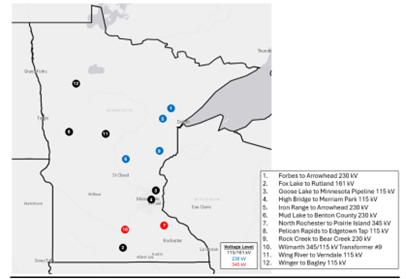
The 12 projects are distributed across the state and use a range of technologies to reduce congestion and increase power flow. Most rely on “grid ‑enhancing technologies” – tools that boost capacity on existing transmission lines, reroute electricity around congested areas, and improve system flexibility – without building new transmission corridors. When used appropriately, GETs solutions can provide faster, lower ‑cost relief than traditional infrastructure.
Stakeholders – including the Department of Commerce, clean energy organizations, rural energy boards, and technology coalitions – supported the GETs plan and encouraged the Commission to broaden its review of advanced transmission technologies, such as power flow controllers, topology optimization, advanced conductors, and grid-scale energy storage.
Why this matters for Minnesota
Grid congestion may not be top of mind for most people, but it has a real impact on electric bills. When transmission lines hit capacity, utilities must turn to higher priced power sources. Reducing congestion lowers overall system costs and can save customers money. In the Midcontinent Independent System Operator region, real-time congestion added $928 million in costs between December 2025 through February 2026 alone – costs felt by customers from Manitoba to Minnesota to Louisiana.
Congestion also impedes Minnesota’s clean energy progress. Wind and solar farms are sometimes forced to curtail output because the grid can’t carry the electricity they produce. That slows the transition to clean energy, and it affects rural communities that rely on production tax revenue tied to renewable generation.
“Minnesotans are looking for relief on their energy bills, and this is one concrete way we can deliver that relief,” said Commissioner Hwikwon Ham. “By removing bottlenecks in our grid, we’re not just making the system work better, we’re keeping costs down. These projects show that smarter use of existing infrastructure can pay real dividends for ratepayers.”
The Commission’s decision directs Minnesota transmission owners to move forward with the full portfolio of proposed grid enhancing technology projects. The Commission will also require transmission owners to continuously evaluate cost-effective congestion mitigation opportunities and submit a GETs Report every two years as part of the Biennial Transmission Projects Report.
Additional information
GETs Study Report is available here. Full record information available in Docket 25-99. Project map and details.
The Minnesota Public Utilities Commission regulates three cornerstone service industries in Minnesota's economy: electricity, natural gas and telephone. The Commission’s mission is to create and maintain a regulatory environment that ensures safe, adequate, and efficient utility services at fair, reasonable rates consistent with State telecommunications and energy policies. It does so by providing independent, consistent, professional, and comprehensive oversight and regulation of utility service providers. Learn more at mn.gov/puc.