Ancestors Take Wing: Monarchs
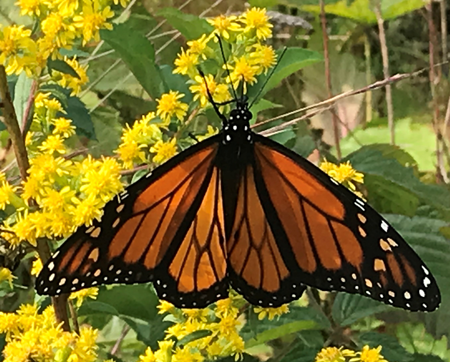
Monarch butterfly on a goldenrod plant in Maine.
All Hallows Eve (October 31) is celebrated through a variety of traditions by people around the world. Some of these traditions have roots in a Celtic festival, Samhain, that originated as a mandatory multiple day after-harvest event that included a community fire from which each participant lit a flame to be used to lite their own household hearth. Over time Samhain celebrations changed and spread to other lands and was combined with local traditions. Those that celebrate Halloween today may find they are carrying on some of these same traditions while incorporating regional, cultural or family traditions of their own.
It is during this same season that Monarch butterflies arrive in Mexico's Central Highlands where the Dia De Los Meurtos (Day of the Dead) is celebrated. Over several days people remember family and friends who have died and welcome back their spirits through beautiful decorations of marigolds, artwork, costumes, and offerings of food. This celebration is not of the Halloween or Celtic traditions but developed independently and finds some roots in Aztec festivals. The annual arrival of millions of monarchs that coincides with this celebration was noted by the native peoples long before the Spanish and other explorer-conquerors arrived to claim the land, exploit the people, and change their culture. It was through the influence of Catholic traditions on the indigenous people that the returning monarch butterflies began to be seen as the returning souls of their departed family and ancestors.
Interesting Facts
- The monarch butterflies that arrive each autumn in Mexico's Central Highlands are not the same butterflies that left the previous spring. They are descendants of those that made the journey northward into the United States and Canada. The butterfly that leaves Maine in the Autumn to make the 2,000 mile journey to Mexico has never been there before; it is at least three to four or generations removed from the butterfly that started out from Mexico in the springtime because the monarch life-cycle is short. They lay eggs and die along the journey northward and during their time in Maine. It is only the last generation of the summer that makes the 2,000 mile flight southward, arriving around All Hallows Eve (Oct 31), All Saints Day (Nov 1), and All Souls Day (Nov 2).
- Female monarchs have wide black wing veins. Male monarchs have thin black wing veins and a small black oval on each lower wing near the abdomen on one of the veins. These ovals are remnant scent pouches. Remnant because they are thought to no longer thought to produce scent. Look at the small photos in the Nature Note header above the issue title. Can you tell if the monarch photo is of a male or female? Do you see the oval scent pouches?
Activities for Children and the Young at Heart
- Watch this Atlas Obscura video about the monarchs in El Rosario, Mexico.
- Learn more about monarch migration and their lifecycle at MonarchWatch.org
- Explore the origins of the traditions your family celebrates and the influences that have changed them over time.
- Make a list of the harvest celebrations in your state or region. If you can, try to visit a new one each year. Some may have online activities as well.
- Create your own tradition. First decide what you want to honor or celebrate. Do you have a favorite plant or animal, or place in nature that you love to visit? Then, decide how to celebrate... will you draw pictures, write poems, play music? Will you make food? Is dressing up or decorations a part of your celebration? Will you keep this as a personal celebration for just you or invite others to learn about what you love and are celebrating? What day and time will you pick to celebrate? Have fun!
- Mariposa is butterfly in Spanish. What language was spoken in Mexico before Spanish-speaking people arrived? Why did Spanish become predominate?
- Since it is the season of pumpkins, you may want to learn more about them. If so, see Nature Note 20 - Extraordinary Squash: The Pumpkin.
Share Nature Note with your friends, family, teachers, scouts, and anyone you think might be interested. Here is how they can sign up for a free subscription:
Read back issues online.
Suggest a topic by email; put Nature Note in Subject line and email Jocelyn Hubbell.
|