|
By Baker Geist and Brian Hughes,
Communications Specialists;
Photos by Jennifer Finch, Public Information Officer and
Kevin Smith, Public Works Foreman |
|
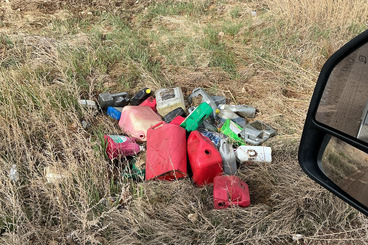
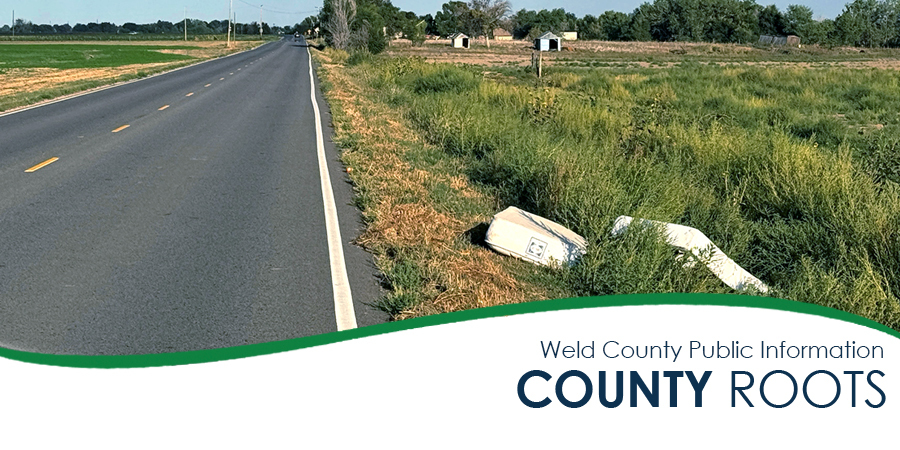
For as long as he can recall, Curtis Hall remembers seeing it — the trash, the used mattresses, the old furniture — left along the side of county roads.
“When I was a grader operator, I used to report trash to public works, and we’d go pick it up,” said Hall, who is now the department’s director in a career spanning more than two decades with Weld County. “It’s been an issue the whole time I’ve been here.”
He thought he saw it all. But in 2020, the issue grew much larger, as abandoned RVs started popping up all over Weld County. It’s a trend that remains.
“That’s been the biggest issue lately,” Hall said. “We pay to tow them and pay for a company to destroy them.”
The “we” Hall is referring to is county taxpayers. Money used to haul away RVs, trash, and other items comes out of public works’ road maintenance fund. That means taxpayer dollars that should be used to repair a road or fill a pothole instead go toward roadside cleanup.
Hall estimates the county pays for 15 RVs to be destroyed every year. With removal and destroy costs around $4,000 per RV, it can add up quickly.
|
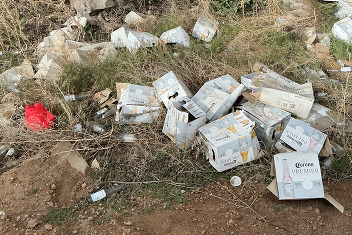
But RVs are only one element to the continued problem of roadside dumping. Every Saturday, employees from public works work overtime to pick up trash, hauling bigger items — furniture, mattresses, TVs, and more — to landfills.
The impact of this work on taxpayers is far from minimal. From 2024 to date, over $573,000 has been spent on equipment and employees to remove trash. Over that same time period, $75,000 has been spent on landfill fees.
Public works is not alone in the continued effort to keep roadsides clear. Individuals in Weld County’s work release program also lend a helping hand. Their efforts help increase the efficiency of roadside cleanup and may also help them receive a sentence deduction — a result for 151 people in the work release program over the past year.
“It can serve as an important incentive for our clients to remain engaged and committed in the work release program,” said Doug Erler, who oversees work release as the director for the Weld County Justice Services Department. “Individuals who participate in roadside cleanup and make a positive impact doing so can have their sentence reduced, allowing them to complete their court-ordered requirements more quickly.”
A look at the overall results of roadside cleanup suggests the work is having an impact. In 2024, 24.5 tons of trash were removed. In 2025, 31.5 tons were removed.
But the amount of trash picked up last year also highlights a negative. The problem is growing.
|
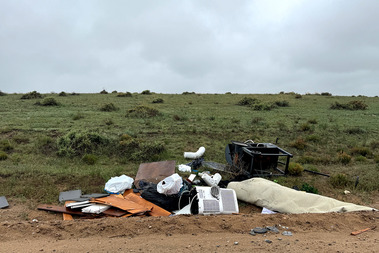
And then there's the safety aspect.
“Sometimes, trash or items can spill over onto a road. That creates a hazard for the traveling public and takes resources to go remove it,” Hall said. “We ask that everyone stop dumping. It costs in more ways than one.”
Roadside dumping doesn’t just create an eyesore or a safety issue. It’s also a top environmental health-related concern, as identified in the county’s 2025 Community Health Survey.
That finding, combined with the amount of time and money public works spends collecting dumped materials, prompted the Weld County Department of Public Health and Environment (WCDPHE) to take a closer look at possible solutions.
It’s not as though WCDPHE’S effort to combat roadside dumping is new. In fact, both it and public works are attacking the problem from different directions: Public works is dealing with the trash that has already been dumped, while WCDPHE is looking for ways to give residents better options before that dumping occurs.
The department has already worked to give residents more disposal options. Free electronic waste recycling events have provided opportunities to properly dispose of televisions, computers, and other electronics, while the county’s free landfill voucher program was developed as another way to encourage residents to take bulky waste to a landfill rather than leave it along a road.
WCDPHE Director Jason Chessher said the voucher program grew out of conversations with public works about the amount of time crews were spending responding to illegal dumping. While use of the vouchers continues to grow, the county is now looking at whether a broader, long-term approach is needed.
“We're all aware that there's a problem,” Chessher said. “Even if it's just driving around on county roads seeing illegal dumping, we all know it's a problem. We're trying to figure out what the best solution is based on resident needs.”
|
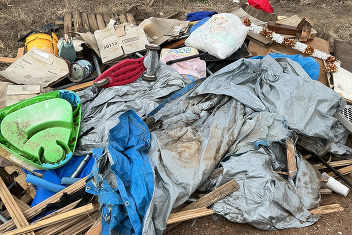
For WCDPHE, the best solution starts with understanding why residents may be turning to illegal dumping in the first place and what options could make proper disposal easier.
One option being explored is a county transfer station — a facility where residents and waste haulers could bring materials before they are consolidated and transported to a landfill. Such a facility could potentially include recycling, household hazardous waste, and other disposal services as well.
No decision has been made yet on whether Weld County needs a transfer station, how many facilities might be appropriate, or who would operate them. If approved, a proposed $50,000 needs assessment in the 2027 budget would help answer those questions by looking at the county’s population, geographic distribution, infrastructure, and potential locations. The assessment could also examine whether the best approach would be a county-operated facility or a partnership with a private waste company.
The county is studying how other communities handle waste disposal. WCDPHE staff have visited regional recycling and transfer facilities to learn what services they provide, how they operate, and what approaches could work in Weld County.
The next step is hearing directly from Weld County residents.
WCDPHE is currently conducting a short public survey to find out how large household items are disposed of. Residents are encouraged to take the anonymous survey, as it will help identify gaps in existing disposal services and determine whether additional waste and recycling options would be useful.
Although WCDPHE has taken the lead on studying residents’ needs and possible solutions, Chessher said continued collaboration with public works will be important. If the county eventually moves forward with a waste facility, public works’ experience with heavy equipment, road infrastructure, and waste cleanup could make the department a natural fit for operating it.
“It may very well turn into a public works operation a few years down the road, and that's OK if that's what best serves the needs of Weld County residents,” Chesser said. “We’ll bring a recommendation back to the board, and ultimately it’ll be a decision of the board as to what the best solution for the county is.”
|
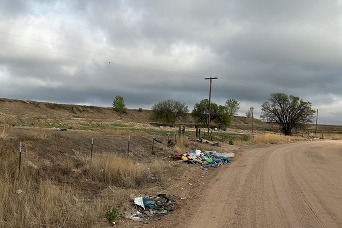
As both departments continue to tackle the issue of trash, it’s the hope that residents will do their part by disposing of items appropriately, as many have done through the large item voucher program and electronic recycling events. New options may be on the horizon — representing the latest step in reducing clutter, enhancing safety, and preserving Weld County’s natural beauty.
|
|
|
Roadside dumping was identified as a top public health concern in Weld County’s 2025 Community Health Survey. |
In 2024, 24.5 tons of trash were removed by Weld County Public Works and individuals in Weld County’s work release program. That number grew to 31.5 tons in 2025. |
WCDPHE has developed a survey to understand why people are dumping items and find solutions. |
|
|
miscellany: a group of or collection of different items.
- The 2026 State of the County is almost here! Join the commissioners on Thursday, Oct. 8, from 7:30 to 8:30 a.m. in the Welcome Center at Aims Community College and hear important updates on how Weld County continues to serve residents. Learn more about the 2026 State of the County.
-
The Weld County Planning Department continues to work on the Comprehensive Plan update. Learn more about the draft plan and ask your questions during two open house events in October. Stop by any time between 4 to 6 p.m. on Monday, Oct. 26, at the Weld County Administration Building, 1150 O St. in Greeley. A second open house will be held Tuesday, Oct. 27, at the Fort Lupton Recreation Center, 203 Harrison Ave., also from 4 to 6 p.m.
- Don’t miss the last in-person foster care orientation of 2026! If you just want to learn more about how foster care works here in Weld County, or if you’re ready to make a difference in a child’s life, join us for this informational session on Wednesday, October 21, from 4:30 to 6 p.m. at the Department of Human Services in Greeley. Register at . If you can’t make it this month, additional virtual options will be available in November and December.
- Strengthen your online habits during Cybersecurity Awareness Month in October. One easy way is to update your passwords. Remember, passwords should be long — aim for at least 16 characters — different for every account, and contain a mixture of numbers and symbols. Watch for more of these tips during the month of October on our Facebook and X platforms and find resources anytime at www.staysafeonline.org.
|
|
|
Welcome to County Roots, the official newsletter of Weld County Government. For those of us who work in county government, we think what we do is pretty interesting. So the goal of this newsletter is to highlight some of the partnerships, technology and efficiencies we are using to make government stronger and more effective for its residents.
Our goal is to establish regular communication with residents, spur interest in county projects, highlight county accomplishments and provide meaningful information to the public. In fact, our goal is to live up to the name “County Roots.” Want to know more about the meaning behind the name? Please visit our webpage, where you can also find previous editions of this newsletter.
|
|
|
|
|