|
Section 3
By Baker Geist, Communications Specialist |
|
Section 4
Every year, staff in Weld County’s Weed Division traverse the county searching for noxious weeds — mowing, spraying, and cutting them when they’re found along county roadsides, around county facilities, and on county property. It’s important work, but it can be somewhat routine.
Until it isn’t.
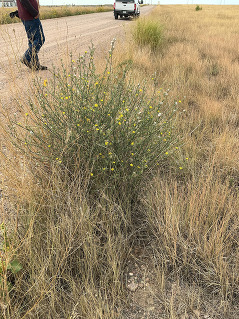
“The plants I initially spotted from the road were unusually tall,” Kathy Griffee said, recalling what first caught her eye last September near the Sam Brownlee Training Center in Carr. “Most of our noxious weeds stand out because they look unlike anything else in the surrounding environment.”
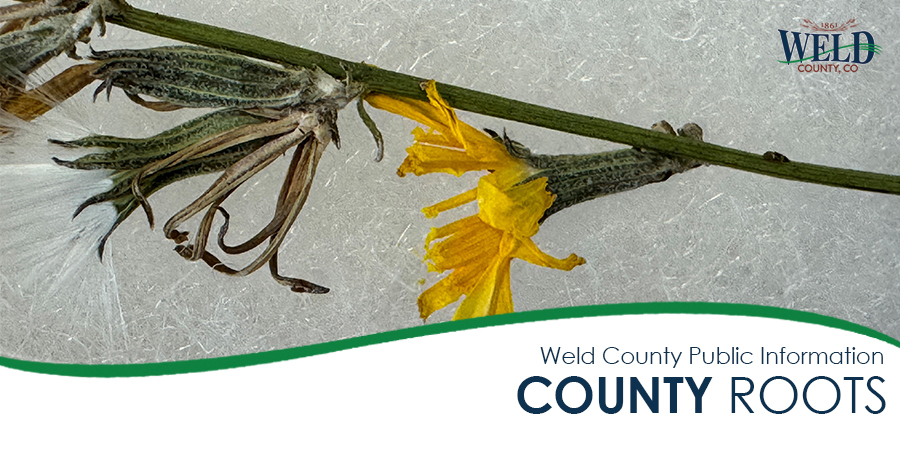
Griffee, a weed landowner specialist for the weed division since 2019, knew the plant was different from the Canada thistle, Dalmatian toadflax, and many other weeds common in Weld County. She collected a few samples, and using software, her deep knowledge of botany, and after comparing the plant to other noxious weeds, she discovered that it wasn’t a large dandelion or sunflower, even though parts of the plant have similar yellow petals. It was a species rare to Colorado, new to Weld County, and a threat to native species: rush skeletonweed.
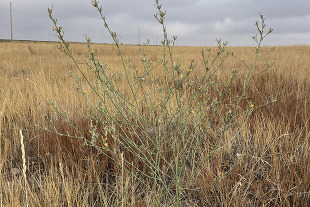
Despite looking, at least in part, like other familiar weeds, rush skeletonweed has distinguishing characteristics, most notably its size. The thin, wiry plant can grow between 1 and 4 feet tall. Similar to fellow noxious weeds, it can displace vegetation and destroy native grasses, and it can do so quickly, spreading up to 10,000 seeds per plant, according to the U.S. Department of Agriculture. Weld County Weed Division Supervisor Tina Booton said seed viability can last between three to five years — all tendencies that make the plant’s arrival concerning, especially in a county stretching over 4,000 square miles.
|
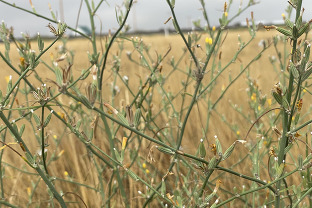
“It’s challenging how fast it can grow and form a monoculture, displace vegetation, all destroying native landscapes,” Booton said. “It appears that it can spread quickly and that control options may be more difficult.”
That explains why Booton and Griffee acted aggressively upon discovering the weed. The two spent the next few days removing it, filling 60 trash bags through manual removal as well as three different chemical treatments.
“Looking where Kathy originally discovered the weed, we were expecting a dozen or so plants,” Booton said. “Then when we got up there to treat it, we realized how extensive it was over four parcels — along a county road, on the railroad, and on a landowner’s parcel.”
“As I do with any noxious weed, I wish we found it sooner, but I’m happy we found it so we can start to treat it and be on the lookout for it.”
Asking the public for help
Despite the weed being rare in Colorado, with Boulder County being the only other county statewide with a known rush skeletonweed infestation, the Colorado Department of Agriculture understands the damage it can cause. That’s why it’s classified as a List A species, effectively requiring it to be eradicated.
The biggest challenge in Weld County’s fight against rush skeletonweed moving forward? Knowing exactly where it is. While it’s been identified in a relatively small section in northern Weld County, has it spread to other areas? Is it in southern Weld County?
To help answer these questions, Booton and Weld County Public Works Director Curtis Hall are turning to residents and landowners for more information.
“The public’s help in identifying rush skeletonweed is critical. It can be beneficial to our team tracking its movement, understanding how quickly it’s spreading, and identifying the best way to treat it,” Hall said. “Working together is our best opportunity to catch it early and get it out of Weld County before it starts to disrupt the landscape or being a hinderance to farmers growing crops.”
|
How to help
-
Know what to look for – Booton said the weed is distinguishable from May through July and stands out due to its large size and bush-like appearance. Other specific characteristics can be found from the Colorado Department of Agriculture.
-
Call first – While the weed needs to be eradicated, Booton asks people to contact the weed division first if they believe they’ve spotted rush skeletonweed. This helps avoid misidentification and gives staff a chance to suggest the best treatment plan for a given area. As rush skeletonweed is a species set for eradication, the weed division may be able to treat the weed on people’s property, something reserved for List A weeds.
Alerting the weed division also gives staff an idea of where the weed is prevalent or how it might be spreading.
Perhaps most importantly, assistance from the public will help the division’s staff of eight be as effective as possible. They already treat over 1,000 acres of noxious weeds every year from known weeds that have a tendency to reappear. It’s a hope that with the watchful reporting of residents and landowners, this new invasive species will be short-lived in Weld County.
|
|
|
Section 6
Rush skeletonweed was discovered in Weld County in the fall of 2025. |
The county’s weed division is working to eradicate it through manual removal and chemical treatments. |
The county would like residents and landowners to report any sightings of the new noxious weed. |
|
Section 11
|
miscellany: a group of or collection of different items.
- Weld County Government offices will be closed for Memorial Day on Monday, May 25, 2026. We thank the men and women who served and defended our country.
-
Ahead of big projects on Weld County Road 66 and Weld County Road 54, much planning and coordination is taking place to deliver the best improvements possible. Read more in the latest project newsletters at www.weld.gov/Go/WCR54 and www.weld.gov/Go/WCR66. After reading, subscribe to receive new updates via email.
- Job seekers, did you know the Weld County Workforce Center offers workshops in Greeley, Fort Lupton, and online? These workshops cover helpful topics like writing a resume, preparing for interviews, and learning how to search for jobs. Find the workshop that’s right for you at www.weld.gov/Go/job-seeker-workshops.
|
|
Section 15
|
Welcome to County Roots, the official newsletter of Weld County Government. For those of us who work in county government, we think what we do is pretty interesting. So the goal of this newsletter is to highlight some of the partnerships, technology and efficiencies we are using to make government stronger and more effective for its residents.
Our goal is to establish regular communication with residents, spur interest in county projects, highlight county accomplishments and provide meaningful information to the public. In fact, our goal is to live up to the name “County Roots.” Want to know more about the meaning behind the name? Please visit our webpage, where you can also find previous editions of this newsletter.
|
|
|
|
|