|
By Brian Hughes, Communications Specialist |
|
|
A local property owner with a private well wanted to check the water before a renter moved in, asking for a straightforward water quality test. It’s the kind of “just to be safe” request Weld County’s Public Health Laboratory hears often, but once that sample of water entered the lab, it became more than a simple vial of water. It became part of a sophisticated process, powered by science and technology, transforming it into actionable data that informs residents and can often reveal far more than many people know to ask for.
Most private testing starts the same way, with a question at the health department counter window or a phone call: What should I test for? Sometimes residents show up without a sample at all. They explain what’s going on, lab staff talk them through options, provide the right bottles and instructions, and the customer returns with water collected from home. When it comes to municipal water sources, the lab usually directs residents to talk with their municipality, but will test samples submitted from that municipality.
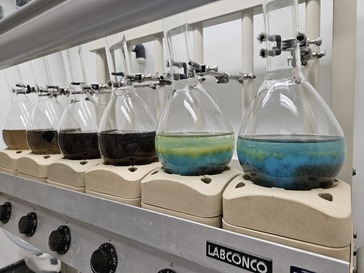
One water source, multiple tests
The lab’s work spans three critical areas: drinking water, wastewater, and well water. Each requires different testing protocols, from bacteria detection to chemical analysis. For well owners, the stakes are personal. “We talk with people every day about what they’re seeing or smelling in their water,” said Lab Manager Katrina Alsum. “Our job is to make sure they have safe drinking water.”
In this case, the property owner was motivated by a move-in deadline. Alsum noted that rental and real-estate situations often lead people to choose a simple testing package focused on the biggest health concerns — typically bacteria, nitrate, and lead.
There are many individual laboratory tests available for a fee, and several water quality testing packages available that bundle commonly needed and annual tests. Weld County well owners also have an option to get a volatile organic compound (VOC) test at no charge.
Since bacteria testing was in the customer’s testing package, that test was prioritized because microbiology tests have a strict 30-hour window from collection to analysis. That time pressure is part of what the public rarely sees: the lab isn’t just testing for contaminants; it’s also racing natural changes that can occur after water is collected. “We want to get the sample into the incubator right away,” Alsum explained, “to prevent any degradation that could interfere with results.”
|
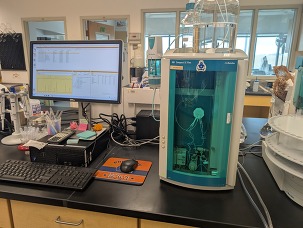
Technology that can do more than a request form
Because the testing package included lead, the sample was sent to certified Lab Chemists Sarah Schweickart and Augustin Yu to be analyzed on the county’s new Inductively Coupled Plasma Mass Spectrometer (ICPMS) an instrument that can scan for many metals at once with remarkable accuracy and far more efficiently than older lab equipment.
“Our old instrument could only run one metal at a time,” said Lab Specialist Carly Ruble Stanfield, who is currently being trained to run the ICPMS. “Now, we can analyze nearly all of them in a single run, saving time and improving detection limits.”
This is where the customer’s simple test request came to a turning point. In this case, lab staff noticed the issue wasn’t limited to the single metal the customer was concerned about, but instead the ICPMS showed there were actually five metals over the EPA’s Maximum Contaminant Levels (MCLs) limit.
In other words: the ICPMS didn’t just confirm what the property owner asked about, it uncovered what the customer didn’t know to ask about. “Even if a customer only asks about sodium or lead, we can alert them if other metal levels are high,” Alsum said. “That’s huge for public health.”
The lab also provides guidance when such problems arise, such as disinfection protocols for wells contaminated with bacteria. For the property owner, that meant a direct call from the lab and additional information added to the report: multiple additional metals were elevated, and treatment should be considered. While treatment decisions rest with the customer, the lab ensures clear, timely information the customer could act on.
This leap in technology isn’t just about speed; it’s about depth. The ICPMS allows the lab to identify contaminants that could pose serious health risks, even at trace levels. And soon, a Gas Chromatography-Mass Spectrometry (GCMS) system will bring VOC testing in-house, eliminating the need to send samples to Denver and cutting turnaround times dramatically.
|
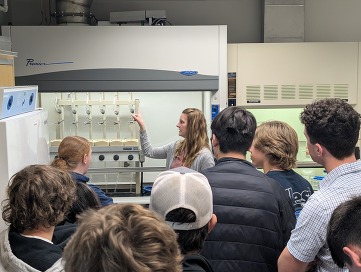
Where science meets service
For Ruble Stanfield, the technology is awe-inspiring, but the human connection matters most. “I love knowing where the water comes from and why it’s important,” she shared. Sometimes, especially with bacteria, a straightforward water quality test turns into an ongoing back-and-forth with retests, troubleshooting, and problem-solving until a well finally tests clean. “We’re not just running tests; we’re helping people stay healthy.”
Alsum agrees: “I get to do science, which I’m passionate about, and work with people, which I’m also passionate about. That combination is what makes this job so meaningful.”
The landlord’s bottle is just one among many, but it shows what modern lab testing looks like in real life: a single sample moving through multiple pathways and interpreted by people who understand the numbers lead to real information for residents to make decisions about the water they drink every day.
As Weld County grows, so does the demand for water testing. Population increases mean more samples, more regulations, and more pressure on systems. By expanding its technological capacity and training staff to keep pace, the Weld County lab proves that technology isn’t just transforming water testing, it’s safeguarding public health, one drop at a time.
|
|
|
Weld County's Public Health Laboratory uses advanced technology to detect water contaminants residents don't even know to ask about, going far beyond a basic test request. |
A new Inductively Coupled Plasma Mass Spectrometer (ICPMS) allows the lab to test for nearly all metals in a single run, dramatically improving speed, accuracy, and public health protection. |
Behind every water sample is a team of dedicated staff who combine scientific expertise with personal service to help Weld County residents make informed decisions about the water they drink. |
|
|
miscellany: a group of or collection of different items.
- As work will soon begin by the City of Greeley to transform the intersection of 59th Avenue and O Street into a roundabout, drivers are asked to be aware of both the closure and detours. The closure will begin on March 9 and go through June 26, 2026. Detours can be viewed on Weld County’s Road Advisory Map.
-
On Monday, March 9, the Weld County Board of Commissioners will read a proclamation in recognition of National Groundwater Awareness Week (March 8 to 14), encouraging all water well owners to annually test their water and stay informed on proper well maintenance. More information about Groundwater Awareness Week can be found on the laboratory webpage.
- If you’re between 14 and 24, or you’re a parent, teacher, mentor, or family member supporting a young person, the Young Adult Job Fair on March 11 in Greeley is a great place to start. This event connects young adults with local employers, hands-on career opportunities, and helpful county and community resources — all in one place. Get all the details at:
|
|
|
Welcome to County Roots, the official newsletter of Weld County Government. For those of us who work in county government, we think what we do is pretty interesting. So the goal of this newsletter is to highlight some of the partnerships, technology and efficiencies we are using to make government stronger and more effective for its residents.
Our goal is to establish regular communication with residents, spur interest in county projects, highlight county accomplishments and provide meaningful information to the public. In fact, our goal is to live up to the name “County Roots.” Want to know more about the meaning behind the name? Please visit our webpage, where you can also find previous editions of this newsletter.
|
|
|
|
|