|
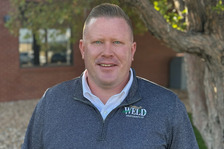
Director's note
As we deliver the first Energy Line issue of 2026, another year for Weld County’s Oil and Gas Energy Department (OGED) is also underway. Looking wholistically at this year, our task as a department is an important one: protect the people of Weld County by looking after the health, safety and welfare of the public and the environment, while managing oil and gas development in the real world.
Our role goes far beyond permits. Every application requires detailed siting and location review, coordination with referral agencies, and direct engagement with residents. We work through access, road standards, and haul routes with the Weld County Public Works Department and local partners. We push for practical solutions that reduce impacts before they happen, not after. We also make sure the 1041 Weld Oil and Gas Location Assessment process includes clear public notice, so nearby residents and local jurisdictions stay informed and have a real opportunity to engage.
Last year, we strengthened our local code to reduce duplication, add clarity, and keep health, safety, welfare, and environmental protection front and center. That work continues in 2026 with the same focus: regulatory certainty, transparent communication, and field-level accountability.
We do not just receive notices, we verify them. We have two inspectors who go on-site for every operational notice we receive. Operators must provide specific notifications at key milestones, including notice when site construction is starting. Our inspectors confirm conditions, document compliance, and follow-up until the site meets county standards.
When residents call or email, they reach a real person who tracks the issue, coordinates response, and closes the loop.
We are proud of this work because it matters. It keeps neighborhoods safer, protects the environment and wildlife, and ensures development happens responsibly. That is the standard OGED brings to every project, every time.
Brett Cavanagh, Director of the Weld County Oil and Gas Energy Department
|
|
|
By Baker Geist, Weld County Communications Specialist
Part of being a county commissioner involves standing up in support of or against state legislation that affects Weld County — think energy, transportation, or air quality. Every legislative session, the board is active, taking stances through editorials or personal testimony to make sure residents’ voices and concerns are considered in key state decision-making.
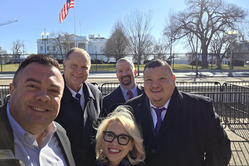
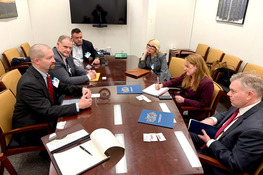
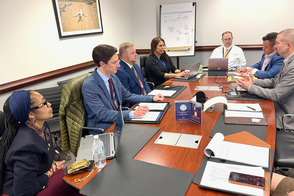
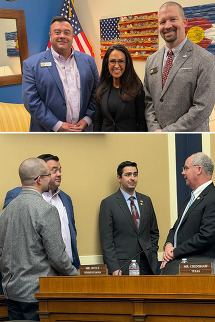
In January, for the first time ever, Weld County’s legislative concerns were taken to a new level when Commissioners Scott James, Jason Maxey, and Kevin Ross met with federal departments and congressional representatives in Washington, D.C.
“We were able to have highly productive in-person meetings with multiple departments,” Ross said, citing discussions with the Environmental Protection Agency, Department of Energy, Department of Transportation, and the White House. “In-person meetings allowed us to collaborate and find multiple solutions that can help Weld County when it comes to energy production and air quality.”
|
Energy
It’s no secret that energy has a major impact on Weld County’s overall economy. Oil and gas production routinely accounts for more than half of Weld County Government’s assessed value and is a primary economic driver to the budgets of school districts, fire departments, and municipal governments countywide.
While the Weld Oil and Gas Location Assessment (WOGLA) process has worked well at the county level to safely permit surface sites in unincorporated Weld County, the state’s permitting process has faced burdensome delays, with approval taking anywhere from six to 18 months — a delay driven by changing regulations and difficulty interpreting state rules. This, despite a memorandum of understanding with the Colorado Oil and Gas Conservation Commission and changes to the WOGLA process in hopes the state will recognize the county’s ability to protect the health, safety, and welfare of the public and environment and more quickly approve permits in Weld County.
As permitting delays hurt Weld County’s economy, cause uncertainty in the industry, and create conflict in government, the commissioners asked for “federal support and primacy in managing oil and gas resources and siting, ensuring local government, not distant state regulators, can best serve the interests of communities.”
Transportation
Weld County maintains thousands of miles of roads, hundreds of bridges, and thousands of culverts. This is a big challenge in itself; add population growth into the equation and the challenge is that much greater.
Meetings with the Department of Transportation brought several projects to light, notably the interchange project planned for Interstate 76 and Weld County Road 8 and continued improvements to Interstate 25 from Colorado Highway 7 to Colorado Highway 66. While the commissioners asked for consideration for federal funding for these projects, they also pointed out steps the county’s taken to create a safer transportation system, one major step being completion of a Safety Action Plan in 2025.
|
There was one element of the transportation discussion that the commissioners pointed to as being most exciting, however: continued discussions about the progress made in rebuilding the Greeley-Weld County Airport to a regional facility, built to handle greater air traffic and larger planes.
“We were able to find potential funding solutions for our airport improvements and timeline, Ross said of meeting with the Federal Aviation Administration.
Ross explained the discussions helped the board and the agency identify ways to keep the project moving forward, receiving instructions on how to expedite potential federal funding as well important technicalities, such as getting the airport’s runway approved for greater load capacity.
Air quality and ozone
Over the past several years, much has been written about Weld County’s air quality. In their meeting with the Environmental Protection Agency (EPA) the commissioners’ goal was simple: Work to get the EPA’s delegation of Weld County as a non-attainment county lifted.
Through the placement of air quality monitoring stations and the launching of an informative air quality website, the county has taken great steps to monitor its air quality. The commissioners’ discussion with the EPA centered around attainable goals for the county and the ineffectiveness of a one-size-fits-all approach of the Clean Air Act, considering unique challenges to different parts of the country, notably size and topography. Some of the air-quality goals can be difficult to meet, or may not make sense in more spread out counties like Weld.
Similar arguments were made concerning energy and Gov. Jared Polis’ push toward electrification. The argument was made that the governor’s reliance on electricity is not the best approach, given energy-reliability challenges throughout Colorado — the recent public safety power shutoffs being an example.
Attention was given to the all-energy stance of Weld County, with the commissioners explaining that solar and wind projects are expanding. This led to a request for more federal support of additional energy sources, including nuclear, solar, geothermal and wind. The request also asked for a reduction of regulatory burdens around those sources as well as energy storage.
How did the trip come together? Why now?
|
At the end of last year, Purple Label Government Solutions LLC, a federal lobbying group, was hired by the Weld County Board of Commissioners to establish lines of communication between the board and Washington, D.C., effectively extending the voice of Weld County Government to act on residents’ behalf.
“This was first for the board — to go to D.C. and meet with federal representatives,” said Jennifer Finch, Weld County Public Information Officer. “Trips like these have greater staying power than an email and provide an open line of communication for local concerns to be heard at a much higher level and for the board to raise awareness of impactful legislation to garner support or assistance at the federal level.”
It’s that open line of communication that excites Ross the most and has he and his fellow commissioners optimistic about the future.
“Our concerns we’re definitely heard,” Ross said. “We walked away with deliverables and follow-up items to keep the various departments engaged with us. We believe the solutions we worked on will make it easier to do business in Weld County.”
|
|
|
By Baker Geist, Weld County Communications Specialist
It's easy to think of government as simply a regulatory body. But to Brett Cavanagh, Director of the Weld County Oil and Gas Energy Department, his role and the role of his staff is one centered around something else: Yes, utilizing expertise to assist with permitting processes and questions but also helping educate those with questions about the industry.
So, when the opportunity arose to speak to the Colorado Women in Oil and Gas Association earlier this month, it was one he was not going to pass up.
"I chose to speak because education is essential to the long-term future of oil and gas in Colorado, particularly in the DJ Basin," Cavanagh said. "When people understand how systems actually work, where the challenges are, what the tradeoffs look like, and what the data shows, it creates space for better decisions.
"Thoughtful, informed dialogue is what allows the industry, regulators, and communities to move toward solutions that are both practical and sustainable."
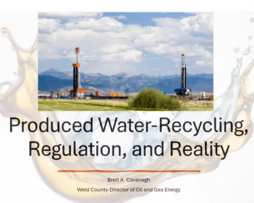
Cavanagh's presentation centered on Colorado's produced water regulations, ideas on how to meet them, and what challenges might lie ahead for doing so in well-known production sites throughout the state, with the DJ Basin serving as one example.
The presentation also included a Q&A session, allowing Cavanagh a chance to offer greater insight on the topic and showcase the OGED as an educational resource, something he's aimed to do since becoming director in 2024.
Watch the presentation.
|
|
|
|
Q: I'm all for oil and gas production, but some of those production sites can get pretty noisy. Does Weld County have requirements or steps in place to monitor noise during production?
A: We understand the importance of oil and gas operations peacefully existing near landowners and minimizing the overall disturbance. Yes, during the permitting process, operators must identify ways they plan on staying in compliance with the county's noise requirements. During production, our inspectors regularly monitor sites to ensure noise requirements are being met.
During updates to the Weld Oil and Gas Location Assessment process last year, changes were made to make the county's noise requirements clearer for the industry. Specific noise requirements can be found in Chapter 21-5-320 of the Weld County Code.
Have a concern about noise or need more information? Reach out to the oil and gas energy department.
|
|
|
|
|