|
By Baker Geist, Communications Specialist |
|

Changing seasons are always noticeable — the crisp air, colorful leaves and shorter days. While summer is on its way out, so too is another season — road construction season.
Road construction season in Colorado typically runs from March to October, and while no one looks forward to the delays and detours the season brings, building, improving and maintaining the county’s infrastructure is crucial to providing the traveling public safe roads to drive on — in any season.
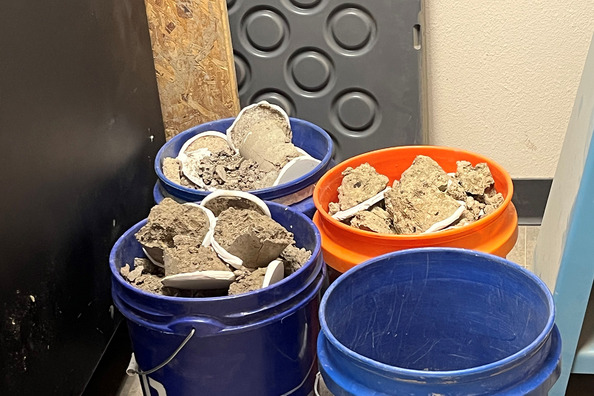
And while it’s easy to think road construction season starts with “road closed” signs, detour routes or heavy equipment, it actually starts in a little lab inside the Weld County Department of Public Works with employees shaking, sifting through and looking, rather intensely, at dirt.
“Roads have to have a good foundation. It’s like building a house,” said Ryan Axtman, Construction Inspection Supervisor for the Weld County Department of Public Works. “We’re looking at the grain sizes of the soil we pull out of the ground, down to gravel, sand and dust.”
|
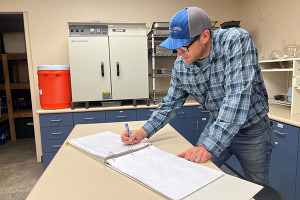
With knowledge and precision similar to both a scientist and a chef, Axtman and five inspectors in public works’ soils lab extract soil from a project site and work to determine its composition — information that is critical in helping engineers and project managers within public works know how to construct improvements and how to maintain roads effectively. How much material to use to make that happen, such as asphalt, road base or cement powder, depends on the soil that sits underneath a driving surface — also known as the road’s subgrade.
“We’re trying to figure out three key questions: What’s the makeup of the soil? At what point will it lose strength when it gets wet? How strong is it?” Axtman explained.
Employees in the soils lab seek to find those answers during the design phase of a project — often a year or more ahead of actual construction. Axtman said throughout Weld County, the soils can be primarily sand, clay or silt, which can each provide different challenges to public works' staff when determining how to stabilize the soil and get it to compact. Sometimes the solution can be found by blending soils together, adding concrete or mixtures of rock or by placing geosynthetic materials on or under the soil to help stabilize and strengthen it.
The strength of soil and how well it compacts has a direct affect on how long road improvements last. Building on unstable soil can cause potholes or other pavement distresses, which can lead to more frequent repairs, something that utilizes more taxpayer money and requires closing a road more often. Public works aims to build asphalt roads that can last at least 20 years and concrete roads that can last at least 30 years before major repairs are needed.
While every project has its challenges with regard to composition, there is pride evident in Axman’s voice when he explains how the public works’ inspection division, which includes the soils lab, has helped various projects move forward from design to reality. Weld County Road (WCR) 39 between WCR 50.5 and WCR 52 near LaSalle, which was built around a swamp, comes to mind.
“We removed the vegetation and organics and dug a couple feet down to remove broken down, rotten material until we found solid soil,” Axtman said, explaining the inspection division’s involvement in helping to build the road, which was completed in 2020 and is now maintained by LaSalle. “The contractor rolled out swaths of geosynthetic fabric across the roadway subgrade and placed lifts of gravel on it, wrapped it up and then added a second layer of fabric and gravel to create gravel bags, which the road sits on today.”
|
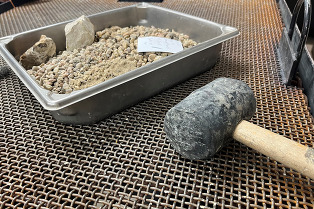
In addition to taking a hands-on approach to assist with soil identification and compaction, the soils lab also assists with inspection of projects completed by an outside contractor, like during the construction of the roundabout at the intersection 35th and O St. in 2022. When the silt-like soil at the intersection wouldn’t compact, staff worked alongside the contractor making suggestions and testing samples to ensure the soil eventually met specifications, something achieved by continually adding and removing water from the soil or finding other soil sources.
“We monitor construction to ensure a contractor is meeting the county’s specifications and expectations. The inspectors also help by providing insight from years of knowledge and experience.
"We inspect everything from concrete structures to concrete roads, asphalt roads, soil and aggregate placement, bridge construction and placement of stormwater facilities,” Axtman said. “Our main objectives are to help ensure projects are safe, well built, on time and within budget. ”
Curtis Hall, Director of the Weld County Department of Public Works, said such attention to detail, which can change based on a specific project need, only adds to the benefit of having an in-house soils lab.
“Often during a project, our staff is assisting with quality control — either continually letting our operations team know soil conditions or pavement compaction results. There is always a check and balance with what we do, so we send soil samples we’ve tested to outside Geotech companies to ensure our readings are correct,” he said. “I feel like we have one of the best labs in the state.”
Hall’s words aren’t based on opinion but reflected in the continued high-test scores the lab receives when soils lab inspectors participate in yearly round-robin testing conducted by the Colorado Department of Transportation. That, added to consistently testing to the federal standards of the American Association of State Highway and Transportation Officials, speaks to the quality work produced by the soils lab.
|
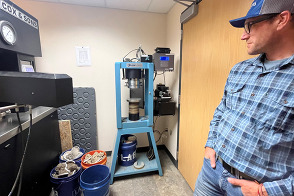
Perhaps the biggest benefit of the soils lab to the public is that it’s part of public works, meaning soil samples can be tested and results can be found same day or in a few days versus up to a week or longer by using outside companies. It’s also more cost-effective to have a team in-house than to rely solely on outside testing.
“Giving residents a well-designed, safe infrastructure starts in the soil,” Axtman said, before a slight smile came to his face when explaining the part of his job that makes him the most proud. “I love building stuff and watching it develop from on-paper design to the real thing. It’s amazing to watch that happen.”
Axtman’s pride extends to a broader goal within public works when it comes to delivering road improvements: giving residents the most bang for their buck and the smoothest ride possible in spring, summer, fall and winter.
|
|
|
The lab assists with soil specification and stabilization a year or more ahead of construction. This assistance continues during projects. |
Having a soils lab in-house as part of public works saves time and money versus sending samples to an outside company to test. |
Staff in the soils lab participate yearly in round-robin testing
to meet state and federal standards. |
|
|
miscellany: a group of or collection of different items.
- The Weld County Commissioners invite the public to their first-ever State of the County event on Tuesday, Oct. 22, at 7:30 a.m. at the Aims Community College Welcome Center in Greeley. This event aims to strengthen community ties and provide updates on initiatives prioritizing Weld County residents and businesses. Commissioner chair Kevin Ross emphasized that the county is prepared to tackle the challenges that come with unprecedented growth, projected to double the population by 2050. The event will focus on growth, transportation and quality of life by highlighting ongoing and future projects. This free event includes a light breakfast, and attendees are asked to RSVP by 5 p.m. on Oct. 15. Read more about this event and RSVP today!
|
|

Don't miss the next edition of County Roots for an insightful recap on this first-ever State of the County event, which will be focused on the county's accomplishments and its commitment and connection to the future.
|
|
|
|
Welcome to County Roots, the official newsletter of Weld County Government. For those of us who work in county government, we think what we do is pretty interesting. So the goal of this newsletter is to highlight some of the partnerships, technology and efficiencies we are using to make government stronger and more effective for its residents.
Our goal is to establish regular communication with residents, spur interest in county projects, highlight county accomplishments and provide meaningful information to the public. In fact, our goal is to live up to the name “County Roots.” Want to know more about the meaning behind the name? Please visit our webpage, where you can also find previous editions of this newsletter.
|
|
|
|
|