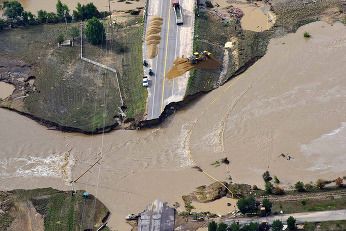
In Weld County, the flood affected 3,000 homes and more than 350 commercial properties. A total of 122 bridges were damaged along with 654 lane miles of roads. Many communities, including portions of Greeley, Evans, Firestone, Frederick and Milliken faced mandatory evacuations.
The floodwater also impacted the county’s primary economic drivers — oil and gas and agriculture. While many wells were shut down prior to the flood, several ended up under water, and there were reports of storage tanks swept away.
The flood also ruined many fields and pastures and caused significant crop damage. In total, 2,377 agricultural parcels were ruined.
“While it left tremendous property damage, there were no deaths (in Weld County),” said Weld County Commissioner Mike Freeman, reflecting on the flood in a previous County Roots story in 2020. Seeing the county’s emergency operations center function and the Weld County Department of Public Works working quickly to reopen more than 100 roads closed by floodwater was eye-opening for Freeman, who was in his first term in 2013. It allowed him to see how effective Weld County Government could be.
“I thought the response was handled tremendously well,” he said. “To be able, under pressure, to make the right decisions, do the right things and coordinate the response, I was so impressed with the employees across Weld County.”
Preparedness is key
Weld County has many preparedness resources and emergency tips. From making an emergency prep plan to reviewing insurance information, these resources break preparedness down into easy steps.
- For emergency preparedness tips, visit Emergency Preparedness Tips – Weld County.
- Take a step in preparing today by signing up for CodeRed, Weld County’s emergency alert system at CodeRED – Weld County.
- Weld County OEM works directly with communities on preparedness, be sure to check out their emergency preparedness guide.
More disaster declarations
1969: Severe storms and flooding. The flooding claimed one life and resulted in nearly $21 million in damages statewide.
1973: Dam failure. Kersey residents evacuated after the Lower Latham Reservoir dam gave way. Total damage was more than $3.5 million.
1973: Heavy rains, snowmelt and flooding. Damage to homes, businesses and public facilities, including roads, bridges, and water systems, exceeded $50 million (over $20 million in Weld County alone). The flood claimed 10 lives and caused heavy livestock losses.
1976: The Big Thompson flash flood stands as the deadliest natural disaster in Colorado’s recorded history. On the evening of July 31, a year’s worth of rain fell in just 70 minutes. Those floodwaters hit Weld County the next day. In total the event caused $35.5 million in damages and claimed 144 lives — of which five people were never found.
1997: The Spring Creek flood in Fort Collins claimed five lives and caused over $200 million in property damage, including flooding in the town of New Raymer, which led the board of county commissioners to declare a disaster in Weld County on Aug. 11, 1997.
1999: Severe storms, flooding and mudslides. In April, a storm system stalled along the Front Range. The rain, coupled with the snowmelt, caused flooding resulting in substantial damage to public and private facilities. The board of county commissioners declared a disaster as damage amounts were over $2 million. President Clinton later declared a major disaster for five Colorado counties.
2001: Severe storms. In April, Colorado suffered severe winter storms covering most of the eastern plains and Front Range counties, and causing major damage to private and public property. The economic impact of the storms was in excess of $4.9 million.
2003: Snowstorm. Between March 17 and 20, a powerful blizzard covered most of Colorado. Heavy, wet snow fell for nearly three straight days and paralyzed the region. Numerous locations throughout the state received over six feet of snow. In total, the massive storm caused $93 million in damages.
2006: Drought. Below average yearly snowfall and spring precipitation combined to cause an emergency situation for Weld County farmers in the South Platte River Basin. The Colorado State Engineer refused to allow 449 alluvial wells to withdraw water for irrigation, leaving 200 farms from Brighton to Fort Morgan in crisis and their crops to wither in the heat.
2006: Snowstorm. A blizzard overwhelmed Weld County, where up to 22 inches of snow fell and caused losses of at least $400 thousand. The blizzard caused four confirmed deaths in Colorado. Along the plains, between 10,000 and 15,000 cows were found dead due to the cold and severe weather conditions.
2012: Drought. In June, the commissioners unanimously passed a resolution declaring a disaster emergency in Weld County and asked Gov. Hickenlooper to allow pumping for 30 days from restricted South Platte irrigation wells. Despite numerous letters, meetings and conference calls, that request was denied.
2020: Pandemic. Gov. Jared Polis declared a State of Emergency due to COVID-19 and a declaration of disaster emergency was signed by the Weld County Board of Commissioners to ensure any future Federal assistance made available in response to COVID-19 would be accessible to not only the business community but also county residents.
2022: Avian Influenza. Highly Pathogenic Avian Influenza (HPAI) was initially detected in the United States in the wild bird population then spread rapidly to domestic poultry, with a mortality rate above ninety percent. In April, HPAI was confirmed in a commercial table-egg layer facility in Weld County, affecting 1.4 million birds and more than seven million eggs. The facilities with positive HPAI cases were depopulated.
2024: Avian Influenza. Colorado’s first confirmed detection of avian influenza in dairy cattle was in April. Additionally, the Colorado Department of Public Health and Environment identified human cases of avian influenza in workers responding to the avian flu outbreak at a commercial egg layer operation.
2024: Severe storm. A months worth of rain and two inches of hail dumped from the sky in just two hours impacting homes, businesses, government buildings and roads in Greeley and surrounding areas, causing approximately $3.4 million in damages.
|