|
By Dylan McConnell, Communications Specialist |
|

Safety and support.
Those are two focal points that Weld County’s Department of Human Services staff focus on when caring for foster kids in Weld County. It's understood that providing each can be critical in helping to achieve positive outcomes for young people.
One of the best ways to provide safety and support is by placing youth with relatives while their immediate family members work through challenges and toward reunification.
“We know that kids do far better with kin than they do in foster care,” said Jamie Ulrich, Director of the Weld County Department of Human Services. She explained that while foster care providers are valued and open their homes and hearts, the familiarity and bond kids have with kin provides “an ingrained sense of belonging and family.” Ulrich’s words are backed by research that shows kinship care can lead to a child experiencing less trauma, fewer behavioral health issues and better educational outcomes.
|
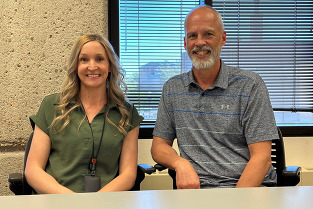
Issues often arise however when a child needs to be moved to relatives outside of their home state. Moving kids from Weld County to be with out-of-state kin has become more and more difficult due to the ineffectiveness of the Interstate Compact for the Placement of Children (ICPC), an outdated compact originally ratified in 1960. John Wittwer and Jamie Sanders, two supervisors in DHS’ Child Welfare Division, knew they had to act to amend these issues, and that meant working to update the compact with new legislation.
“The original compact is very outdated,” Sanders said. “Right now, timeliness is a huge issue when we’re trying to send kids to other states. It can sometimes take the receiving state up to six months to let us know if we can place a child there or not. Senate Bill 24-125, which is this new compact, will really focus on that.
“There is no ability to enforce any compliance with the current compact. States can take as long as they deem necessary to complete the assessments of kinship caregivers while children wait in the system.”
Ulrich added that while six months of waiting is frustrating enough, she’s even seen placements take a year or more in some cases.
As of March 31, 2024, 12 children in Weld County were waiting on an ICPC decision to be made, determining if they could move to a relative caregiver out of state. Sanders notes that while 12 may not sound like a big number, that’s out of approximately 87 kids total who were in foster care at the time, meaning a significant percentage of Weld County foster care youth are at the mercy of other states doing placement work in a timely fashion.
In 2023, Sanders and Wittwer attended an ICPC conference where they were presented the information about updating the compact and what it would take to do so. Ulrich said they came back from the conference with a sense of urgency.
“They came to meet with me as soon as they got back and said, ‘We have to get Colorado on board with this,’” Ulrich explained. “They had been talking to the rest of the delegation from Colorado at this conference and they said, ‘We need to get this passed, but we don’t know who can do it, or how to do it.’ So, when they brought it to me, we figured out a way to get it done.”
First, Ulrich, Sanders and Wittwer dug into the law and into the current ICPC. The next step involved bringing the county attorneys on board to see what changing this law would look like. Once the attorneys were on board, Ulrich went to the board of county commissioners, spoke with her commissioner coordinator, and gained approval and permission to move forward.
After all of this was copasetic, they needed to obtain sponsors in the state legislature.
“I knew that Senator [Byron] Pelton was a big advocate for human services, and he was willing to commit to sponsoring the bill moving forward,” Ulrich said. “He was an original sponsor and made it one of his five bills, which was huge for us.”
Senator Pelton, a Republican, engaged with Senator Michaelson Jenet, a Democrat, in order to release the new bill. Even with a bit of initial pushback, the bill received unanimous approval to go to the Senate floor, where it was also passed, before moving to the House of Representatives.
|
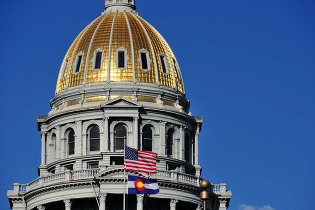
Representatives Gabe Evans and Andrew Boesenecker came on to sponsor the bill in the House.
“They [Evans and Boesenecker] really continued to advocate and stand by our bill,” Ulrich said. “It passed the House unanimously as well, and then passed the House floor.”
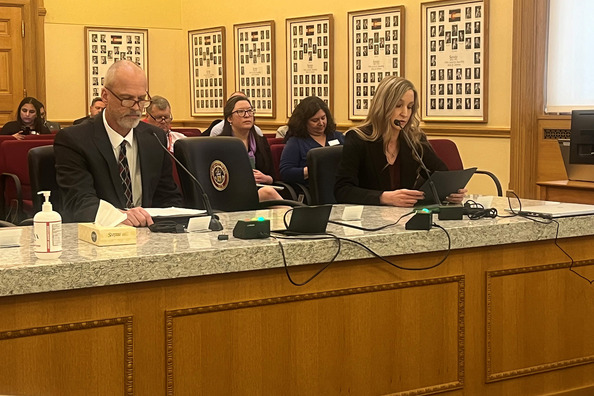
While the sponsors were critical in the process, so too was the work of Sanders and Wittwer. Beyond bringing the idea of changing the ICPC to Ulrich, they also testified in support of it at the state legislature, a big part of seeing an idea come closer to reality.
“This was my first time working on any legislation, so I didn’t know if we would even find a sponsor. Then once we did find one, it was like okay, we can check that box and go onto the next one,” Sanders said, reflecting on the bill’s progression. “It just kept gaining momentum, and I said, ‘Oh my gosh! This might actually pass! We might actually get this done!’”
Not only did it pass, but it did so relatively quickly, something that impressed Ulrich and showed the quality of ideas and work that was brought forward.
“John and Jamie brought this to my attention in June or July of 2023, and we had an introduced bill by January, which is actually pretty fast,” she said. “It’s tremendous. It shows just how hard people like John and Jamie will fight for children and families. Sometimes, I think staff just see all these policies come into play, and they may not always have a lot of opportunity to influence them. For two employees to go above and beyond their normal duties and have an actual input in a policy change is amazing.”
Their new and improved ICPC has DHS excited about what it can mean for foster kids moving forward — mainly a much quicker timeline to relocate them with relatives out of state. While the old compact served as a courtesy effort between states, the new one is backed by legislation that Sanders hopes will establish a 45-day timeline to complete out-of-state placement.
Although the new ICPC, or Senate Bill 24-125, was signed by Gov. Jared Polis on May 31, it may be some time before the full impact of passing this bill will become tangible. The compact requires 35 states to pass this bill before the rule-making stage, and Colorado became state number 18. However, the effort of Sanders and Wittwer to work on the newest ICPC shows an effort to continue providing safety and support for Weld County foster youth, while giving them a voice to connect with loved ones.
Sanders also hopes this will spur others to feel empowered to make meaningful change.
“It’s all about passion,” she said. “If you have that passion, you can do it.”
|
|
|
The new ICPC compact aims to improve timeliness of the placement of foster care children to relatives out of state. |
As one of the first 35 states to pass this compact, Colorado will have a say in defining the rules regarding these timelines. |
Studies have shown that kinship care decreases trauma and behavioral health issues and provides better educational outcomes for children. |
|
|
miscellany: a group of or collection of different items.
- The Weld County Fair is underway! Be sure to visit Island Grove Regional Park this week to see 4-H and FFA exhibits, animal showmanship and other unique events like team roping, a ranch rodeo and more. Don't miss Family and Community Day on July 28, which features a free community barbecue. See the full list of events.
- August is Child Support Awareness Month. Each year, Weld County reaffirms its commitment to strengthening families by providing child support services to improve the economic stability and well-being of children. In August, we recognize the dedicated child support workers, clerks of the court, county attorneys, magistrates, judges, and deputy sheriffs throughout Weld County who work diligently to establish and enforce child support obligations for the benefit of children in our community. Learn more about child support services in Weld County.
|
|
Barney Hammond's story is just one example of the impact Weld County's boards and commissions can have on residents. These volunteer-driven bodies offer crucial insight and guidance to the county commissioners, ensuring informed decision-making across diverse sectors — from public health to airport management. Boards and commissions not only foster a deeper understanding of local governance among participants but also empower residents to contribute their expertise toward recommendations that help shape policies, which directly impact their communities' well-being and future development.
In the next edition of County Roots, learn how volunteers like Hammond play a vital role in strengthening Weld County's governance.
|
|
|
|
Welcome to County Roots, the official newsletter of Weld County Government. For those of us who work in county government, we think what we do is pretty interesting. So the goal of this newsletter is to highlight some of the partnerships, technology and efficiencies we are using to make government stronger and more effective for its residents.
Our goal is to establish regular communication with residents, spur interest in county projects, highlight county accomplishments and provide meaningful information to the public. In fact, our goal is to live up to the name “County Roots.” Want to know more about the meaning behind the name? Please visit our webpage, where you can also find previous editions of this newsletter.
|
|
|
|
|