Summer 2023 Weld County Area Agency on Aging Newsletter
Weld County, Colorado sent this bulletin at 06/01/2023 11:00 AM MDT
Summer 2023
In this issue: Alzheimer's and Extreme Heat • Friendly Fork Dietitian Office Hours Healthier Living Diabetes • Friendly Fork Summer Evening Meals Golden Gallery 50+ Art Show • Advance Care Planning Financial Fraud Reporting PSA • Free Dental Care
Alzheimer’s and Extreme Heat: Exercise Caution
As temperatures rise, extreme heat can have a significant impact on everyone’s safety, but these conditions can be especially stressful and confusing for individuals with Alzheimer’s and other dementias.
“Alzheimer’s disease causes a number of changes in the brain and body that may affect the individual’s safety, including changes in sensitivity to temperatures,” said Meg Donahue, director of Community Engagement for the Alzheimer’s Association of Colorado.
According to a study by the National Institutes of Health (NIH), people living with Alzheimer’s were 6% more likely to die on an extremely hot day, with an added 6% increased risk for individuals with previous hospital admissions for atrial fibrillation.
There are more than 6.5 million Americans living with Alzheimer’s, including 76,000 Coloradans. Planning ahead for weather changes, including extreme heat, can prevent injuries and help a person feel more relaxed and less overwhelmed.
“People living with Alzheimer’s and other dementias can be more vulnerable than normal during extreme weather because their judgment may be impaired and they may be unable to communicate their discomfort,” said Donahue. “It’s important to take extra precautions with these individuals during periods of extreme heat or other severe weather conditions.”
The Alzheimer’s Association is offering important safety tips for caregivers and families dealing with Alzheimer’s and other dementias to prepare for the hot days ahead:
Make a plan. Family and friends should prepare accordingly and make plans to regularly check in on a person living with Alzheimer’s during periods of extreme heat. Arrange alternative plans for cooler spaces if air conditioning is unavailable, and dress in loose-fitting, light clothing.
Pay attention at night. Keep people living with Alzheimer’s cool by using fans and keep the air conditioning on. At night, low temperatures can still exceed 75 degrees with little fluctuation in humidity levels, making for difficult sleeping conditions, heightened anxiety and increased agitation.
Prepare for behavioral changes. Research shows that heat can increase agitation and confusion in people. Try to remove behavioral triggers by addressing the person’s physical needs related to the heat, then tending to their emotional needs.
Stay hydrated. Increased water intake is essential to maintaining good hydration and health during extreme heat. Know the signs of heat exhaustion to avoid heat stroke. Dehydration may be difficult to notice in a person living with Alzheimer’s, as signs like increased fatigue, dry mouth and headache may be difficult to detect. People taking diuretics, sedatives, or certain heart medications may not sweat as much as others, but this does not mean they are not hot.
Stay indoors out of the sun. Heat stroke and heat exhaustion may occur in extreme heat conditions but symptoms may be difficult to detect in people living with Alzheimer’s and other dementias. Keep individuals cool by using air conditioning at home or move to a public place, such as a senior center or shopping mall. If you must go outside, dress appropriately with loose-fitting, light clothing, wear a hat and apply sunscreen with an SPF of 30 or higher.
Stay informed. Keep an eye on local weather forecasts. High temperatures are not the only cause for concern. Humidity and air pollution can cause breathing difficulties. The person should be monitored regularly, and seek medical attention if symptoms arise of dehydration, heat exhaustion or heat stroke.
The Alzheimer’s Association is here to help families prepare for and cope for such extraordinary circumstances. For more information, visit www.alz.org or call the Association’s free Helpline, staffed by trained professionals around-the-clock, at (800) 272-3900.
By Jim Herlihy, Senior Marketing & Communications Director, Alzheimer's Association
Reprinted with permission.
Friendly Fork Dietitian Office Hours
The Friendly Fork dietitian will be coming to two meal sites in June for registered dietitian (RD) office hours! This is an opportunity for meal site participants to stop by and ask nutrition questions or request resources, recipes, and cooking tips.
Milliken meal site - June 23 before and after the Friendly Fork lunch from 10:00 a.m. - 1:00 p.m.
Eaton meal site - June 28 before the Friendly Fork lunch from 9:00 - 11:00 a.m.
Please contact Jessi Like, RD, at (970) 400-6118 if you have any questions or comments.
Healthier Living Diabetes
Become a better self-manager of your diabetes by applying the knowledge you already know to prevent low blood sugar, increase healthy eating, and develop an exercise program. Workshop meets once a week for six weeks on Thursdays beginning June 8 to July 13 from 9:00 - 11:30 a.m. at the Windsor Recreation Center (250 N. 11th Street). To register for this FREE class, call Jake Luna at (970) 400-6117 or email at jluna@weld.gov.
Friendly Fork Summer Evening Meals
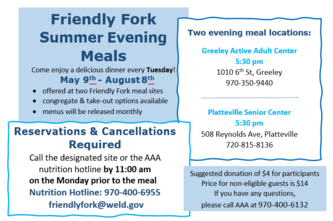
Come enjoy a delicious meal every Tuesday from May 9 – Aug 8
Offered at two Friendly Fork meal sites
Congregate and take out options available
Reservations & Cancellations Required
Call the designated site below or the AAA nutrition hotline by 11:00 am on the Monday prior to the meal.
Suggested donation of $4 for participants Price for non-eligible guests is $14. If you have any questions, please call AAA at (970) 400-6132.
Calling All Artists!
The 2023 Golden Gallery Art Show is set for it’s 5th year coming this September! The Golden Gallery Arts Show promotes the art of Weld County 50+ residents and their wonderful artistic abilities. The opening reception and show are free and open to the public. If you or someone you know is a Weld County artist, age 50 or older, show off your talents and enter the Golden Gallery Art Show to have your art on display at the new Library Innovation Center (LINC) this September. For more information and an application to enter, contact the Greeley Active Adult Center located at 1010 6th St Greeley CO 80631; email Sheri Lobmeyer at Sheri.Lobmeyer@GreeleyGov.com, or call 970-350-9437.
Advance Care Planning
Advance care planning is the process of allowing people to make decisions about their future medical care and provides direction when an individual is unable to talk about their medical, financial or life care choices. Advance care planning can include advanced directive documents as well as conversations with loved-ones and designated decision-makers. Advance care planning is important for anyone over the age of 18 to allow them the power to make sure their health care wishes are respected. Advance care planning can be an ongoing and is not just intended for end of life.
What exactly is an advance directive?
An advance directive is made up of legal documents that explain your wishes on what you do or do not want for your medical care to your health care team when you are not able to make these decisions for yourself.
Should I do anything right now?
First you will want to name and document a Medical Durable Power of Attorney (MDPOA)
An MDPOA names an individual of your choice to make medical decisions for you if you become unable to speak for yourself.
Discuss your values and wishes with the individual you choose as well as with other important people in your life so they understand what your wishes are for certain health care situations.
Secondly, keep your advance directive document(s) available and present them to all your health care providers. Many providers can keep them in their systems or patient portals for reference. However, providers will not always ask for advanced directives, so it is very important to present them on your own and advocate for yourself.
The Department of Justice's Elder Justice Initiative collaborated with the FBI’s Internet Crime Complaint Center (I3C) to develop a financial fraud PSA for the general public. This PSA encourages the public to file reports of internet-related financial fraud through the IC3 electronic reporting system, demonstrates how to file the report, and explains what types of fraud can be reported, including internet-related fraud targeting older Americans. The PSA stresses the urgency of filing reports quickly to increase opportunities to intervene. This video could provide useful material for outreach efforts and the prevention of fraud. Please check it out and share the PSA with the general public!
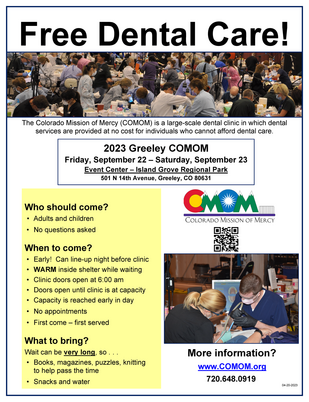
The Colorado Mission of Mercy (COMOM) is a large-scale dental clinic in which dental services are provided at no cost for individuals who cannot afford dental care.
2023 Greeley COMOM Friday, September 22 – Saturday, September 23
Event Center – Island Grove Regional Park 501 N 14th Avenue, Greeley, CO 80631
Who should come?
Adults and children
No questions asked
When to come?
Early! Can line-up night before clinic
WARM inside shelter while waiting
Clinic doors open at 6:00 am
Doors open until clinic is at capacity
Capacity is reached early in day
No appointments
First come – first served
What to bring?
Wait can be very long, so . . .
Books, magazines, puzzles, knitting to help pass the time