|
The National Telecommunications and Information Administration (NTIA), which is the federal agency responsible for administering the Broadband Equity, Access, and Deployment (BEAD) Program published the “BEAD Restructuring Policy Notice” on Friday June 6, 2025. The policy notice requires Wisconsin to implement significant changes to its BEAD program and eliminate certain requirements that were previously included in the BEAD Notice of Funding Opportunity (NOFO) and in the State of Wisconsin's approved Initial Proposal.
- States must rescind all prior preliminary awards and complete a Benefit of the Bargain (BOB) round in which all BEAD eligible locations are available for bidding.
- The new policy notice eliminates certain requirements related to fair labor practices, workforce development, middle-class affordability, climate change resilience, and open network access.
- The scoring criteria initially approved is no longer allowable to be used in the BOB round, due in part to its inclusion of criteria associated with the eliminated requirements. Instead the new scoring criteria must primarily favor the lowest cost bidder. Certain additional criteria, including speed to deployment, speed of network, and the applicant's receipt of a preliminary award in Round one, are allowed to be considered when the project costs are within 15 percent of each other.
- The BOB round must also adopt a technology neutral approach. Prior to the policy notice BEAD had a fiber first approach that gave priority to fiber projects; now all technologies meeting scalability, latency, and speed performance standards must be considered in the BOB round without preference.
- States have ninety days (until September 4, 2025) to implement all changes, complete the BOB subgranting round and submit the final proposal to NTIA. NTIA will review all final proposals with 90 days.
Additional Resources
BEAD Restructuring Policy Notice
NTIA Press Release
"Here's How NTIA is Changing the BEAD Program" from the Benton Institute for Broadband & Society
The Wisconsin Broadband Office is proud of the extensive BEAD planning and implementation efforts undertaken in Wisconsin to date.
The State of Wisconsin, the Public Service Commission, state agency partners, Tribal Nations, local governments, and others have spent more than two years preparing for BEAD implementation through BEAD local planning grants, the 5-year plan, the “Badger the FCC” campaign, development and approval of BEAD Initial Proposal Volumes 1 and 2, and the State Challenge Process. We were making considerable progress in partnership and coordination with local officials, Tribal Nations, the Broadband Task Force internet service providers, community-based organizations, and other stakeholders.
Since the June 6, 2025 notice, the Wisconsin Broadband Office has worked tirelessly to analyze these federal changes and their impact on our BEAD process and our many partners who have already invested significant time and resources into this important endeavor.
As we continue to navigate these disruptive changes, we remain unwavering in our commitment to Internet for All in Wisconsin. We will continue to keep you informed when more updates are available.
Commission Rescinds BEAD Preliminary Awards
The NTIA BEAD policy notice required Wisconsin to rescind all BEAD preliminary awards and halt the current subgranting process. On June 12, 2025 the Commission posted a letter to docket confirming that all preliminary awards were rescinded. See the Rescind letter.
Prior to the release of the policy notice, the Commission had completed the Letter of Intent process and two full rounds of BEAD subgranting. In BEAD Round One the Commission received 425 applications to serve 95% of BEAD eligible locations, and the Commission preliminarily awarded $540 million to applications that would have served 103,685 BEAD eligible locations. See the Round One letter. These preliminary awards are now rescinded. In BEAD Round Two the Commission received 259 applications for consideration, that coupled with the preliminary awards would have reached 98% of the BEAD eligible locations in Wisconsin. See the Round Two letter. Per the policy notice, the Commission will not make any additional preliminary awards from Round Two submissions.
Additional BEAD BOB Letter of Intent to Open June 17, 2025
The Commission invites new eligible applicants to submit a BEAD BOB Letter of Intent (LOI). An approved LOI is required to participate in the BEAD program. If an entity’s LOI has already been submitted and approved, a new LOI is not necessary to participate in the BEAD BOB round.
The LOI is used to evaluate a potential applicant's technical, financial, operational, and managerial capacity to deploy and operate broadband service and capability to comply with BEAD requirements. The LOI will be used to determine additional entities that are qualified and eligible to compete for subgrants in the BEAD program.
BEAD BOB LOI submissions are due no later than June 30, 2025, at 1:30 p.m. C.T. The Commission will publish instructions that detail the questions and needed information for completing all sections of the BEAD BOB LOI application before the LOI opens.
On Friday June 20, 2025 at 10:00 a.m. CT the Wisconsin Broadband Office will host BEAD Letter of Intent Office Hours for potential applicants and interested stakeholders. Advance registration is required. Register here.
Updated Wisconsin Broadband Map Released
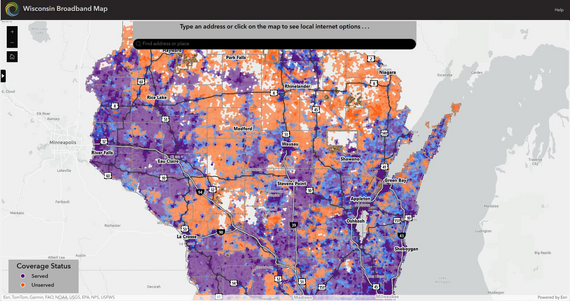 On June 3, 2025 the Wisconsin Broadband Office released a refreshed Wisconsin Broadband Map. The map lets users easily access the information about internet coverage options and for locations with in-progress broadband projects, the estimated service date for their location to be complete. The map uses the state definition of served and unserved.
The Wisconsin Broadband Map is made to work on desktop computers and most mobile devices. The new map will be useful for residents and communities looking to understand internet access in their area. The map includes data as of December 31, 2024 and will be updated semi-annually.
Commission Awards USF Grants to Expand Access and Affordability of Telecommunications Services
The Commission announced the award of $750,000 to non-profit entities and educational institutions that will help people in Wisconsin access essential telecommunications services. The Commission awarded a total of 19 grants from the 2025 rounds of the Nonprofit Access Grant Program and the Lifeline Outreach Grant Program, both of which are funded by the Universal Service Fund (USF). The USF was created to promote and assist with the availability and affordability of telecommunications services in Wisconsin.
- The PSC awarded $500,000 from the Nonprofit Access Grant Program to 14 nonprofit organizations to help provide access to telecommunications services for low-income households and persons with a disability.
- The PSC awarded $250,000 from the Lifeline Outreach Grant Program to fund five projects to increase participation in the Lifeline Program, which provides eligible households discounts on the cost of phone, cellphone, and internet services.
Digital Equity Capacity Grant Funding Update
The Public Service Commission of Wisconsin, along with other states, was notified that effective Friday, May 9, 2025, the State Digital Equity Planning and Capacity Grants were unilaterally terminated, by federal executive action. The Digital Equity Capacity Grant was funded as part of the Infrastructure Investment and Jobs Act and appropriated by Congress and includes funding for programs and services to help advance internet adoption and digital skills for Wisconsin residents. The Commission was accepting competitive grant applications when the termination notice was received. The grant program was designed to target digital skills and internet adoption support to low-income households, veterans, people with disabilities, older adults, rural residents and others Wisconsin residents who need additional programs and support to access and make use of the internet.
Governor Evers and the Public Service Commission remain committed to the grant program's objectives. We are working to understand the impacts that termination of this program will have on statewide internet adoption and digital skills.
|